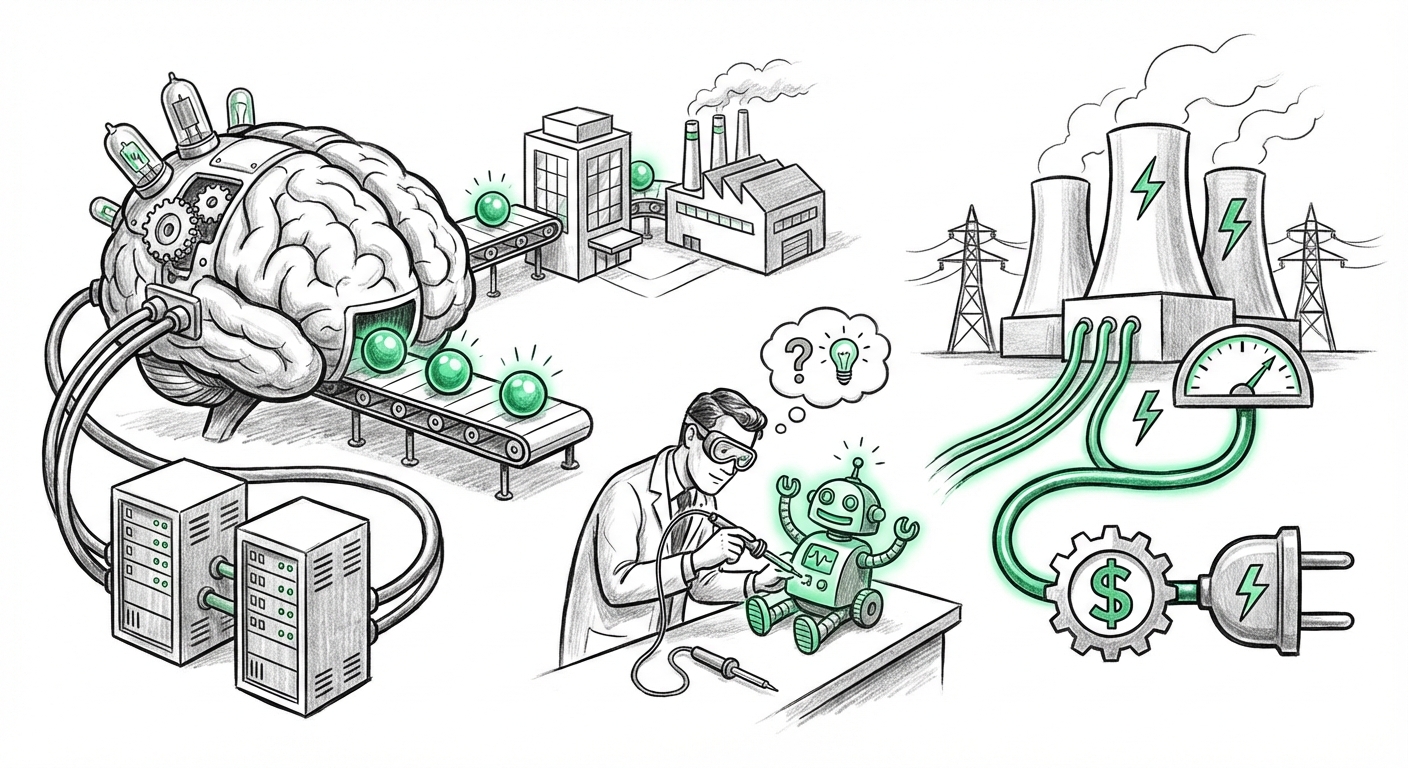
Encrypted AI Reasoning Traces Are Hiding a Silent Data Leak, What It Means for the Future of AI
Frontier AI models no longer just answer. They think first. When you ask a hard question, the model writes out a private chain of reasoning, a "scratchpad" of steps, guesses, corrections, and halfway ideas, before it hands you a clean final answer. That thinking process is called a reasoning trace.
Over the past year, the labs that build these models have started locking those traces down. The reasoning steps get encrypted. Users can't read them. Competitors can't copy them. Regulators can't poke at them. It sounds like a privacy win.
It isn't. New scrutiny into how frontier models handle reasoning traces points to a quieter problem: encryption protects the pipe, not the payload. The traces themselves can be carrying private data out of your systems, and almost nobody can see it happening, because the whole point of the encryption is that nobody gets to look inside.
What Are Reasoning Traces, and Why Are They Encrypted?
To understand the leak, you first need to understand what a reasoning trace actually is.
Older AI models worked like a reflex. You typed a question, the model produced the most likely next words, and that was that. Newer frontier models work more like a person working through a math problem on scratch paper. They break a task into steps, test ideas, throw out dead ends, and then write up the final response.
That scratch paper is the reasoning trace. It is often far longer and far messier than the answer you see.
Labs encrypt these traces for three reasons:
- Competitive secrecy. A readable reasoning trace is basically a public demo of how the model thinks. That is valuable intellectual property.
- Safety and abuse prevention. If users can read the raw reasoning, they can find weak spots to exploit.
- User privacy. Traces may contain fragments of the user's own prompt and data, so keeping them locked down seems like the safe choice.
All three goals are reasonable. The problem is that encryption answers the question "who can read this?", and never asks the far more important question: what is in it in the first place?
The Hidden Leak: Why Encryption Isn't Privacy
Here is the core insight, and it is simple enough to explain to anyone.
Imagine you seal a letter in an unbreakable envelope. Nobody can open it. But if the letter inside contains your bank account number, sealing it does not make you safe. It just means you can't check what leaked either.
Reasoning traces are that letter. They are generated from whatever the model was given and whatever the model has absorbed. That means a trace can quietly pick up and restate:
- Personal details from a user's prompt, names, addresses, account numbers, health details.
- Private business data pasted into a chat window or fed through an API.
- Fragments of other users' data, if the model's training or memory pipeline was not cleaned properly.
- Sensitive internal context from connected tools, documents, or databases.
Once those details land inside an encrypted trace, they are now sitting in a storage system that is designed to be unreadable. Data loss prevention tools can't scan it. Security teams can't review it. Compliance officers can't audit it. The encryption that was supposed to protect users instead becomes a blind spot in the exact place where private data collects.
Why This Matters More Than It Sounds
It is tempting to file this under "interesting technical problem." That would be a mistake, for three reasons.
1. Reasoning traces are growing fast
Reasoning models produce far more text internally than they show externally. A short answer can sit on top of thousands of hidden tokens of thinking. That means traces are becoming one of the largest categories of AI-generated data in existence, and one of the least understood.
2. They are often stored, not discarded
Many providers keep traces for debugging, quality improvement, safety review, or to resume conversations. Even where they are deleted quickly, there is a window where private data sits in an encrypted store that nobody is inspecting.
3. Encryption creates false confidence
This is the dangerous part. A team that sees "encrypted" on a vendor's security page tends to stop asking questions. The padlock becomes a substitute for understanding. In practice, encryption at rest and in transit tells you almost nothing about what data the model is quietly writing down.
The Trust Gap: You Can't Audit What You Can't See
There is a hard trade-off here, and nobody has solved it cleanly yet.
On one side: labs genuinely need to protect reasoning traces. Fully open traces invite model theft and misuse.
On the other: enterprises, auditors, and regulators need to know what is inside AI systems that touch customer data. "Trust us, it's encrypted" is not an answer that survives a serious review.
That tension is now the central question in AI governance. The industry is starting to reach for answers such as:
- Confidential computing. Processing traces inside hardware-protected enclaves so that even the provider cannot read them, while still allowing automated scanning for sensitive data patterns.
- Attestation and audit logs. Cryptographic proof that a trace was scanned, redacted, or deleted, without exposing its contents.
- On-device or in-tenant trace handling. Keeping reasoning inside the customer's own environment so it never becomes someone else's encrypted mystery.
- Automatic redaction at generation time. Filtering sensitive patterns as the trace is written, rather than after it has already been stored.
- Trace retention limits by default. Treating reasoning output like a password, not like a log file, ephemeral unless there is a strong reason to keep it.
None of these is a silver bullet. But they point in the same direction: privacy must be built into the reasoning layer, not bolted on at the storage layer.
The Regulatory Collision Course
Data protection rules around the world share a common spine: organizations must know what personal data they hold, why they hold it, and be able to delete it on request.
Encrypted reasoning traces break all three.
If a user asks, "What data do you have about me?", a company that cannot read its own traces may genuinely not know. If a user asks for deletion, that is doable, but proving that nothing sensitive was ever exposed is much harder. And if a regulator asks how sensitive data is prevented from entering the trace pipeline, "it's encrypted" will not satisfy anyone who understands what encryption actually does.
This is the next big compliance frontier for AI, and it arrives faster than most legal teams expect. The companies that get ahead of it will treat reasoning traces as a data category, with the same rules, reviews, and controls as any customer database.
What This Means for Businesses: Practical Steps
If your organization uses frontier AI models, and most do now, here is what to do next.
- Ask your vendor directly. Are reasoning traces stored? For how long? Who holds the encryption keys? Can you turn trace retention off?
- Treat traces as personal data. Add them to your data map, your privacy impact assessments, and your retention schedule.
- Stop pasting sensitive data into prompts. This is the single highest-impact fix, and it costs nothing. Redact before you send, not after.
- Test for leakage. Run controlled experiments with fake sensitive data and see whether it shows up anywhere it shouldn't, logs, exports, or later outputs.
- Push for verifiable assurance. Prefer providers who can prove trace handling with technical controls, not marketing language.
- Consider self-hosted reasoning for the most sensitive workloads, where the trace never leaves your environment.
- Update your contracts. Make trace handling, key ownership, and deletion guarantees explicit obligations, not optional extras.
The Bigger Picture: Where AI Reasoning Is Heading
Reasoning traces are not a passing feature. They are the direction of the entire field. The more capable models get, the more they will think before they speak, and the more valuable, and more sensitive, that hidden thinking becomes.
That leads to an uncomfortable prediction. In the next phase of AI, the most important data in the system will be the data nobody is allowed to look at. The industry will have to solve a problem it has largely avoided: how to prove that a system is safe when its inner workings are deliberately opaque.
There are two paths from here.
The first is the lazy path. Labs keep encrypting traces, vendors keep saying "encrypted" on their security pages, and buyers keep accepting it. Data leaks inside those traces go unnoticed for years. When they finally surface, they surface as headline incidents rather than as fixes.
The second path is harder but better. Trace encryption gets paired with real auditing, enclaves, attestation, redaction, and strict retention. Users get privacy that is demonstrated rather than merely claimed. Regulators get something they can actually verify.
The second path is the only one that scales. Because trust in AI will not come from making systems impossible to inspect. It will come from making them inspectable in the right ways, without handing the whole world the keys.
Conclusion
The silent data leak inside encrypted reasoning traces is a warning about a habit that the AI industry has picked up: confusing secrecy with safety. Encrypting a stream of thought does not make the thought harmless. It just makes the harm invisible for a while.
The good news is that this is fixable, and much of the fix starts with asking better questions. What is going into the trace? Where does it go? Who can prove what happened to it? Organizations that ask those questions now will be the ones that avoid a very expensive lesson later.
Reasoning is the future of AI. Privacy has to be built into that reasoning from the first token, not added as an afterthought once the data has already leaked.