JetBrains Mellum2: What a 12B Mixture-of-Experts Model Means for the Future of AI
On June 1, 2026, JetBrains announced Mellum2, a 12-billion-parameter model built on a Mixture-of-Experts (MoE) architecture. On the surface, that is one product announcement from a company best known for developer tools. Underneath, it is a signal flare for where the entire AI industry is heading.
The biggest models still grab headlines. But the real story of the next few years is not about who can build the largest model. It is about who can build the smartest-sized model, one that is cheap to run, fast to respond, and reliable enough to sit inside the tools people use every day. Mellum2 lands squarely in that story.
What "Mixture-of-Experts" Actually Means
To understand why this matters, you need one simple idea.
Traditional large language models are like a single enormous brain. Every time you ask a question, the whole brain lights up and does work. That is powerful, but it is also wasteful. You pay for 100 percent of the brain even when the question only needs 5 percent of it.
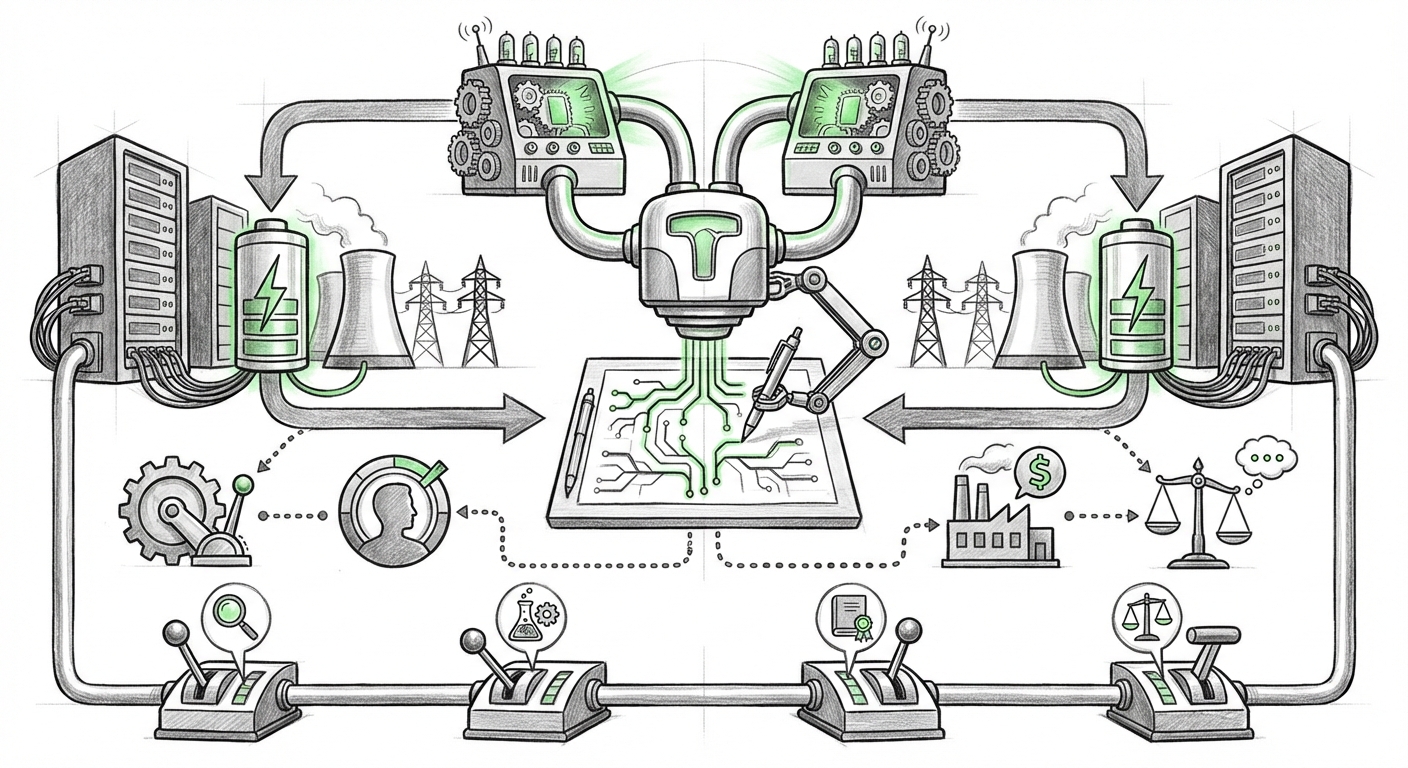
A Mixture-of-Experts model works differently. Instead of one giant brain, it is a collection of many smaller specialist "experts," plus a router that decides which experts should handle each request. When a question comes in, only a small slice of the model actually activates.
The practical result is a clever trade-off:
- You get the knowledge capacity of a big model, because the total number of parameters is large.
- You get the speed and cost of a much smaller model, because only a fraction of those parameters run on any given request.
- You get better efficiency per dollar, which is exactly what businesses care about once the novelty of AI wears off.
This is why MoE has moved from a research curiosity to the default choice for serious production systems. Mellum2's 12B size, paired with MoE, puts it in a category designed for real workloads rather than demo reels.
Why a 12B Model Is a Bigger Deal Than It Sounds
For a couple of years, the AI conversation was dominated by a simple assumption: bigger equals better. That assumption has quietly collapsed.
What replaced it is a more mature question: What is the smallest model that can reliably do the job?
A 12B Mixture-of-Experts model is compelling precisely because of where it sits on the curve. It is large enough to handle genuinely useful work, reasoning through problems, writing and reviewing code, following complex instructions. Yet it is small enough to be practical in ways that frontier-scale models are not:
- It can run closer to the user. Smaller models are far easier to deploy in private environments, on company hardware, or in regions with strict data rules.
- It costs less per request. When you serve millions of requests a day, inference cost becomes the single biggest line item in an AI budget.
- It responds faster. Latency is the difference between an AI tool people love and one they abandon.
- It is easier to fine-tune. Teams can adapt a mid-sized model to their own domain without needing a data center the size of a small town.
In other words, Mellum2 represents the "right-sizing" era of AI. The winners will not be the companies with the biggest model. They will be the companies with the best fit between model, task, and cost.
The JetBrains Angle: AI Where the Work Already Happens
Who built Mellum2 matters as much as what it is.
JetBrains is a company whose entire identity is built around the tools developers live in, the editors, the debuggers, the environments where software actually gets written. That context explains why a 12B MoE model from this particular company is worth paying attention to.
The most valuable AI in the world is not the one that wins a leaderboard. It is the one that shows up inside the workflow, at the moment of need, without friction. For developers, that means an assistant that understands the codebase, responds instantly, respects privacy, and does not charge per keystroke.
A model of this size and architecture is a natural fit for that mission. It is big enough to be genuinely helpful and small enough to be embedded rather than bolted on. This is the direction the whole industry is moving: from chatbots you visit to intelligence that lives in your tools.
The Bigger Trend: Specialisation Over Scale
Mellum2 is not an isolated event. It is part of a clear pattern that has been building across the AI industry:
1. Efficiency is the new frontier
Once model quality crossed a certain threshold, the competitive battleground shifted to cost, speed, and reliability. Architecture innovations like Mixture-of-Experts are the primary way to win that fight. Every percentage point of efficiency compounds across millions of daily interactions.
2. Domain-specific models are beating generalists at their own game
A model tuned for software engineering can outperform a much larger general-purpose model on coding tasks, while costing a fraction as much to run. The same logic applies to medicine, law, finance, and customer support. Expect a wave of focused models aimed at specific industries.
3. Privacy and control are becoming buying criteria
Companies are increasingly unwilling to send sensitive data to a third-party API. Mid-sized models that can be deployed privately are not just a technical nicety, they are a compliance requirement in many sectors.
4. The tool layer is becoming the AI layer
The most durable AI products will not be standalone apps. They will be features inside the software people already pay for. When a tool company builds its own model, that integration becomes seamless in a way an external API can never quite match.
What This Means for Businesses
If you are making technology decisions, the Mellum2 announcement carries several practical lessons.
Stop defaulting to the largest model. Many teams pay frontier-model prices for tasks that a mid-sized model handles just as well. Audit your workloads. Match model size to task difficulty. The savings are often immediate and substantial.
Think about total cost of ownership, not just API price. A cheaper per-token rate is meaningless if latency slows your product or if your data cannot legally leave your infrastructure. Factor in deployment, compliance, and user experience.
Watch where your tools are going. If the software your teams already use starts shipping capable built-in AI, that changes your build-versus-buy math significantly. You may not need to build an AI feature at all, you may just need to turn one on.
Prepare for a multi-model world. The future is not one model to rule them all. It is a portfolio: a large model for the hardest 5 percent of tasks, a mid-sized model for the everyday 95 percent, and small models for instant, private, on-device work. Routing between them is becoming a core engineering skill.
What This Means for Society
The shift toward efficient, deployable models has consequences beyond the balance sheet.
When capable AI can run on modest hardware, access widens. Startups, universities, small clinics, and public agencies in regions without massive compute budgets can participate in the AI economy. That is a meaningful change from a world where only a handful of organisations could afford to play.
It also changes the privacy conversation. If intelligence can live on a device or inside a company's own network, the default assumption that your data must travel to someone else's server starts to weaken. That is good news for anyone who has ever hesitated to paste something sensitive into a chat box.
On the other side, efficiency lowers the barrier for misuse as well as use. Responsible deployment, clear policy, and human oversight remain essential. Cheaper intelligence is still intelligence, and it still needs judgement behind it.
Actionable Takeaways
- Benchmark before you buy. Test mid-sized MoE models against your actual tasks before paying for frontier scale you may not need.
- Map your data sensitivity. Identify which workloads must stay private. Those are your candidates for locally deployable models.
- Build a routing layer. Design your systems so you can swap or combine models without rewriting your product.
- Track the tool ecosystem. The AI features arriving inside your existing software may replace projects on your roadmap.
- Measure cost per useful outcome, not cost per token. That is the number your finance team actually cares about.
- Invest in evaluation. The harder models become to differentiate on raw capability, the more value there is in knowing precisely which one works for you.
The Road Ahead
Mellum2 is a single model from a single company, but it points at something much larger. The AI industry is graduating from a phase of raw capability to a phase of practical deployment. The questions are changing. Not "how smart can a model be?" but "how useful, how affordable, how fast, and how trustworthy?"
A 12-billion-parameter Mixture-of-Experts model is a statement about priorities. It says that the future of AI will not be won by whoever burns the most compute. It will be won by whoever puts capable intelligence where people actually work, quietly, efficiently, and at a price that makes sense.
For businesses, that means the window to build a genuine advantage is open right now. The tools are becoming cheaper and more accessible every quarter. The differentiator is no longer access to AI. It is knowing exactly where to put it.