Goodfire's Block-Sparse Featurizers: The AI Interpretability Breakthrough That Could Change How We Trust Machines
Imagine hiring someone brilliant, but they can never explain a single decision they make. You would not let them run your finances. You would not let them fly your plane. Yet that is exactly how we treat many of today's most powerful AI systems.
Goodfire's work on block-sparse featurizers is a serious attempt to fix that problem. It is a new approach to one of the hardest challenges in artificial intelligence: opening up the black box and seeing what is actually happening inside. And it may be one of the most important developments in AI interpretability to date.
This article breaks down what block-sparse featurizers are, why they matter, and what they mean for the future of AI, for businesses, for regulators, and for anyone who will live alongside these systems.
The Black Box Problem Nobody Has Solved
Modern AI models are trained, not programmed. Nobody writes a rule that says "if you see a cat, say cat." Instead, the model learns patterns from huge amounts of data, and those patterns get stored in billions of numbers called parameters.
The trouble is that those numbers do not come with labels. A single neuron inside a model might react to a mix of ideas, a bit of "legal language," a bit of "sad tone," a bit of "mentions of money", all tangled together. Researchers call this superposition. The model is cramming far more concepts into its network than it has individual neurons to store them.
So when a model gives a strange answer or refuses a simple request, we often have no idea why. Was it a safety guardrail? A weird learned association? A bug in the training data? Nobody can say for sure.
That uncertainty is fine for a chatbot writing a poem. It is not fine when the same technology is deciding loan approvals, flagging medical scans, or helping control critical infrastructure.
What "Block-Sparse Featurizers" Actually Means
To understand this breakthrough, you need two ideas: features and sparsity.
Features: The Concepts Inside a Model
A feature is a single idea that a model has learned to detect. "This text is in French." "This is a question, not a statement." "This image contains fur." Interpretability researchers try to pull these features out of the tangled mess of a trained network so humans can read them like a list.
Sparsity: Few Things Active at Once
Sparse means only a small number of features turn on at any given moment. If you ask a model about a recipe, the "baking" features light up and the "car repair" features stay dark. Sparsity makes explanations human-readable, because you get a short list instead of a fog of a million faint signals.
Tools called sparse autoencoders and similar featurizers are the standard way to do this. They act like a translator, converting messy internal activity into a clean set of named concepts.
Blocks: The New Ingredient
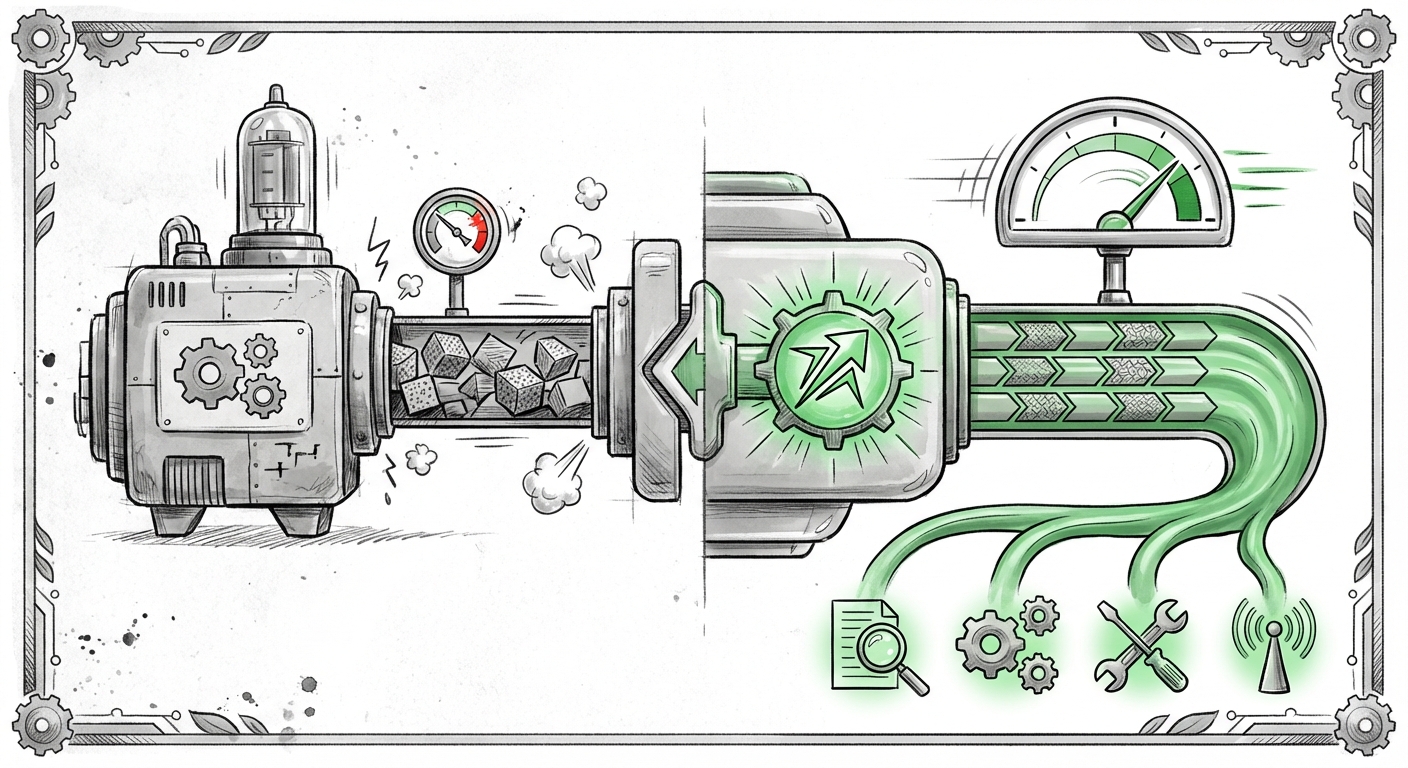
Here is where the block-sparse approach differs. Instead of treating every feature as a lone, independent unit, block-sparse featurizers group related features into blocks. Sparsity is then enforced at the block level, not just the individual level.
That sounds like a technical detail. It is not.
Real concepts are almost never alone. "Legal contract language" is really a bundle: obligations, parties, deadlines, jurisdiction, penalties. "Medical diagnosis" is a bundle: symptoms, history, test results, differentials. A model that learns these as scattered, unrelated units produces explanations that feel like scattered, unrelated words.
A model that learns them as coherent groups produces explanations that read like actual reasoning. The blocks mirror how concepts genuinely cluster in the world.
There is a practical payoff too. Enforcing structure at the block level can make the featurizer more efficient and more stable, cheaper to train, cheaper to run, and less likely to produce noisy, one-off features that mean nothing. For teams trying to analyze models with billions of parameters, that efficiency is not a nice-to-have. It is the difference between a research demo and a tool you can actually use every day.
Why This Is a Real Breakthrough, Not Just a Better Tool
Interpretability research has been stuck in an awkward place. The methods work, but they are slow, expensive, and hard to scale. You can understand a small model beautifully. You can barely scratch the surface of a frontier one.
Block-sparse featurizers attack that gap directly. By building structure into the featurizer itself, they make it possible to extract meaning from large models at a scale and cost that fits real workflows.
That shift matters because it moves interpretability from academic curiosity to operational capability. And once a capability becomes operational, everything downstream changes.
What This Means for the Future of AI
Interpretability Becomes Infrastructure
The biggest implication is that interpretability stops being a research project and starts being plumbing. Think of it like logging in software. In the early days, logs were an afterthought. Today, no serious company ships a system without them.
If featurizers become efficient enough, the same thing happens to AI. Every deployed model gets a readable map of its own concepts. That map powers debugging, monitoring, auditing, and safety, automatically, not as a special project.
Steering and Editing Models With Precision
Once you can see features, you can often turn them up or down. This is called steering. A model that is too cautious might have an overactive "refusal" block. A model that is too wordy might have an overactive "padding" block.
Block-level structure makes this control far more surgical. Instead of nudging a thousand vague signals, you adjust a coherent group. That is the difference between a blunt dial and a set of labeled switches. It opens the door to models that can be tuned, repaired, and constrained after training, without retraining from scratch.
Safety Testing That Actually Means Something
Today, most AI safety testing is behavioral. We poke the model with prompts and watch what comes out. That approach misses problems that only appear in rare situations.
If we can inspect the internal concept structure, safety testing gains a second layer. We can ask questions like: Does this model have a feature block associated with deception? Does it treat certain groups of people as a distinct, negative cluster? Are there blocks that only activate in unusual contexts?
That is a fundamentally stronger position. You are no longer only testing what the model says. You are examining what it has learned.
Practical Implications for Businesses
1. Audit Trails Become Possible
Regulators and customers increasingly want to know why an AI system made a decision. Behavioral explanations, "the model said so", are not enough. Feature-level explanations give you something concrete to show: here are the concepts that drove this output, here is their weight, here is what changed when we adjusted the input.
2. Faster Debugging, Lower Costs
When an AI product misbehaves, engineering teams currently burn weeks guessing. Interpretability tools can shorten that loop dramatically. If you can see which feature block fired incorrectly, you can often fix the problem without a full retraining cycle. For companies paying for expensive compute, that is direct savings.
3. Better Model Customization
Every industry wants a model that speaks its language. With feature-level control, you can emphasize the concepts that matter for your domain, clinical reasoning, compliance language, engineering notation, and suppress the ones that do not. This is a much more targeted path than fine-tuning on a huge pile of new data.
4. A New Layer of the AI Stack
Expect interpretability to become a product category of its own. Companies will buy tools that monitor model internals the way they buy security monitoring today. The firms that build and understand this layer will hold real leverage, because they will sit between model makers and the businesses that depend on those models.
What It Means for Society
The public conversation about AI is stuck between two extremes: total trust and total fear. Neither is useful. What people actually want is accountability, the ability to check the machine and hold someone responsible when it fails.
Interpretability is the technical foundation for that accountability. It also changes the nature of AI regulation. Rules that demand "explainability" are nearly impossible to enforce when explainability is a research problem. They become enforceable when explainability is a standard tool with standard outputs.
There is a risk, of course. The same techniques that let good actors audit a model could let bad actors manipulate one. Steering a model's internal concepts is powerful, and power can be misused. That is precisely why the research needs to mature in the open, with clear norms, rather than behind closed doors.
Actionable Insights: What to Do Now
- For technical leaders: Start tracking interpretability tooling as a first-class part of your AI stack, alongside evaluation and monitoring. Budget for it the way you budget for observability in software.
- For business leaders: Ask your AI vendors a blunt question, can you show me which internal concepts drove this output? Vendors who cannot answer will look increasingly exposed.
- For compliance and risk teams: Treat feature-level transparency as a future requirement, not a nice idea. Build the internal vocabulary now so you are ready when customers and regulators demand it.
- For builders and founders: The gap between "the model works" and "we understand why the model works" is a market. Block-sparse approaches widen the set of problems that can be solved at a reasonable cost.
- For everyone else: Pay attention to interpretability news. It is less flashy than a new chatbot, but it shapes whether AI systems can be trusted with anything that actually matters.
The Road Ahead
Goodfire's block-sparse featurizers are not the end of the interpretability story. They are a strong signal about where it is heading. The field is moving from "can we understand a model at all?" to "can we understand a model at scale, cheaply, and on demand?"
That is the version of interpretability that changes industries. When understanding a model is as routine as reading a log file, AI stops being a mysterious oracle and starts being an engineering system. Systems can be audited. They can be repaired. They can be trusted with more responsibility.
Grouping features into meaningful blocks sounds like a small design choice. In practice, it is the kind of choice that turns an interesting research result into a foundation other people can build on. And in AI, foundations are where the real leverage lives.
The next few years will tell us whether interpretability becomes standard practice or stays a specialist pursuit. Goodfire's approach makes the first outcome meaningfully more likely, and that is worth paying attention to.