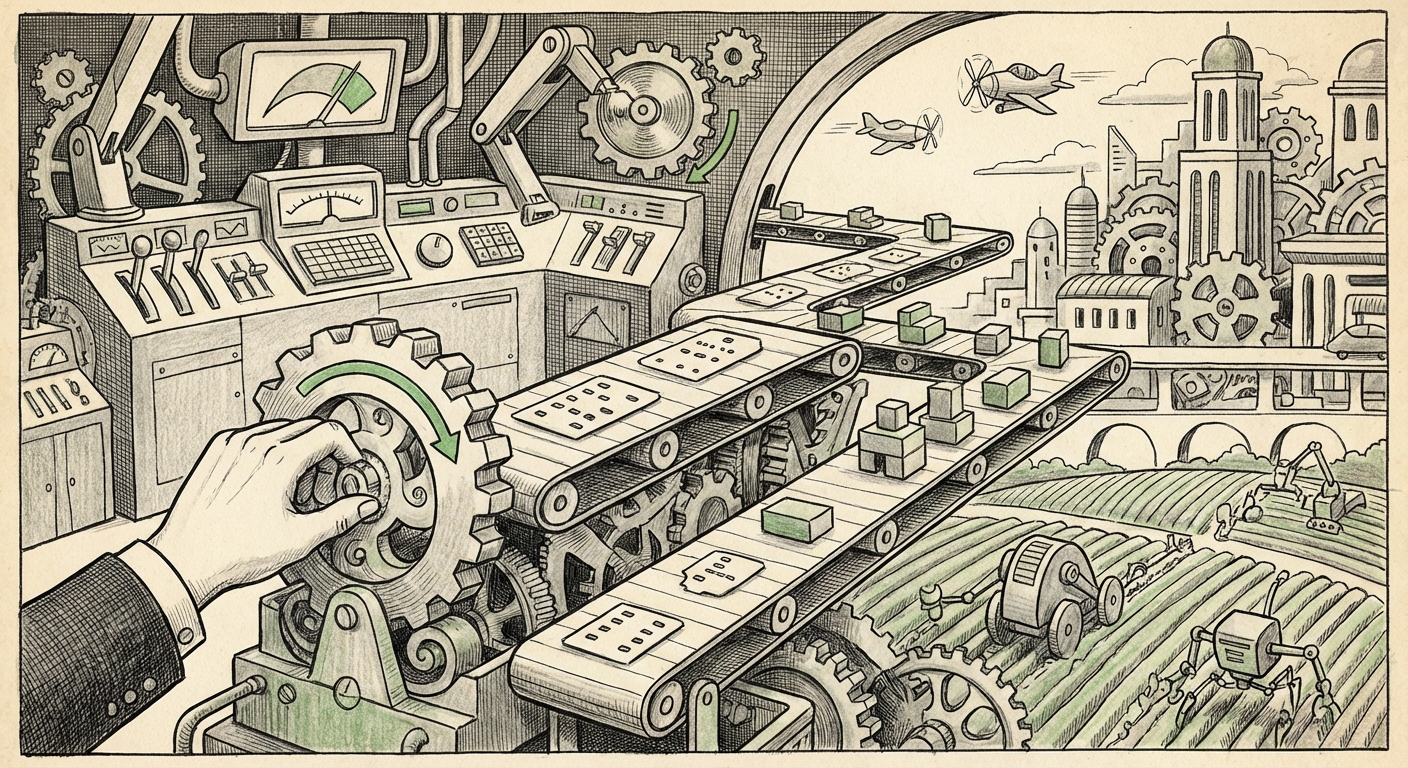
Temperature, Top-K, Top-P and Test-Time Compute: The Hidden Dials That Decide How AI Thinks
Ask most people how a large language model writes an answer, and they picture something like a search engine pulling facts off a shelf. The reality is stranger and more interesting. Every time an AI chatbot answers you, it is playing a high-speed guessing game. It predicts the next word, then the next, then the next, thousands of tiny decisions stacked into a single paragraph.
What controls those decisions? A small set of settings called generation configurations. The three most important are temperature, top-k, and top-p. And a newer idea, test-time compute, is starting to change the whole picture.
These settings sound technical, but they are the difference between an AI that gives you the same boring answer every time and one that surprises you. They decide whether your customer support bot stays on script or goes off the rails. They decide whether your coding assistant writes safe, predictable code or creative, risky code. Understanding them is no longer just for engineers. It is becoming a basic literacy for anyone who buys, builds, or manages AI tools.
The Four Dials Behind Every AI Answer
Here is the core idea. When a language model finishes reading your prompt, it does not "know" the answer. Instead, it produces a long list of possible next words, each with a probability attached. Maybe "the" has a 40% chance, "a" has 20%, "this" has 8%, and so on, across tens of thousands of options.
The generation configuration is the rulebook for turning that list into an actual choice. Change the rulebook, and you change the personality, reliability, and creativity of the output, even though the underlying model has not changed at all.
That last point is the one most businesses miss. You do not always need a bigger, more expensive model to get better results. Sometimes you just need better dials.
Temperature: The Creativity Knob
Temperature is the easiest of the three to understand. It controls how much randomness gets injected into the choice.
- Low temperature makes the model almost always pick the most likely word. The result is stable, predictable, and repeatable. Ask the same question twice, get the same answer twice.
- High temperature flattens the odds, giving less likely words a real chance of being chosen. The result is more varied, more surprising, and sometimes more creative.
Think of it like a thermostat for imagination. Turn it down for factual work, summarizing a contract, extracting data from an invoice, answering a math question. Turn it up for brainstorming, marketing copy, story ideas, or naming a product.
The danger is that turning the heat up also turns up the error rate. A model at high temperature is more willing to wander into territory that sounds confident but is wrong. That is why temperature is often described as the trade-off between creativity and reliability.
Top-K: The Shortlist
If temperature controls how random the choice is, top-k controls how many options are even on the menu.
Instead of considering all tens of thousands of possible next words, top-k tells the model: only look at the k most likely ones. If k is set to 50, the model throws away everything outside the top 50 and picks from that shortlist.
The benefit is simple. It weeds out nonsense. Without top-k, a high-temperature model could occasionally reach deep into the probability tail and pull out a word that makes no sense at all. Top-k acts like a bouncer at the door, keeping the weird options out.
The limitation is that k is a fixed number. Sometimes the model is very confident and only three words make sense. Sometimes it is genuinely uncertain and 200 words are reasonable. A fixed shortlist does not adapt to either situation.
Top-P: The Smart Shortlist
That is where top-p, also called nucleus sampling, comes in. Instead of picking a fixed number of candidates, top-p picks a fixed amount of probability.
Set top-p to 0.9, and the model keeps adding words to its shortlist, from most likely to least likely, until the combined probability reaches 90%. Then it picks from that group.
The genius of this approach is that it adapts automatically. When the model is confident, the shortlist is tiny. When the model is uncertain, the shortlist grows. Top-p gives the model room to breathe when it needs it and keeps it on a tight leash when it does not.
For most production systems, top-p has become the preferred tool of the two. It is more flexible and generally produces more natural-sounding text.
Putting the Three Together
In practice, these dials are used together, and the combinations matter:
- Low temperature, low top-p: Maximum reliability. Great for data extraction, classification, and anything where the same input should always give the same output.
- Moderate temperature, moderate top-p: The everyday workhorse. Good for chat assistants, summarization, and general writing help.
- High temperature, high top-p: Maximum creativity. Good for ideation and content generation, with a human reviewer on standby.
There is no universal "best" setting. The right configuration depends entirely on what you are asking the model to do. A medical triage bot and a poetry generator should not share the same dials.
Test-Time Compute: The Biggest Shift of All
Temperature, top-k, and top-p all control how the model picks its next word. But a fourth idea changes something deeper: how much effort the model spends before it answers at all.
This is test-time compute, also called inference-time compute. Instead of generating one answer in a single pass, the model is allowed to think longer. It can generate multiple candidate answers, check its own work, reason step by step, or explore several paths before committing to one.
The insight is powerful and a little unsettling. Two systems using the exact same underlying model can perform very differently depending on how much computation is spent at the moment of answering. In other words, how hard you let the model think can matter as much as how big the model is.
This shifts the economics of AI. Instead of endlessly chasing larger models, builders can get better results by giving smaller models more room to reason. That is cheaper to train, cheaper to run in some cases, and far more flexible.
But it comes with a cost. More thinking means more time and more money per query. A system that reasons for thirty seconds before answering is not the same product as one that answers instantly. The trade-off between speed, cost, and accuracy becomes something every product team has to negotiate deliberately.
Why This Matters for Businesses
These settings are not abstract engineering trivia. They show up directly in the bottom line.
Consistency builds trust. If a customer asks the same question twice and gets two very different answers, confidence drops fast. Locking down temperature for customer-facing tasks is one of the cheapest reliability wins available.
Cost control is real. Test-time compute means you can choose to spend more or less per query. Route simple requests to fast, cheap settings and complex ones to slower, deeper reasoning. That kind of routing can cut costs dramatically at scale.
Risk management needs guardrails. High creativity settings increase the chance of fabricated or off-brand output. In regulated industries, finance, healthcare, legal, configuration choices are effectively compliance choices.
Tuning is faster than retraining. Adjusting settings takes minutes. Training a new model takes months and millions. For most companies, configuration is where the fastest return on investment lives.
A Practical Playbook
If you are deploying AI in any capacity, here is a straightforward way to approach these settings:
- Start conservative. Begin with low temperature and moderate top-p. Loosen only when you have a clear reason.
- Match settings to the job. Build separate configurations for extraction, chat, and creative tasks rather than using one default for everything.
- Test like you mean it. Run the same prompt set across several configurations and score the results. Guessing is not a strategy.
- Budget your compute. Decide up front how much thinking time each task deserves, and route accordingly.
- Keep a human in the loop wherever creativity is dialed up. The more surprising the output, the more review it deserves.
What Comes Next
The direction of travel is clear. Generation configuration is moving from a hidden setting buried in code to a first-class product decision. We should expect tools that expose these dials in plain language, automatic systems that tune themselves per task, and a growing split between "fast-mode" AI and "deep-think-mode" AI.
Longer term, the rise of test-time compute hints at something bigger. The future of AI performance may not be a single giant model that does everything, but a system that decides how much effort each question deserves, like a person who knows when to answer from memory and when to sit down and think it through.
That is the real lesson here. The intelligence of an AI system is not just in its weights. It is in the choices made around it: how random, how focused, and how long it is allowed to think. Those choices are made by people. And increasingly, the people making them will need to understand exactly what those dials do.