What Happened to the $20 Billion? The AI Spending Reality Check That Changes Everything
On October 9, 2026, one question cut through all the noise surrounding artificial intelligence: What happened to the $20 billion?
It is a simple question. It is also the most important question in tech right now. For years, the AI story has been told in giant numbers. Billions for data centers. Billions for chips. Billions for new models. Billions for "AI-first" everything. Those numbers filled headlines and investor decks. They promised a future that felt inevitable.
But headlines are not buildings. Press releases are not power lines. A pledge is not a payment. And that is exactly why the $20 billion question matters so much. It marks the moment the industry stopped asking "How big is the promise?" and started asking "Where is the money?"
That shift is bigger than any single deal. It signals a change in how AI gets built, funded, and used for the next decade. Here is what it means, and what smart businesses should do about it right now.
Announcements Are Not Spending
This is the heart of the matter, and it is easy to miss. When a company says it will invest $20 billion in AI, that sentence can mean at least five very different things.
First, it can mean money spread over many years. A $20 billion figure might actually be $2 billion a year for a decade. Only a small slice shows up in any single year. If you were expecting a giant wave of spending all at once, you will be disappointed, but nothing is actually wrong.
Second, it can mean money that is conditional. Big AI projects need electricity, land, water for cooling, permits, tax deals, and long-term power contracts. If any of those fall through, the money does not move. The promise stays on paper.
Third, it can mean money that gets redirected. A plan to build new data centers can quietly turn into a plan to buy more chips instead, or the other way around. The total stays the same. The shape changes completely. Suppliers who were counting on one kind of order get a different one.
Fourth, it can mean money eaten by cost inflation. Chips, power, cooling systems, and skilled construction labor have all been under pressure. A budget that looked generous can buy far less than planned. The number stays big. The output shrinks.
Fifth, and this is the one nobody likes to say out loud, it can mean money that quietly gets shelved. When the business case stops working, projects do not always get cancelled with a press release. They get "paused." They get "rephased." They slowly stop appearing in updates.
So when someone asks what happened to the $20 billion, the honest answer is usually: some of it was never a single lump of cash in the first place. Part of it was always a direction, not a deposit.
Why This Is Happening Now
From roughly 2023 through 2025, AI investment ran on belief. The technology was improving fast, the use cases looked endless, and being late felt riskier than overspending. In that environment, big announcements were a strategy. They attracted talent, customers, partners, and investors.
That phase is ending. Not because AI failed, it clearly did not, but because belief has a limit. Once the money is committed, the questions change. Investors stop asking "What is your AI plan?" and start asking "What did that plan earn?"
This is normal. Every major technology goes through it. Railroads, electricity, the internet, cloud computing, all of them had a phase where promises outran delivery, followed by a painful sorting-out period. The strongest players survived and the foundation they built carried the next thirty years.
AI is now in that sorting-out period. The $20 billion question is simply the sound of it beginning.
Three Numbers That Now Matter More Than Headlines
If dollar figures are no longer the best signal, what is? Watch these three instead. They are much harder to fake.
- Power, actually connected. Not power "planned," not power "secured", power physically delivered to a site and running. Every serious AI facility is limited by electricity more than by ideas. Connected megawatts are the truest measure of real capacity.
- Chips, actually installed. Announced GPU orders and operating GPU fleets are two different worlds. The installed base is what trains models and serves users.
- Revenue per dollar of compute. This is the number that decides who survives. If a company spends a dollar on compute and earns two, it can scale forever. If it spends a dollar and earns thirty cents, no amount of enthusiasm fixes it.
When these three numbers are healthy, the headline number does not matter much. When they are unhealthy, no headline can save you.
What This Means for the Future of AI
Here is the counterintuitive part: a spending reality check is good for AI. It makes the technology stronger, not weaker.
Efficiency becomes the goal. When compute is scarce and expensive, engineers get creative. They build smaller models that do more. They cut waste. They stop using a giant model for a task a small one can handle. The whole field gets leaner and cheaper, which means more people can use it.
Inference starts to matter more than training. Training a model is a one-time cost. Running it for millions of users is a forever cost. As spending gets scrutinized, the smart money moves toward making models cheap to run, faster hardware, better serving systems, smarter routing, caching, and model selection.
The winners change. In the announcement era, the loudest companies won attention. In the delivery era, the companies that can actually energize a site, install hardware, and serve paying customers win. That is a different skill set, and it favors operators over storytellers.
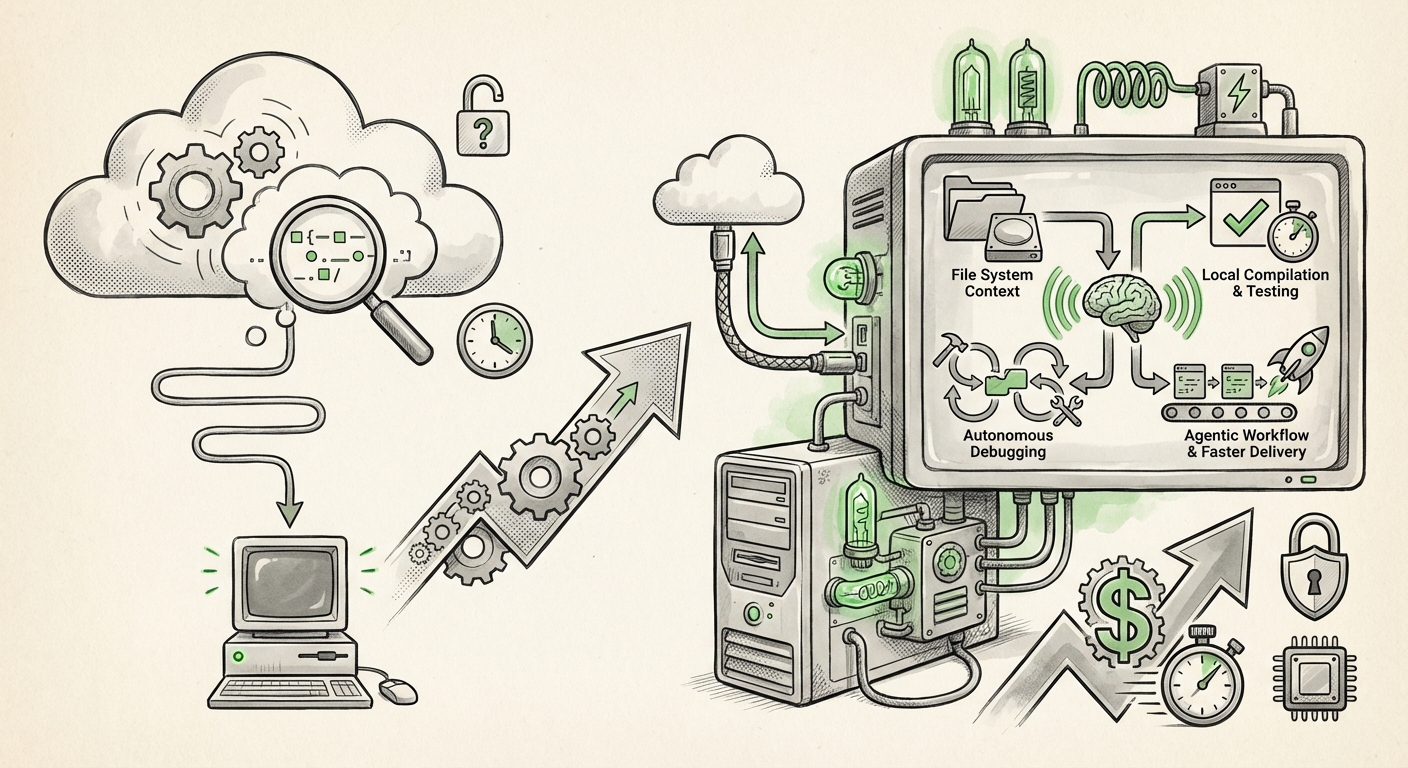
AI moves closer to the work. Instead of everything happening in a few giant data centers, more AI will run on laptops, phones, factory floors, and hospital systems. Smaller models running locally are cheaper, faster, and keep private data private. That shift is already being pushed by cost, not just by preference.
Practical Implications for Businesses
If you run a company that depends on AI, and by now, most do, this moment has direct consequences.
Do not build your strategy on someone else's press release. If your roadmap assumes a vendor will have massive new capacity by a certain date, you are exposed. Phased spending and paused projects are now the norm, not the exception.
Assume capacity will slip, and plan for it. Ask vendors hard questions: How much of your announced spend is contractually committed? What is your energized power today? What happens to my workload if your next phase is delayed?
Buy flexibility, not loyalty. Build systems that can switch between models and providers without a rewrite. This used to be an engineering nicety. It is now risk management.
Measure unit economics, not usage. "We used more AI this quarter" is not a win. "Each AI interaction costs us less and earns us more" is a win. Track cost per task, cost per customer, and payback period.
Follow the power, not the promises. Energy contracts and grid connections are the least glamorous and most honest signal in this entire sector. Where power is flowing, AI is real.
Actionable Insights: A Short Checklist
- Audit every AI commitment you have made and mark it as contracted, conditional, or aspirational.
- Identify your single biggest AI vendor dependency and write a one-page contingency plan for a six-month capacity delay.
- Find one workload running on an oversized model and test a smaller one against it this quarter.
- Add "cost per successful task" to your AI reporting dashboard.
- When you read a multi-billion-dollar AI announcement, ask what fraction is committed, over how many years, and contingent on what.
What to Watch Next
Over the coming quarters, the signals worth watching are quiet ones. Grid connection filings. Equipment delivery schedules. Hiring for operations roles rather than research roles. Earnings language that shifts from "investment" to "returns." Growing talk of efficiency, smaller models, and on-device processing.
If those signals strengthen, AI is maturing fast and the $20 billion question was just growing pains. If they weaken, we will see more paused projects and more headlines asking where the money went.
Either way, one thing is now clear. The era of believing numbers is over. The era of verifying them has begun.
The Bottom Line
The question of what happened to the $20 billion is not really about one number. It is about a maturity milestone. AI has moved from a story about what might be built to a business about what actually got built, and paid for.
That is uncomfortable for anyone who preferred the announcement era. It is excellent news for anyone who needs AI to be reliable, affordable, and useful for the next twenty years. Real infrastructure is boring. Boring infrastructure is what actually changes the world.