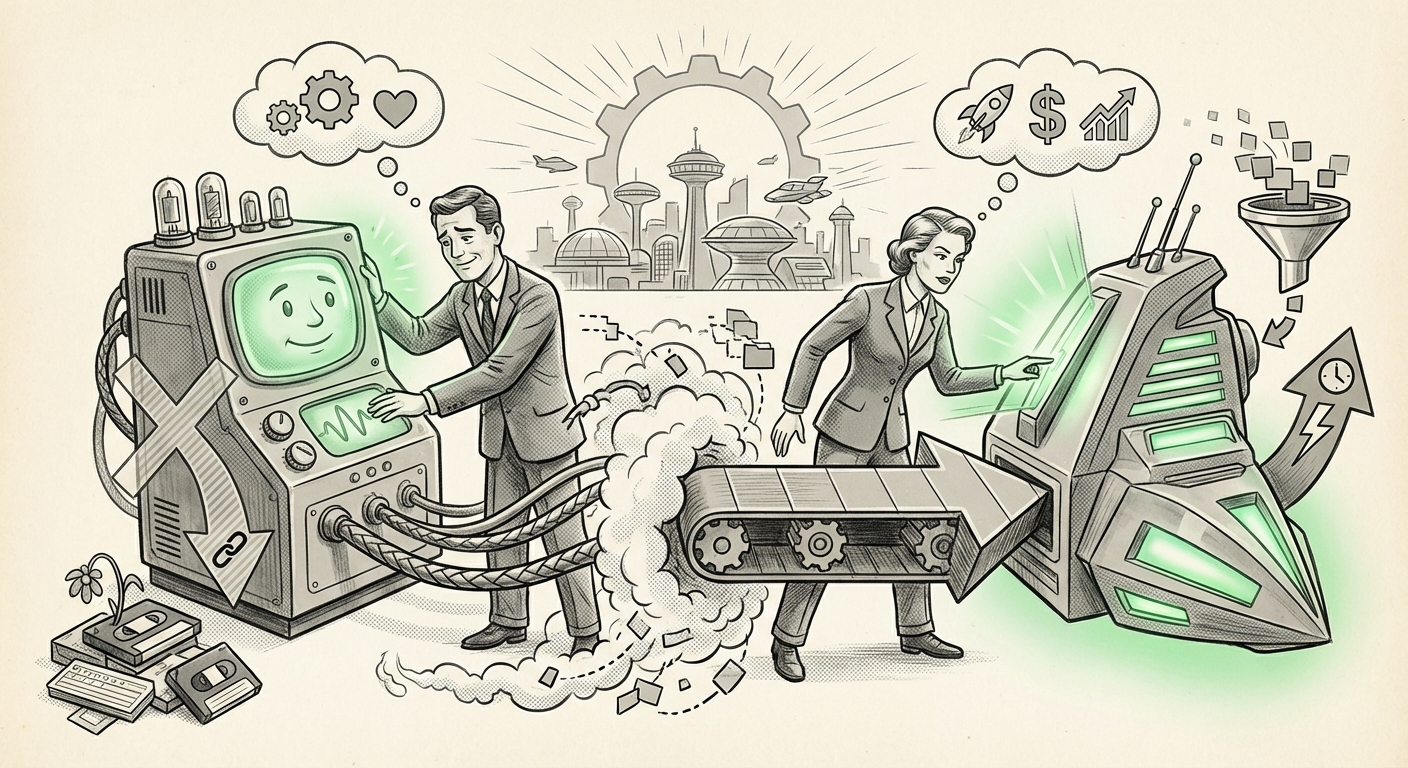
Anthropic's Quest to Give AI Morals: Why Teaching Machines Right From Wrong Is the Next Big Battle in Tech
Artificial intelligence can now write code, draft contracts, summarize research, and hold conversations that feel surprisingly human. But there is one thing it still cannot do reliably: know the difference between right and wrong.
That is the problem Anthropic is trying to solve. The company's core mission centers on a question that sounds more like philosophy than engineering, how do you give a machine a moral compass? It is a question that will shape the next decade of AI, and it matters far beyond the walls of a research lab. It matters for every business that wants to deploy AI, every regulator writing new rules, and every person who will one day rely on these systems to make decisions that affect their life.
Why "Morals for Machines" Is Suddenly a Business Problem
For years, AI safety was seen as a niche concern, something researchers worried about while everyone else raced to ship products. That era is over.
The reason is simple: AI models are moving out of the chat box and into the real world. They are drafting legal documents, screening job applicants, helping doctors sort through symptoms, and making split-second calls inside customer service systems. When a model gives bad advice or biased output, the consequences are no longer academic. They are lawsuits, lost customers, and damaged trust.
This is where the idea of "giving AI morals" moves from theory to practice. A model with a strong moral framework is not just a nicer chatbot. It is a system that knows when to refuse a request, when to flag uncertainty, when to escalate to a human, and when to say "I should not answer that."
That capability is becoming a competitive advantage. Companies that can prove their AI behaves predictably and safely will win contracts in regulated industries like finance, healthcare, and government. Companies that cannot will find themselves locked out.
The Hard Part: You Cannot Just Write a Rulebook
Here is the challenge. You cannot simply hand an AI a list of rules and expect it to behave. The real world is messy. Rules conflict. Context changes meaning. A statement that is fine in one setting is harmful in another.
So researchers have taken several different approaches, often combining them:
- Learning from human feedback. Humans review the model's answers and rate them. Over many rounds, the model learns which responses people prefer. The catch: humans disagree, and human feedback can bake in biases.
- Written principles. Instead of rating thousands of answers one by one, you give the model a set of written values and have it critique and revise its own responses against those values. This scales much faster, but it depends entirely on how well those principles are written.
- Red teaming. Deliberately trying to break the model, asking it to help with harmful tasks, to find weaknesses before the public does. This is the AI equivalent of stress-testing a bridge.
- Looking inside the model. Techniques that try to understand what is actually happening inside a neural network, rather than just judging its outputs. If you cannot see why a model made a choice, you cannot fully trust it.
None of these approaches is solved. Each one is a work in progress. But together they represent a shift in how the industry thinks: safety is not a feature you bolt on at the end. It is part of the foundation.
What This Means for the Future of AI
1. Character may matter more than raw capability
For the past few years, the AI race has been about benchmarks, who scores higher on tests of reasoning, coding, or knowledge. That is starting to change. As models become broadly capable, the differentiator shifts to behavior. Does the model know its limits? Does it push back when a request is unethical? Does it stay consistent under pressure?
Expect to see "trustworthiness" become a headline metric, right alongside accuracy. Buyers will start asking not just "how smart is it?" but "how does it behave when things go wrong?"
2. Alignment work becomes infrastructure
Think of it like electrical safety standards. Nobody markets a toaster by bragging about its grounding wire, but you cannot sell a toaster without one. In the same way, the techniques used to give AI moral guardrails will become invisible infrastructure, expected, regulated, and boring.
That is a good thing. It means the field is maturing.
3. The "who decides" problem gets louder
Here is the uncomfortable truth buried inside all of this: someone has to write the morals. Whose values get encoded? Which cultures are represented? Who reviews the principles when they cause harm?
A model trained with one set of values will behave differently from a model trained with another. That is not a technical bug, it is a governance question. Expect fierce debate over transparency, third-party audits, and who gets a seat at the table when the rulebook is written.
4. Regulation will follow the technology, not lead it
Governments are already struggling to keep pace. The likely path forward is a patchwork: some regions demanding documented safety testing, others relying on industry self-regulation, and companies caught in the middle trying to build systems that satisfy everyone.
Businesses that build strong internal safety practices now will have a much easier time adapting later. Those that wait will be retrofitting under pressure.
Practical Implications for Businesses
If you are running a company that uses or plans to use AI, this trend lands squarely on your desk. Here is what it changes:
- Vendor questions change. Instead of asking only about accuracy and price, ask how the model handles refusals, edge cases, and harmful requests. Ask for documentation. Ask what happens when the model is wrong.
- Human oversight becomes a design requirement. Any AI system making consequential decisions needs a clear path to human review. Build it in from day one, not after an incident.
- Policy becomes product. Your internal rules about what the AI may and may not do are no longer just a compliance document. They are part of your user experience.
- Trust becomes a marketing asset. In a crowded market, the company that can honestly say "our AI is safe and we can show you why" has an edge.
Practical Implications for Society
The stakes are bigger than any single company.
AI systems are increasingly asked to make judgment calls: Is this loan application risky? Is this content harmful? Is this medical symptom urgent? When a machine makes those calls, it absorbs a piece of human authority. The question is whether it does so fairly, consistently, and with accountability.
Giving AI morals is not about making machines that never make mistakes. It is about making machines that fail in predictable, correctable, and transparent ways. That is a meaningful difference, and it is the difference between a technology people trust and one they fear.
There is also a cultural dimension. Different societies hold different values. A single global model trained on one set of principles will inevitably clash with some users' expectations. The long-term answer probably involves configurability, transparency, and local oversight, not one universal moral code imposed from a single lab.
Risks and Open Questions
Not everything about this trend is reassuring. A few things to watch:
- Safety as a moat. If "responsible AI" becomes a marketing claim rather than a measurable standard, it loses its value. Independent verification matters.
- Over-refusal. A model that is too cautious becomes useless. Balancing helpfulness against safety is a constant tension, and getting it wrong erodes trust just as badly as harmful output.
- Whose morals? Encoded values reflect the people who wrote them. Without diverse input and outside scrutiny, biases get locked into the foundation.
- Moving targets. As models get more capable, the safety techniques that worked yesterday may not work tomorrow. This is not a problem you solve once.
Actionable Insights: What to Do Now
- Audit your AI use cases. Sort them by how much harm a bad output could cause. High-stakes uses need the most oversight.
- Ask vendors hard behavioral questions. Not just "what can it do?" but "what will it refuse, and how do you know?"
- Write down your own rules. Define what your AI is allowed to say and do before deployment, not after.
- Keep a human in the loop for decisions that affect people's money, health, safety, or opportunities.
- Track the ethics field like you track the tech. The methods for giving AI moral guardrails are evolving fast. What was best practice a year ago may already be outdated.
- Prepare for documentation requests. Regulators, partners, and customers will increasingly want proof of how your AI behaves. Build that record as you go.
The Bottom Line
Anthropic's push to give AI morals is a signal flare for the entire industry. The next phase of AI competition will not be won purely by building the smartest model. It will be won by building systems that people, businesses, and governments feel safe relying on.
That means the hardest work ahead is not just technical. It is philosophical, organizational, and deeply human. Somebody has to decide what good behavior looks like, write it down, test it, and stand behind it when it fails.
The companies and countries that take that work seriously now will shape how AI is used for decades. The ones that treat it as an afterthought will spend those same decades catching up, or explaining themselves.