Beyond LLMs: Why Scalable Enterprise AI Adoption Depends on Agent Logic
For the past few years, the enterprise conversation about artificial intelligence has been dominated by one question: which large language model should we use? Companies ran pilots, benchmarked chatbots, and debated model sizes. But a growing number of teams are discovering the hard truth that the model was never the whole product. The real bottleneck in getting AI to deliver value at scale isn't the intelligence of the model, it's the logic wrapped around it.
That's the core argument behind a shift now underway in enterprise AI: moving beyond large language models as standalone answer machines and toward agentic systems, software that can plan, act, check its own work, use tools, and operate inside real business processes. This article breaks down what that shift means, why it matters, and how businesses should prepare.
The Chatbot Era Hit a Ceiling
Large language models are remarkable. They can summarize, draft, translate, code, and reason across enormous amounts of information. But when you drop a raw LLM into a real workflow, several problems appear fast.
First, a model alone doesn't do anything. It produces text. It cannot look up your inventory system, file a ticket, send an email, update a record, or verify that its answer matches reality. Every action still needs a human to copy, paste, and click.
Second, models can be confidently wrong. In a casual chat, a flawed answer is a minor annoyance. In a procurement process, a compliance review, or a customer refund workflow, it's a liability.
Third, and most importantly for scale, an LLM has no built-in sense of process. It doesn't know the steps, the approval gates, the edge cases, or the rules your business runs on. It knows language, not your operations.
This is why so many impressive AI demos quietly die before they reach production. The demo works because a human is there, holding the whole thing together. Remove the human, and the system falls apart.
What "Agent Logic" Actually Means
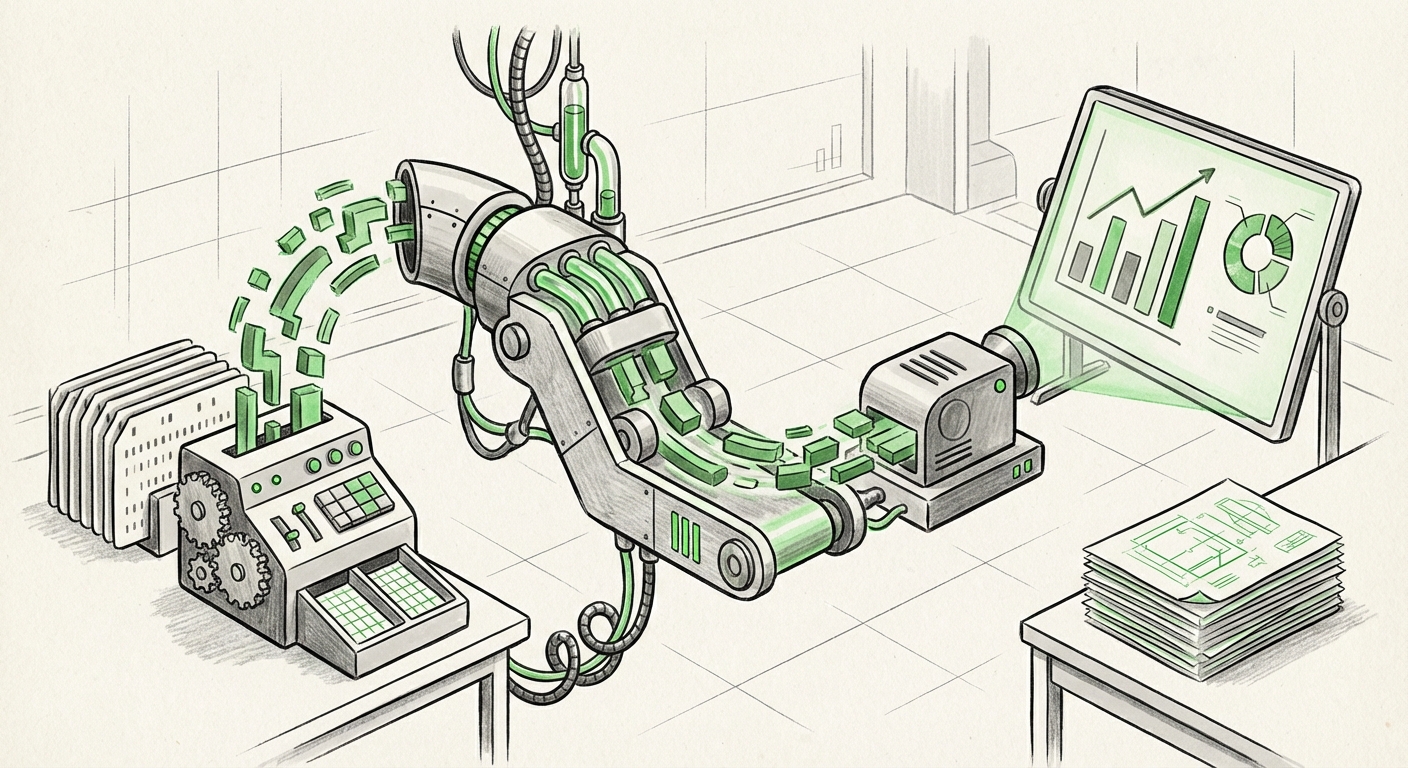
Agent logic is the layer that turns a language model from a talker into a doer. Think of the LLM as a very capable brain in a jar. Agent logic gives that brain hands, memory, a checklist, and a rulebook.
In practical terms, agent logic usually includes several ingredients:
- Planning and task decomposition: Breaking a big goal ("resolve this customer issue") into smaller, ordered steps.
- Tool use: Letting the AI call software, databases, APIs, search, calculators, internal systems, instead of guessing.
- Memory: Keeping track of what happened earlier in a task, and across tasks over time.
- Self-checking: Reviewing its own output, catching mistakes, and retrying before a human ever sees it.
- Guardrails and permissions: Defining what the agent is allowed to do, and what it must escalate to a person.
- Observability: Logging every step so teams can debug, audit, and improve the system.
When these pieces are in place, the AI stops being a fancy search box and starts behaving like a reliable junior teammate, one that follows procedures, asks for help when unsure, and doesn't go rogue.
Why Scale Breaks Without This Layer
Here's the key insight: a single good answer doesn't scale, a reliable process does.
Imagine a company automates customer support with a raw LLM. It works for simple questions. But as volume grows, the system hits the messy reality of real business: refund policies, account quirks, angry customers, legal requirements, and handoffs between teams. Without agent logic to route, check, and escalate, the system either hallucinates its way into trouble or needs so much human supervision that the savings disappear.
This is the difference between automation and orchestration. Simple automation follows a fixed script. Agent logic lets the system adapt when the script doesn't fit, choosing a different tool, asking a clarifying question, or flagging a case for a human.
That adaptability is exactly what enterprises need, because real work is full of exceptions. The value of AI at scale isn't in handling the easy 80% perfectly, it's in handling the messy 20% without falling apart.
The Enterprise Stack Is Being Rewired
As this shift plays out, enterprise AI architecture is changing shape. Instead of "one model, one app," forward-looking teams are building layered systems:
- A model layer that may include several models from different providers, chosen for cost, speed, or capability.
- An agent layer that handles planning, tool calls, memory, and control flow.
- An integration layer that connects the AI to real business systems.
- A governance layer that enforces policy, permissions, and audit trails.
This layering matters because it decouples the AI from any single vendor. If a better model arrives next quarter, you swap it in without rebuilding your entire workflow. The agent logic, the part that encodes how your business actually works, becomes the durable asset.
That's a big strategic point. Models are becoming commoditized. The process knowledge captured in agent logic is where long-term competitive advantage lives.
Governance, Trust, and the Human in the Loop
None of this works without trust, and trust doesn't come from better marketing. It comes from control.
As AI agents gain the ability to take real actions, companies need clear answers to hard questions. What can the agent do on its own? What requires approval? How do we undo a mistake? Who's accountable when something goes wrong?
Good agent design bakes these answers in from the start. That means:
- Least privilege: Agents get only the permissions they truly need.
- Escalation paths: Clear rules for when a human must step in.
- Reversibility: Actions that can be undone, and confirmations before irreversible ones.
- Full logging: A complete trail of what the agent did and why.
Companies that get this right will find that humans don't disappear from the loop, they move up the stack. Instead of doing every task, people supervise, set policy, and handle the genuinely hard cases. That's a healthier division of labor, and it's far more scalable than trying to keep a human on every single interaction.
What This Means for the Future of AI
The move toward agent logic signals something bigger than a technical upgrade. It marks the transition from AI as a tool you visit to AI as infrastructure that works in the background.
In the near term, expect to see:
- Fewer flashy demos, more boring wins. The most valuable AI deployments will be unglamorous, invoice processing, ticket routing, data reconciliation, because that's where volume and cost live.
- Model choice becomes less emotional. Teams will care less about which model is "smartest" and more about which fits the job at the best cost.
- New job categories. Agent design, AI operations, and evaluation engineering will grow as disciplines.
- Rising pressure on integration. The ability to connect AI to messy legacy systems will separate winners from also-rans.
Longer term, the companies that treat agent logic as a first-class part of their business, not an afterthought, are the ones most likely to turn AI from an expense into an advantage.
A Practical Playbook for Businesses
If you're trying to move beyond pilot purgatory, here's a grounded approach:
- Start with a process, not a model. Pick one workflow with clear steps, real volume, and measurable cost.
- Map the exceptions. The edge cases are where agent logic earns its keep. Design for them first.
- Build the guardrails early. Permissions, logging, and escalation aren't extras, they're the foundation.
- Measure outcomes, not vibes. Track time saved, error rates, cost per task, and human override frequency.
- Keep the model swappable. Architect so you can change models without a rebuild.
- Treat agent logic as IP. The process knowledge you encode is a long-term asset. Protect and improve it deliberately.
Risks and Open Questions
None of this is frictionless. Agentic systems are harder to build than chatbots, and mistakes can be more consequential because agents take action. Over-automation is a real risk, some tasks genuinely need human judgment, and forcing them into an agent can create more problems than it solves.
There's also the question of accountability. When an agent makes a decision, who owns the outcome? That's not just a technical question, it's a legal and cultural one that organizations are still working out.
The wisest posture is disciplined ambition: move fast on well-understood processes, move carefully on anything touching money, safety, or trust, and always keep a clear path back to a human when the system isn't sure.
The Bottom Line
The great enterprise AI race won't be won by whoever has the biggest model. It will be won by whoever can reliably turn intelligence into action, at scale, safely, and repeatably. Large language models provided the spark. Agent logic is what turns that spark into an engine.
Businesses that understand this distinction now will be positioned to move faster later. Those that keep waiting for the "perfect model" may find they've been solving the wrong problem all along.