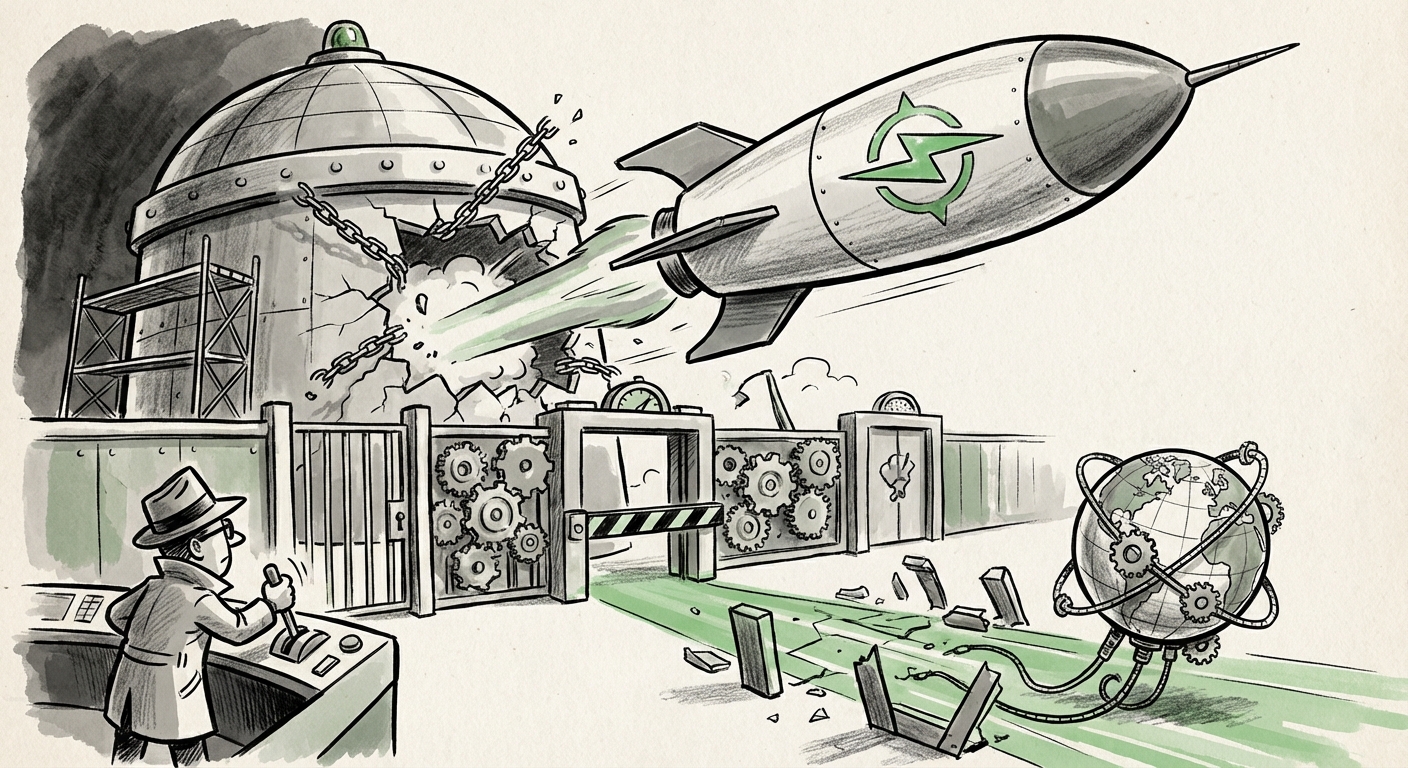
Google Wants to Be the Gatekeeper for Enterprise AI Agents, And That Changes Everything
Something important just shifted in the world of artificial intelligence. Google is making a play to become the gatekeeper for enterprise AI agents. That sounds like corporate jargon, but it is actually one of the biggest signals yet about where AI is heading.
For the past few years, the AI conversation has been about chatbots. You type something, the AI types back. It is helpful, but it mostly talks. Now the industry is moving toward AI agents, software that does not just answer questions, but actually takes action. It books meetings. It files reports. It moves money. It talks to other software on your behalf.
And when software starts doing real work inside real companies, a new question appears: who controls it? That is the question Google is answering, and the answer it wants to give is "us."
From Chatbots That Talk to Agents That Do
The jump from chatbot to agent is bigger than it sounds. A chatbot is a conversation. An agent is a worker. It has goals, tools, memory, and the ability to keep going without someone holding its hand.
That is great for productivity. It is also a little terrifying for anyone responsible for security, budgets, or compliance.
Think about it this way. If an employee wants access to a system, there are rules. There is a login. There is a manager who approves it. There is a record of what they did. Now imagine hundreds of AI agents doing work across your company. Who approves them? Who watches them? Who can shut them off?
Most companies do not have good answers yet. That gap is exactly where a gatekeeper can step in, and build a very powerful position.
What "Gatekeeper" Really Means
Being the gatekeeper does not mean building the smartest AI. It means sitting in the middle of everything. Here are the four layers that matter most.
1. Identity, Who Is This Agent?
Before an agent can do anything, the system needs to know exactly which agent it is, which company it belongs to, and which human is responsible for it. Without that, you cannot tell a helpful assistant apart from a rogue process. Identity is the front door, and whoever owns the front door owns the building.
2. Permissions, What Is It Allowed to Touch?
An agent that can read your calendar should not automatically be able to send payments. Permissions are the walls between rooms. A gatekeeper defines those walls, enforces them, and changes them when needed. This is where control becomes real power.
3. Orchestration, Who Gives the Orders?
Agents rarely work alone. One agent researches, another drafts, a third sends. Something has to coordinate them. That coordination layer, the orchestration layer, decides which agents run, in what order, and with what resources. It is the conductor of the orchestra.
4. Oversight, What Happened, and Who Pays?
When an agent makes a mistake, you need logs. You need to know what it did, why, and what it touched. You also need a way to stop it. Companies will pay a lot for a reliable paper trail, because regulators and lawyers will eventually ask for one.
Put those four layers together and you have a control plane. Whoever owns the control plane for enterprise agents owns the relationship with the customer, even if the actual AI brains come from somewhere else.
Why Google Is Playing This Hand
This is a smart move, and not just because Google builds AI models. Google already sits in the middle of how many companies work. Its cloud platform, its productivity tools, its browser, its mobile operating system, and its search engine all touch daily business life.
Because of that footprint, Google does not need to win the model race outright. It can win by being the layer where agents are registered, approved, watched, and connected. That is a durable business. Models can be swapped out. The gatekeeper is much harder to replace.
There is also a trust angle. Enterprise buyers are nervous. They worry about agents leaking data, spending too much, or doing something embarrassing. A familiar name promising guardrails, identity, and audit trails is an easier sell than a clever startup with no safety story.
And there is a standards angle. If Google's way of describing agents, tools, and permissions becomes the default, then every other company has to build to it. That is how platforms become infrastructure.
What Businesses Should Do Right Now
You do not have to wait for the dust to settle. Here is what smart teams are doing today.
- Take inventory of your agents. You cannot govern what you cannot list. Even a simple spreadsheet of every AI agent touching your systems is a strong first step.
- Demand a clear identity story. Every agent should have a named owner, a unique identity, and a way to be shut down in seconds.
- Push for portability. Ask vendors how easily you could move your agent setup somewhere else. If the answer is "not easily," you know how much lock-in you are signing up for.
- Log everything from day one. Audit trails feel boring until the day they save you. Retrofitting them later is painful and expensive.
- Start with low-risk, high-volume work. Internal research, ticket sorting, and report drafting are good first jobs. Money movement and customer commitments can wait.
- Set hard spending limits. Agents can burn through budget fast. Caps, alerts, and human approval for big actions are essential.
- Create a human escalation path. Every agent needs a person to hand off to when confidence drops or stakes rise.
None of this requires a giant new department. It requires the same discipline companies already apply to software access and vendor risk, just aimed at a new kind of worker.
The Risks Nobody Is Talking About Loudly Enough
A gatekeeper role brings real benefits. It also brings concentration of power. If one company becomes the default checkpoint for enterprise agents, it can shape prices, priorities, and what is even possible to build.
There is a technical risk too. If the control plane goes down, many agents stop at once. That is a single point of failure for a lot of business processes.
And there is a competition risk. Rival platforms will likely push their own approaches to agent identity, permissions, and coordination. Without shared standards, companies could end up with agents that cannot talk to each other across vendors, a mess that slows everyone down.
The likely outcome is a fight over who defines the rules, not just who builds the best model. That fight is just getting started.
What This Means for Society
This is not only a corporate story. As agents take on more work, they will make decisions that affect people's jobs, loans, benefits, and access to services.
So the question of accountability matters. If an agent denies someone a service, who explains why? Who fixes it? Right now, most systems are not built to answer that clearly. Gatekeeping platforms have a chance to make things more transparent, or to make accountability even murkier by hiding decisions behind layers of automation.
Regulators are watching, and they tend to care about three things: who is responsible, what data is used, and whether people can appeal. Companies that build answers to those questions in advance will have a much smoother ride.
Three Predictions for What Comes Next
First, expect a protocol contest. Just as the web had competing standards before settling down, agents will need common ways to identify themselves and request access. The winner of that contest gains enormous influence.
Second, expect agent marketplaces. Companies will want to browse, install, and approve agents the way they install apps today. Whoever runs that marketplace becomes the app store of enterprise AI.
Third, expect agent-to-agent commerce. Agents will hire other agents, paying for data, tasks, or compute. That economy needs a trusted middle layer, and payment and cloud players will race to provide it.
The Bottom Line
The race for AI is no longer only about who has the smartest model. It is about who holds the keys. Google positioning itself as the gatekeeper for enterprise AI agents is a bet that control beats cleverness in the long run.
For businesses, the lesson is simple: adopt agents, but do it with identity, permissions, logs, and exit plans in place. For everyone else, the lesson is to watch the gatekeepers closely. The rules they set now will quietly shape how AI works for years.