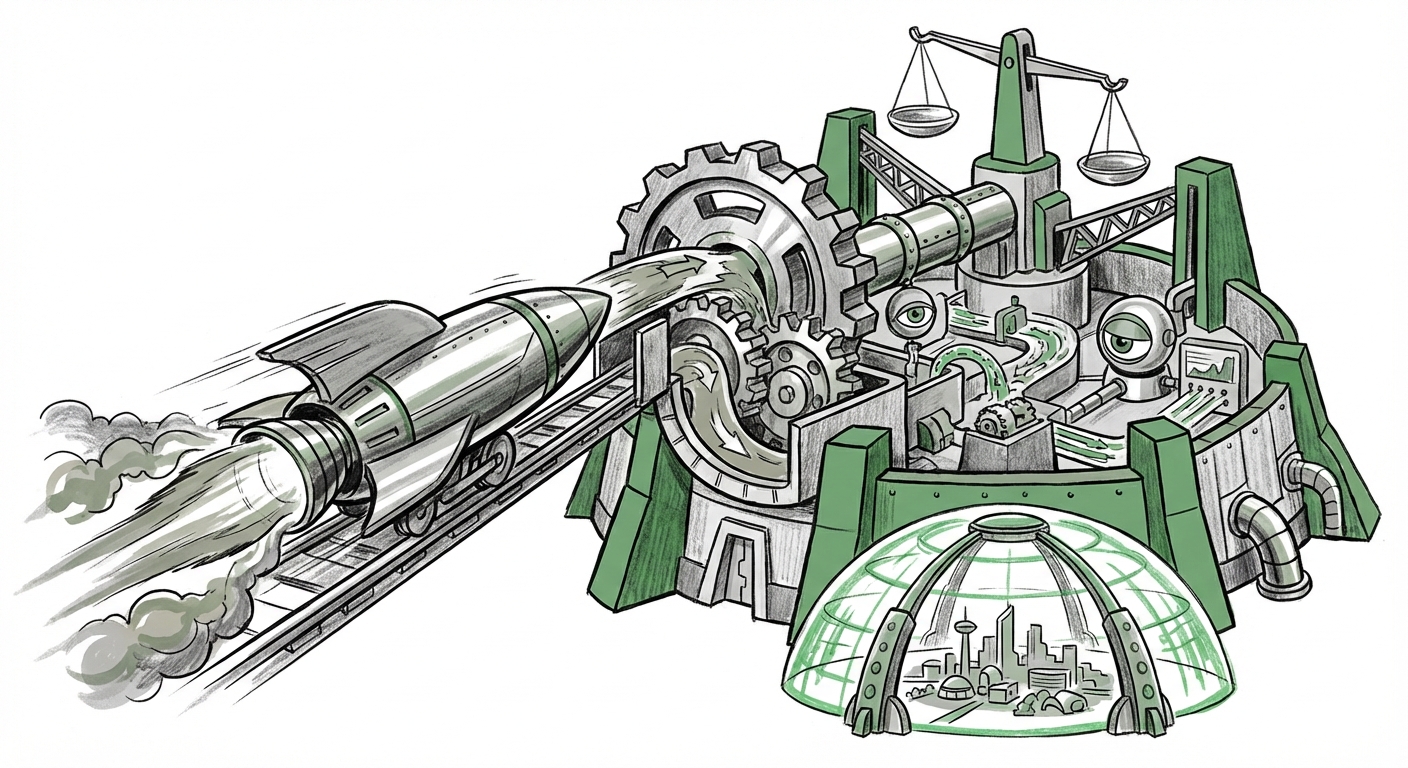
Information-Driven Design of Imaging Systems: Why the Next Big AI Breakthrough Might Be in the Camera Itself
For decades, we have built cameras the same way. Engineers picked a lens. They picked a sensor. Then they wrote software to clean up whatever mess came out the other end. Each part was designed by a different team, at a different time, with a different goal in mind. The lens team wanted sharp glass. The sensor team wanted small pixels. The software team wanted something it could actually fix.
That way of working is now being turned upside down. A wave of new thinking, collected under the heading information-driven design of imaging systems, asks a much simpler and much harder question. Instead of asking "how do we make a better picture?", it asks "what information do we actually need, and what is the cheapest, fastest, smallest way to get it?"
That shift sounds academic. It is not. It goes straight to the heart of how AI will be built, trained, and used over the next several years. And it changes what kinds of companies will win.
The Old Way: Build the Lens, Then Fix It in Software
Think about the camera in your phone. Light comes through plastic or glass lenses. It lands on a grid of tiny light sensors. Those sensors produce raw numbers, and those numbers look terrible on their own, dim, noisy, and oddly colored. Then a chain of software steps turns them into the photo you see.
Every one of those steps was designed separately. The lens was designed to bend light in a certain way. The sensor was designed to catch light in a certain way. The software was designed to patch up whatever the hardware could not do. This is called a sequential pipeline, and it has one big flaw. Each stage does not know what the other stages need. So the whole system ends up carrying around information it does not need, and throwing away information it does.
It works. It has worked for a very long time. But it is wasteful, and it hits a wall as devices get smaller and cheaper.
The New Way: Start With the Information You Need
Information-driven design flips the order. You begin at the end. You ask: who or what is going to use this image, and what do they need to know from it?
A doctor looking for a tumor does not need a beautiful photograph. A self-driving car does not need a pretty picture of the road. A factory robot checking parts on a line does not need a magazine-quality photo of a bolt. In each case, the real goal is a decision, not a picture.
Once you define the goal that way, the design problem changes. Now you can co-design the optics, the sensor, and the AI model together, as one system, aimed at one target. The lens no longer has to make a perfect image. It only has to capture the information the model needs. The model no longer has to fix a bad image. It gets to work with hardware that was built to help it.
This is where modern AI becomes essential. Because these systems can be trained end to end, the physics of light and the math of the neural network can be optimized at the same time. The hardware learns what to capture. The software learns what to expect. They meet in the middle.
What Counts as an Imaging System Now?
It is worth widening the definition. An imaging system is not just a camera. It is anything that turns physical signals into information a machine can use.
- Medical scanners that turn signals into images of the body.
- Satellites that watch crops, forests, ice, and cities from orbit.
- Microscopes that watch cells divide in real time.
- Depth sensors and lidar that help machines understand space.
- Industrial inspection rigs that catch defects humans would miss.
All of these face the same trade-offs: how much light, how much data, how much power, how much time, and how much money. Information-driven design gives engineers a shared language for those trade-offs. Instead of comparing megapixels, they compare how much useful information reaches the decision.
Why This Matters for the Future of AI
Two big things happen when imaging systems are designed around information instead of appearance.
AI that understands physics
Most computer vision models today are trained on pictures taken by ordinary cameras. They learn to recognize cats, cars, and cracks in concrete by looking at millions of examples. They are impressive, but they are also blind to the physics that created the picture. They do not know how light behaves. They only know what the final image tends to look like.
When the camera and the model are designed together, the model can learn from the raw physical signals instead of a polished image. That makes it more robust. It can work in dim light. It can work with cheap sensors. It can work with hardware that was never meant for photography at all. In short, it can do more with less, and that is exactly what makes AI affordable at scale.
Smaller models, bigger jobs
There is a hidden cost to the old approach. Because the hardware hands the AI a messy, low-information image, the AI has to be large and hungry to fix it. That means more compute, more power, and more cloud bills.
If the hardware delivers better information in the first place, the model can be smaller. Smaller models run on the device. On-device AI means faster answers, lower costs, better privacy, and the ability to work with no internet at all. This is the quiet engine behind a lot of the practical AI progress we should expect in the coming years.
Real-World Impacts to Watch
Health care
Medical imaging is the clearest case. If a scanner is designed around the clinical question rather than around producing a nice-looking scan, patients may face shorter scan times and lower exposure. Hospitals could run more scans per machine per day. Rural clinics could use simpler, cheaper devices backed by strong AI.
But this is also where caution matters most, and we will come back to that.
Industry, science, and the environment
Factories could inspect products faster with simpler hardware. Satellites could send back insights instead of raw data, saving precious bandwidth. Scientists could watch living systems under microscopes with less light and less damage to the sample. Each of these is a case where the information matters more than the image.
Everyday devices
Phones, doorbells, cars, and wearables all carry imaging systems. As design shifts toward information, these devices can get thinner, cheaper, and more capable at the same time. Cameras may become less like cameras and more like sensors that quietly feed AI, which is a big change in how we think about privacy and consent.
The Risks Nobody Talks About Enough
When AI helps reconstruct images, it is not just cleaning them up. It is guessing. A model trained to fill in missing detail will fill in detail, whether or not that detail is real. That is fine for a sunset photo. It is not fine for a tumor scan, a crime scene, or a court exhibit.
There is a second risk: loss of interpretability. If the hardware was never designed to produce a human-readable image, then humans may not be able to check the AI's work. We could end up with systems that are fast, cheap, and accurate most of the time, but impossible to audit when they are wrong.
There is a third risk: metric myopia. If you optimize a system around one definition of "useful information," you can quietly lose everything else. A camera tuned for reading license plates may be useless for anything else. That is a form of lock-in that shows up in hardware, where it is very expensive to undo.
None of these risks are reasons to stop. They are reasons to design with eyes open, and to keep a human-checkable path in the loop wherever the stakes are high.
What Businesses Should Do Now
The good news is that most organizations can act on this today, without building anything exotic.
- Start from the decision, not the device. Write down what decision the image supports. Then ask what information that decision truly needs. You will often find you need far less than you are paying for.
- Measure the right thing. Stop grading systems on how good the image looks. Grade them on how well the downstream decision performs. That single change reshapes entire roadmaps.
- Break the team walls. Optics, sensors, and AI teams should sit in the same room, or at least share the same goal. Co-design does not work across a handoff.
- Invest in your own data. Co-designed systems learn from physical signals, not just pretty pictures. If your data is all post-processed images, you are limiting what your models can learn.
- Plan for audit. For high-stakes uses, keep a path that produces images humans can inspect. Regulators and courts will expect it.
- Watch the supply chain. When the software can compensate for imperfect hardware, the pressure on component tolerances changes. That can lower costs dramatically, or shift who your suppliers need to be.
The Bigger Picture
There is a pattern here that goes well beyond cameras. For years, AI has been treated as a layer bolted onto older systems. You build the thing, then you add intelligence. Information-driven design says the opposite: intelligence should be part of the design from the very first sketch.
That idea is spreading. We see it in chips built for specific AI workloads. We see it in robots whose bodies and brains are tuned for each other. We see it in sensors that send conclusions rather than raw data. The imaging world is simply one of the clearest places to watch it happen, because the trade-offs are easy to see: light, size, speed, cost, and power.
The companies that figure this out first will not necessarily have the best cameras. They will have the best questions. They will know exactly what information they need, and they will build the smallest, cheapest, smartest system that delivers it. That is a harder skill than buying better glass. It is also a much bigger advantage.
The next wave of AI will not just be about better models. It will be about better systems, hardware and software grown together, aimed at real decisions. The camera is a good place to start watching.