OpenAI Doubled Revenue and Is Doing More Business Than Azure, What It Means for the Future of AI
Something strange happened in the world of technology in June 2024. New reports landed with a claim that would have sounded like a joke just two years earlier: OpenAI doubled its revenue, and the company is now doing more business than Azure.
Read that again. Azure is not a small thing. It is one of the largest cloud platforms on the planet, the invisible engine behind countless websites, banks, hospitals, retailers, and governments. For an AI company to be compared to it at all is a signal that something fundamental has shifted.
This is not just a story about one company's bank account. It is a story about where the money, power, and infrastructure of the next decade are heading. And it is a story every business leader should be paying attention to right now.
Why "More Business Than Azure" Is the Real Headline
Revenue doubling is impressive. But the comparison to Azure is the detail that matters most.
Cloud computing was the defining tech story of the last fifteen years. Companies like Microsoft built enormous businesses by renting out storage, servers, and software to everyone else. The cloud became the plumbing of the internet economy. If a company wanted to build something digital, it ran on someone's cloud.
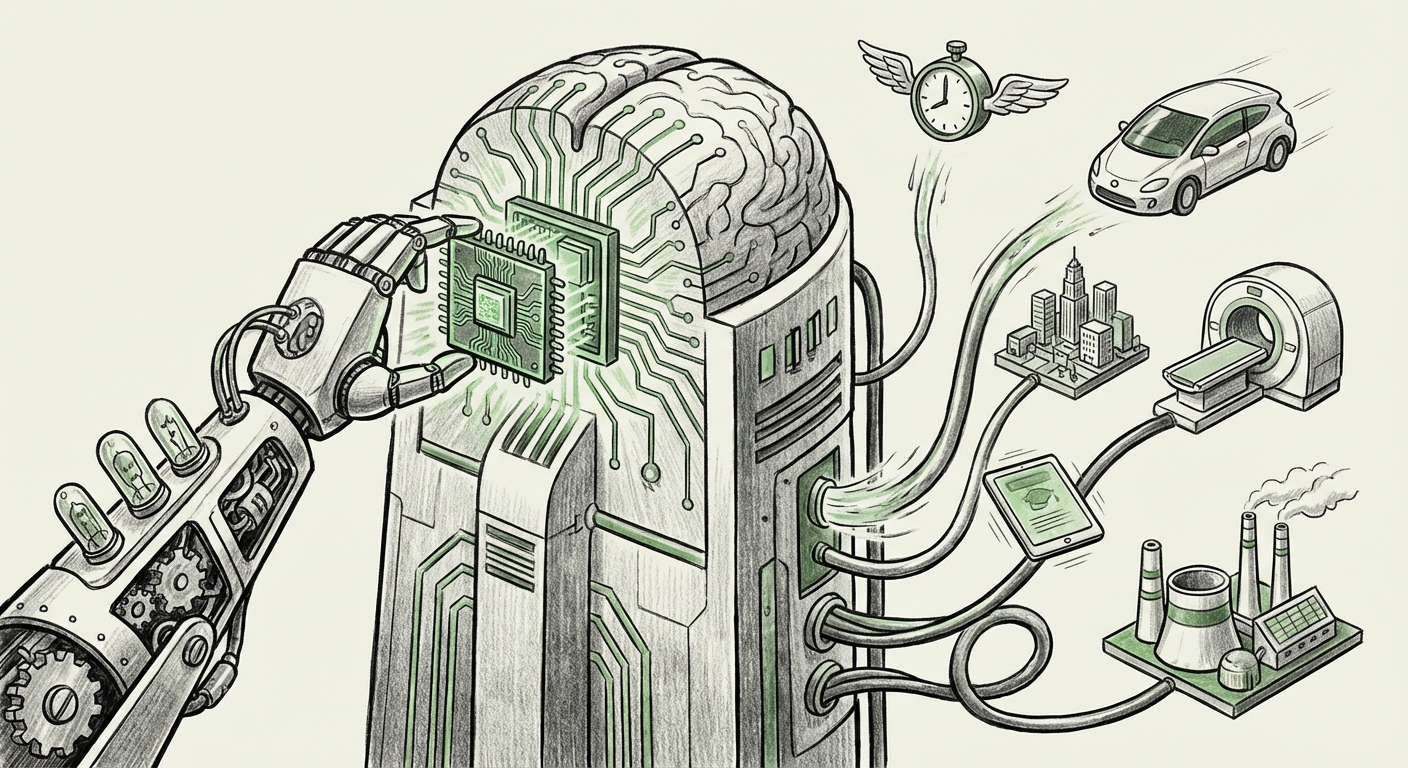
Now the reports suggest an AI lab is running more business than a major cloud player. That tells us AI is no longer a side experiment bolted onto existing products. It is becoming its own core layer of the economy, a place where businesses spend real money, at real scale, every single day.
Think of it like electricity a century ago. At first, factories made their own power with steam engines. Then power plants arrived, and electricity became a utility you bought by the kilowatt. Computing followed the same path with the cloud. AI is now following that path again, turning "intelligence" into something you buy on demand.
What Doubling Revenue Actually Tells Us
A company doubling its revenue is not just growing fast. It is showing that a loop is working.
Here is the loop in plain terms:
- More people and businesses use the product.
- That usage generates money, feedback, and real-world problems to solve.
- Those resources get poured back into making the product better.
- A better product attracts even more users.
When that loop spins fast enough, growth stops looking like a straight line and starts looking like a curve shooting upward. Doubling revenue is one of the clearest signs that the loop is spinning.
There is a second message hidden in the number. Fast growth usually means customers are moving from trying AI to depending on it. Pilots and experiments do not double revenue. Production systems do. When businesses start putting AI into the tools their staff use every day, and into the products they sell, spending jumps.
That is the shift the reports point to: AI has crossed from "interesting demo" into "part of how work gets done."
The New Competitive Map: Clouds and AI Labs Are Colliding
The most fascinating part of this story is how messy the competition has become. Cloud providers and AI companies used to have a simple relationship. The AI company needed massive computing power. The cloud provider had it. One paid the other. Everyone was happy.
Now those same companies are partners, suppliers, and rivals all at once. Cloud providers are building and selling their own AI tools. AI companies are becoming platforms that businesses build on directly. Each side is creeping into the other's territory.
That collision has consequences:
- Compute becomes the bottleneck. AI runs on enormous amounts of processing power. Whoever can secure chips, data centers, and electricity wins.
- Energy becomes a tech story. Training and running AI models uses serious power. Utilities, grids, and local communities are now part of the AI conversation.
- Pricing power shifts. If AI is essential, providers can charge more, until competitors offer something cheaper or good enough.
- Lock-in becomes a real risk. Businesses that build deeply on one AI provider may find it painful to switch later.
For anyone planning a technology budget, this is the new landscape. It is less like buying software and more like choosing a power company for the next ten years.
What This Means for Businesses Right Now
Billion-dollar headlines can feel far away from a normal company's daily problems. But there are practical lessons buried in this news.
1. AI budgets are becoming permanent, not experimental
When an AI provider doubles revenue, it means thousands of organizations moved AI from a test line item to a real one. If your company still treats AI as a "someday" project, you are now behind the curve, not ahead of it.
2. Build versus buy is the decision that matters
Most companies will not train their own giant models. They will rent intelligence through APIs and tools. The smart move is to design systems so you can swap providers if prices change or quality drops. Keep your data in a form you control.
3. Your data is your advantage
If everyone can rent the same powerful model, the difference between companies comes from their own data and workflow knowledge. The model is the engine. Your data is the fuel that makes it useful for your specific business.
4. Measure results, not excitement
Fast-growing providers make it easy to overspend on hype. Track hours saved, errors reduced, revenue added, and customer satisfaction. Kill projects that do not show returns.
5. Plan for cost swings
AI pricing can move quickly in both directions. Build flexibility into contracts and architecture so a change in the market does not break your budget.
What It Means for Society
The business story is only half of it. When AI becomes one of the biggest businesses in the world, the effects reach everyone.
Jobs will change faster. When companies double AI spending, they are usually buying automation, assistance, and speed. Some roles shrink. Others grow. The people who learn to work alongside these tools will have an edge.
Power will concentrate. Building top-tier AI takes money, chips, data, and talent that few organizations have. That concentration raises fair questions about who sets the rules and who gets left out.
Costs will fall for some things and rise for others. AI can make services like writing, coding, design, and customer support cheaper and faster. But the energy and hardware behind it are not free, and those costs show up somewhere, in bills, in land use, in electricity demand.
Trust becomes infrastructure. If AI is handling customer conversations, medical notes, legal drafts, and financial decisions, then accuracy, privacy, and accountability stop being nice extras. They become the foundation.
The Reality Check
It is worth being honest about what we do not know. A report about revenue doubling and beating a major cloud player is a strong signal, but signals are not the whole picture.
- Revenue is not profit. AI companies spend heavily on computing power and talent. Growing fast and making money are two different things.
- "More business" is a fuzzy measure. It could mean bookings, contracts, usage, or something else. The details matter.
- Competition is fierce. Rivals are pouring billions into the same space. Today's leader can become tomorrow's cautionary tale.
- Growth can cool. Every technology wave has a hype phase. The winners are the ones still standing after the excitement fades.
None of this makes the news less important. It just means the smart response is excitement plus discipline, not blind enthusiasm.
What to Watch Next
If this trend continues, a few things will tell us where AI is really heading:
- Whether AI spending keeps doubling, or slows to a steadier climb.
- Whether cloud providers and AI labs keep partnering or start competing directly.
- How much of the growth comes from consumers versus large businesses.
- Whether AI companies turn revenue growth into actual profit.
- How energy, chips, and regulation shape what is even possible.
The bigger picture is simple. AI has moved from a clever tool to a core business layer. The companies selling it are now measured against the giants of the cloud era. The businesses buying it are rewriting how they work. And the rest of us are living with the results.
Companies that treat this moment as a fad will spend the next few years catching up. Companies that treat it as a new kind of infrastructure, one to be planned for, budgeted for, and governed carefully, will be the ones writing the next chapter.