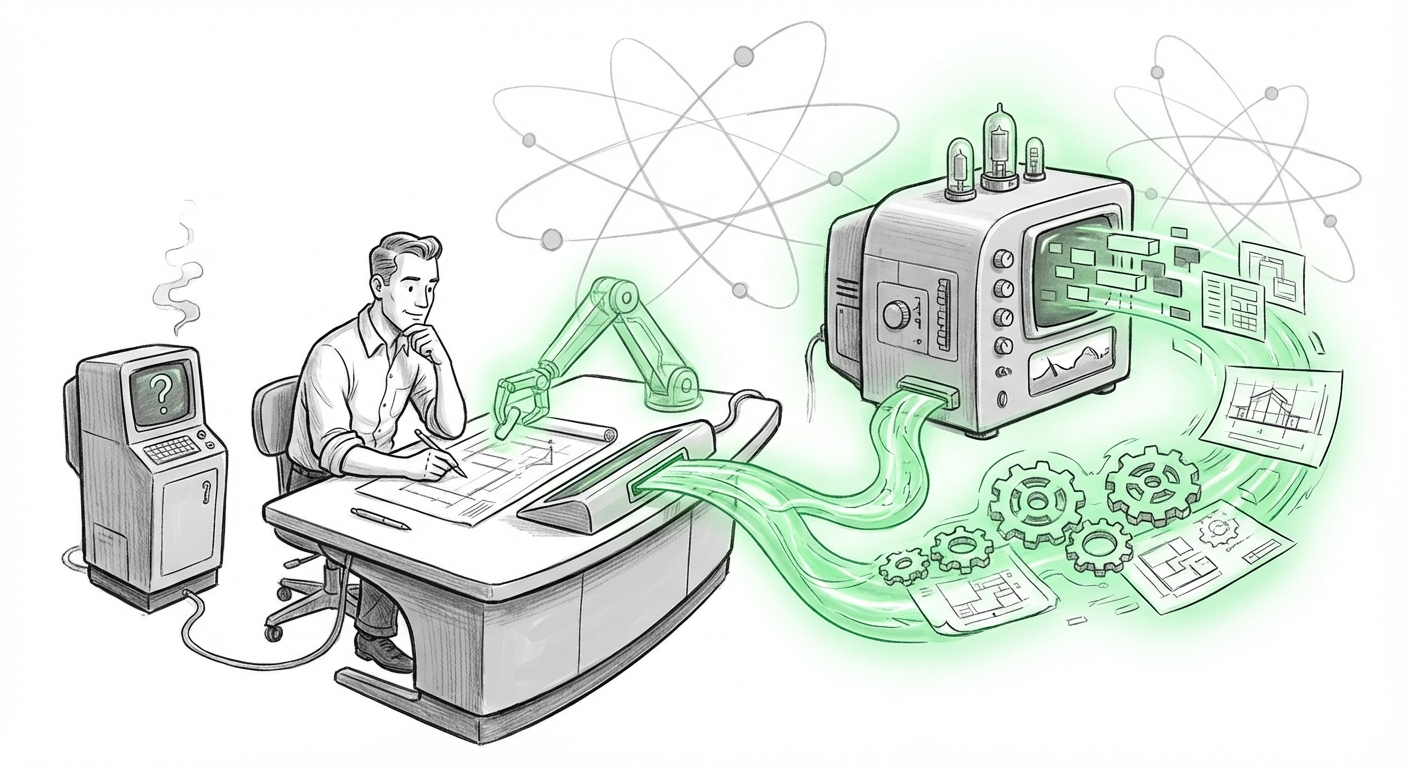
SST V2: How the State Stream Transformer Trains Nonlinear Recurrence in Parallel for Latent Space Reasoning
On October 9, 2026, the next version of a model family called the State Stream Transformer (SST) V2 arrived. Its full title says a lot in very few words: "Parallel Training of Nonlinear Recurrence for Latent Space Reasoning." If you have never heard those terms before, do not worry. This article breaks down what they mean, why this release matters, and what it could mean for the future of AI, and for the way businesses will actually use these systems.
The short version is this: SST V2 is trying to solve one of the oldest and hardest problems in AI. How do you build a model that can think step by step, the way a human reasons through a problem, without training it at a snail's pace? The answer SST V2 puts forward is parallel training of a nonlinear recurrence, applied to reasoning that happens inside the model's own hidden space rather than in words. That is a big deal. Here is why.
What Is the State Stream Transformer?
Most people today know AI through transformers, the architecture behind the chat assistants, image generators, and coding tools that have become part of daily life. A transformer looks at everything at once and weighs how each piece of information relates to every other piece. That "look at everything at once" design is exactly why it trains so efficiently on modern hardware.
The problem is that this design does not naturally think in sequences. It processes a context window in a single sweep. For long, multi-step reasoning, the kind needed to plan a project, solve a math proof, or debug a complex system, that can be limiting.
Recurrent models work differently. They carry a state forward in time, updating it step by step. That makes them naturally suited to sequences and to reasoning that unfolds over time. But that same step-by-step nature is their curse: you cannot easily train a recurrence in parallel, because step two depends on step one, which depends on step zero.
The State Stream Transformer appears to be an attempt to get the best of both worlds. Instead of running the model's reasoning as a single forward pass, SST maintains a state stream, a running internal state, that updates as the model works. That is the "recurrence" part. And V2 focuses on making that recurrence trainable in parallel, which is the part that could change everything.
Why Parallel Training of Recurrence Is a Big Deal
Imagine you are teaching someone a card trick that has twenty steps. If each step depends on the last, you have to show them step one, wait, then step two, wait, then step three. That is slow. Now imagine you could teach all twenty steps at once, on a whole classroom of students, each starting at a different step. That is the promise of parallel training.
For recurrent models, this has always been the dream. And the word nonlinear makes it harder still. A linear recurrence is like a straight, predictable path, easy to compute, easy to speed up, but limited in what it can express. A nonlinear recurrence is more like a winding river. It can model far richer patterns, which is what you want for real reasoning. But nonlinear steps are much harder to line up and run at the same time.
SST V2's headline claim, parallel training of nonlinear recurrence, targets exactly that trade-off. If it works, it means a model can carry a rich, expressive, step-by-step internal process and still be trained at the speed modern AI demands. That combination has been a goal for years. Reaching it would remove a major bottleneck in the field.
Latent Space Reasoning: Thinking Without Words
The third idea in the title is latent space reasoning, and it may be the most important one for the future of AI.
When today's AI models "think," they usually do it out loud, in text. They write out a chain of reasoning, token by token, in human language. This is powerful, but it has real drawbacks. Language is slow. Language is lossy. And forcing thought into words can distort an idea that never needed words in the first place.
A latent space is the model's own internal world of numbers, a huge, high-dimensional map of meaning. Reasoning in latent space means the model thinks in that internal language instead of translating everything into English first. In theory, that lets it explore ideas faster, hold richer intermediate states, and reason in ways that do not map neatly onto sentences.
SST V2 brings these threads together. A state stream gives the model a place to hold its thinking. Nonlinear recurrence lets that thinking grow complex and powerful. Parallel training makes it feasible to build. And latent space reasoning is where all of it happens.
The Bigger Trend: AI Is Learning to Think, Not Just Talk
Step back, and a pattern comes into focus. Across the field, the frontier has been shifting from models that generate text to models that solve problems. The excitement is less about fluent answers and more about reliable reasoning, the ability to work through hard, multi-step tasks and arrive at something correct.
SST V2 sits right on that trend line. It is not trying to be a better chatbot. It is trying to be a better thinker. That is a meaningful shift, because reasoning is where AI's real economic value is starting to concentrate. Anyone can get a summary. Fewer systems can be trusted to plan, verify, and decide.
A second trend matters too: efficiency. As models get bigger, training and running them gets more expensive. Architectures that promise smarter thinking without an endless explosion in cost are exactly what the industry needs. Parallel training of recurrence is, at heart, an efficiency play, do more with the same hardware.
What This Means for the Future of AI
If approaches like SST V2 deliver on their promise, expect several things to change over the next few years.
- Longer, more reliable reasoning. Models that carry a state will be better at tasks with many steps, planning, coding, science, and complex analysis, where today's models sometimes lose the thread.
- Faster, cheaper training. If recurrence can be trained in parallel, the cost of building reasoning-focused models could come down, opening the door to smaller teams and more competition.
- New kinds of intelligence. Latent space reasoning hints at systems that think in ways we cannot fully read in words. That is exciting and also a real challenge for safety, auditing, and trust.
- Blurrier lines between "models" and "agents." A model that holds an internal state and reasons over time looks a lot like an agent that can work on a task continuously.
Practical Implications for Businesses
You do not need to understand the math to see the business stakes. Here is what matters for anyone running or building with AI.
Multi-step work becomes more feasible. Many business problems are long chains: research, draft, check, revise, ship. Today's models often stumble halfway. Architectures built for sustained reasoning could make these workflows far more dependable.
Cost curves may shift again. Efficiency gains tend to lower prices and widen access. If parallel training makes reasoning models cheaper to build and run, more companies can afford to deploy them, including smaller firms that have been priced out.
Trust and oversight get harder. A system that reasons in its own internal space is harder to inspect than one that writes out every thought. Businesses in regulated industries should expect new questions from auditors and compliance teams about how these systems reach their conclusions.
The talent gap widens. Architectures like SST V2 deepen the divide between organizations that can work close to the research frontier and those that simply consume APIs. Understanding the concepts, even without building them, is now a leadership skill.
Actionable Insights
- Track, do not chase. SST V2 is a research direction, not a shelf-ready product. Follow its progress, but do not rebuild your roadmap around a single paper.
- Identify your long-horizon tasks. Find the workflows in your business where AI fails today because the task has too many steps. Those are the ones most likely to be transformed first.
- Ask vendors the right questions. When evaluating AI tools, ask how they handle multi-step reasoning, how they are trained, and how their outputs can be audited.
- Invest in literacy, not just licenses. Give your teams a working understanding of concepts like recurrence, state, and latent reasoning. It is the difference between using AI and being used by it.
- Plan for explainability now. If reasoning moves inside the model, demand clear reporting standards before regulators do.
Risks and Open Questions
Every promising architecture carries open questions, and SST V2 is no exception. The biggest is whether parallel training of nonlinear recurrence holds up at scale, the real test of any clever idea. Another is interpretability: if a model reasons in latent space, how do we know it reasoned correctly, or safely? And a third is whether these gains translate into the messy, real-world tasks that businesses actually care about, rather than only clean benchmarks.
There is also the matter of momentum. The field moves fast, and many architectures that looked revolutionary in a paper never reach wide use. SST V2 is a signal of direction, not a guarantee of arrival.
Conclusion
The State Stream Transformer V2 is a small title with a large ambition. By pairing a running internal state with parallel training and latent space reasoning, it aims at one of AI's deepest puzzles: how to build a machine that genuinely thinks through problems, step by step, without sacrificing the speed and scale that made modern AI possible. On its own, this release is a research milestone. In context, it is a marker of where the field is heading, away from models that merely talk, and toward models that reason. For businesses and society alike, that shift is the one worth watching.