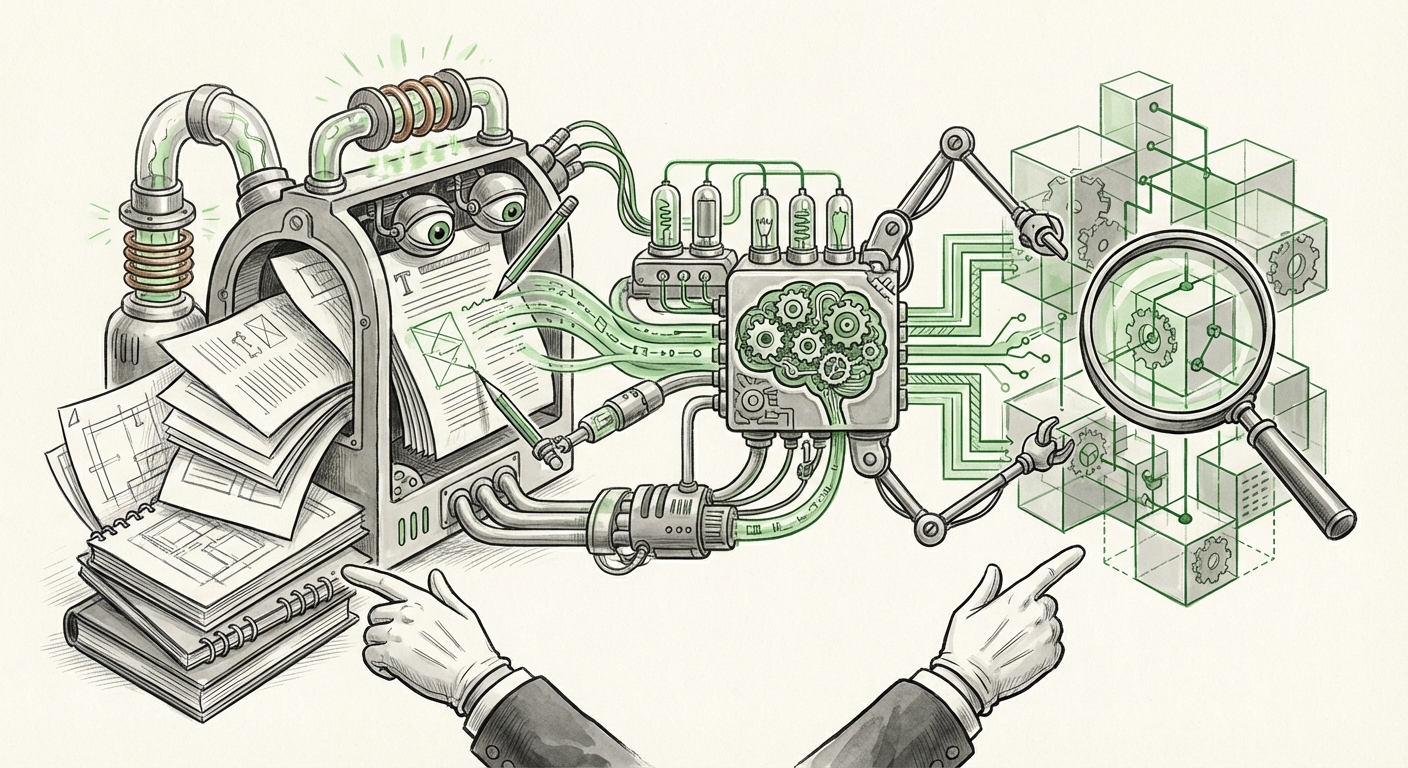
Waypoint-1.5 Brings Higher-Fidelity Interactive Worlds to Everyday GPUs, What It Means for the Future of AI
Something important just happened in the world of AI, and it did not involve a chatbot writing emails or a model passing a test. On April 9, 2026, a system called Waypoint-1.5 arrived with a description that should make anyone paying attention to AI sit up straight: higher-fidelity interactive worlds for everyday GPUs.
That sentence is short, but it carries a lot of weight. It says that AI can now generate worlds you can move around in and interact with, that those worlds look better than before, and, this is the key part, that they can run on the kind of graphics card an ordinary person or small business actually owns. Not a data center. Not a research cluster. A normal computer.
If you only follow AI for the chatbots, this is the story you have been missing. Interactive world generation may end up mattering more than any text model, because it changes what AI is for. Instead of asking an AI to describe something, you step inside what it made.
What Waypoint-1.5 Actually Signals
Let's break down the three words in that headline, because each one points to a different trend.
Interactive worlds. These are not videos and they are not images. They are environments, spaces with physics, movement, and cause and effect. When you press a direction or change something, the world responds. The AI is not painting a picture anymore. It is running a small reality.
Higher fidelity. Earlier versions of this kind of technology looked rough. Objects flickered, textures smeared, and motion felt wrong. Higher fidelity means the illusion holds together better, enough that people can focus on what they are doing instead of noticing the seams.
Everyday GPUs. This is the part that changes the economics. High-end world generation has mostly lived on expensive hardware. When it runs on everyday graphics cards, the audience goes from thousands of specialists to millions of regular users.
The Real Shift: From Watching AI to Playing Inside It
For the past few years, the pattern with AI has been the same. You type something. The model produces something. You look at the result. That is a passive loop. It is powerful, but it keeps you on the outside.
Interactive world models break that loop. You are no longer a reader. You are a participant. And participation changes what the technology is good for.
Think about what a video game is. It is a world someone built by hand, often over years, with a large team. Level designers place every rock. Artists paint every wall. Now imagine the world building itself around the player, in real time, on hardware that fits in a backpack. That is the direction this points toward.
The same idea applies far beyond games. Anywhere people need to explore a space that does not exist yet, a factory layout, a city block, a surgical scenario, a training simulation, generated interactive worlds become a tool instead of a novelty.
Why "Everyday GPUs" Is the Headline That Matters Most
Technology demos are cheap. Anyone can render something beautiful on a machine that costs more than a car. The hard part is making it work for regular people.
When a capability stays locked behind expensive hardware, it follows a predictable path. Big companies use it. Researchers study it. Everyone else reads about it. The technology improves slowly because few people are using it, and few people use it because it is expensive. That loop is hard to escape.
Running on everyday GPUs breaks the loop open. Suddenly:
- Independent creators can build with it without renting cloud compute by the hour.
- Small studios can compete with larger ones on ideas rather than on hardware budgets.
- Schools and students can experiment without a lab full of servers.
- Businesses can test the technology in pilots before committing to major infrastructure.
Lower hardware requirements also mean lower energy costs and less dependence on distant data centers. That matters for privacy, for latency, and for the simple question of who gets to use the technology at all.
What This Means for the Future of AI
World models become training grounds
AI systems learn by doing. But doing things in the real world is slow, expensive, and sometimes dangerous. A robot that learns by knocking over real objects is a liability. A robot that learns inside a generated world can fail a thousand times a day at almost no cost.
Interactive world generation gives AI a place to practice. As these worlds get more realistic, the gap between practice and reality shrinks. That is a direct path to better robots, better autonomous vehicles, and better agents of all kinds.
Simulation becomes a product, not a project
Today, building a simulation is a major undertaking. It takes specialists, months of work, and a specific purpose. If worlds can be generated on demand, simulation shifts from a project to a purchase. Need a warehouse scenario? Generate one. Need ten variants with different layouts? Generate those too, this afternoon.
The data flywheel spins faster
Every time a user moves through a generated world, they produce data about what works and what feels wrong. That feedback improves the next version. More users mean more feedback. More feedback means better worlds. Better worlds attract more users. This is the same flywheel that made large language models improve so quickly, now applied to space and motion instead of text.
Practical Implications for Businesses
You do not need to be a game company to care about this. Here is where the impact lands.
Gaming and media. The most obvious fit. Smaller teams can build larger, more varied worlds. Content that used to take months can be drafted in days and refined by hand.
Robotics and manufacturing. Training and testing happen in simulation before a single physical part is ordered. That means fewer prototypes and faster iteration.
Design and architecture. Clients do not read blueprints well. They understand walking through a space. Generated interactive previews turn a static pitch into an experience.
Education and training. Hazardous, rare, or expensive situations, emergency response, heavy machinery, lab procedures, become safe to practice. Learners can repeat a scenario until it sticks.
Marketing and retail. Interactive product spaces and virtual storefronts become practical to produce, not just premium showpieces.
The Challenges Nobody Should Ignore
It would be easy to read all of this as pure upside. It is not. A few real problems come with the territory.
- Consistency. Generated worlds can drift. Walk away and come back, and things may not be where you left them. For entertainment that is a quirk. For training, it is a bug.
- Physical accuracy. A world that looks right may not behave right. If a simulated machine responds differently than a real one, the training teaches the wrong lesson.
- Cost of quality. Higher fidelity means more compute. Even on everyday GPUs, there is a ceiling, and hitting it means trade-offs between detail, size, and smoothness.
- Skills gap. Tools are only useful to people who know how to use them. Most organizations do not yet have anyone whose job is designing generated environments.
- Trust and safety. Worlds that feel real can be used to mislead. Clear labeling and provenance will matter as much here as it does for generated images and video.
Actionable Insights: What to Do Now
If you are deciding how seriously to take this, here is a practical path.
- Run a small pilot. Pick one real problem, a training scenario, a design review, a layout test. Build a rough interactive version and see whether people engage with it differently than they do with slides or video.
- Measure what changes. Does the pilot save time? Improve understanding? Reduce rework? The value of interactive worlds shows up in decisions made faster, not in how impressive the demo looks.
- Check your hardware reality. The whole point of running on everyday GPUs is that you may not need new infrastructure. Test on the machines your team already has before you budget for anything bigger.
- Build a small internal skill. One or two people who understand both your business and how to shape generated environments will outperform a large team with no direction.
- Plan for the consistency problem. If a world needs to stay stable across sessions, design for that from the start instead of fixing it later.
- Set your labeling rules early. Decide now how you will tell people when a world is generated rather than captured.
The Road Ahead
The most interesting thing about Waypoint-1.5 is not the version number. It is the direction of travel. AI is moving from producing content you consume to producing environments you inhabit. And it is doing so on hardware that normal people and normal businesses already own.
That combination, more capability, less hardware, is how a technology crosses from curiosity to infrastructure. Text models made that jump a few years ago. Images and video are mid-leap. Interactive worlds, if this trajectory holds, are next.
The organizations that benefit most will not be the ones with the biggest budgets. They will be the ones that start experimenting while the tools are still rough, learn what actually works, and are ready when the fidelity and the consistency catch up to the promise. The window for cheap experimentation is open right now. It will not stay open forever.