What Transfers from Text to Vision? The Paper Reshaping How We Think About VLM Scaling
On October 9, 2026, a research paper landed with a title that sounds like a simple question but hides one of the biggest open problems in artificial intelligence: "What Transfers from Text to Vision? Capability Scaling Laws and Transfer Dynamics for VLMs."
That title matters far more than it looks. It is not asking whether AI can see. It is asking something deeper and more useful: when we make a language model smarter, which of those new skills automatically show up in its ability to understand images? And which ones don't?
Get that answer right, and you can predict what the next generation of AI will be able to do before it is even built. Get it wrong, and companies will keep spending millions on systems that read brilliantly but still can't tell you what's in a photo.
A Simple Question With Huge Consequences
Vision-language models, or VLMs, are AI systems trained on both text and images. You've seen them in action: describe a photo, read a chart, answer a question about a diagram, spot a defect on a factory line, or help someone who is blind navigate a street.
Most of these systems start from a language model, a system already trained on enormous amounts of text, and then get taught to handle images. This is the standard recipe across the industry. The assumption behind it is that language skill is the foundation, and vision is an add-on you bolt on afterward.
The new work asks whether that assumption actually holds. Specifically, it examines two things: capability scaling laws, the rules that describe how a model's skills grow as it gets bigger and trains on more data, and transfer dynamics, which is the study of how abilities move from one domain (text) to another (vision).
The framing points to something uncomfortable. Some skills probably transfer cleanly. Others, almost certainly, do not.
What Are Capability Scaling Laws, Really?
For years, AI builders have relied on a rough rule of thumb: make the model bigger, feed it more data, give it more computing power, and it gets better in a predictable way. That pattern is what people mean by a scaling law. It turns AI development from a gamble into something closer to engineering, you can plan capacity and budget because you have a rough sense of what a bigger model will buy you.
But those laws were mostly written for models that do one thing: process text. The moment you add a second sense, sight, the math gets messier. You are no longer scaling one capability. You are scaling a system where two capabilities interact.
That is where this research lands. It treats capabilities as a measurable, comparable thing. Instead of asking "is this new VLM better?" it asks "which specific skills improved, by how much, and where did those gains come from?"
That is a much more useful question for anyone deciding how to spend a budget.
Transfer Dynamics: The Part Nobody Can Guess
Here's the core problem in plain language.
Suppose a language model learns to reason carefully through a step-by-step problem. Does that careful reasoning automatically make it better at reading a chart? Or interpreting a medical scan? Or understanding a warehouse photo?
Maybe. Maybe not. And the answer might be different for each skill.
Some abilities are abstract, logic, sequence-following, understanding instructions, knowing what a "cause" is. Those are the kinds of things that could plausibly carry over from one type of input to another. They live in the way a model organizes ideas, not in the medium it receives them through.
Other abilities are grounded, they depend on understanding the physical world. Perspective. Shadow. Texture. How a reflective surface behaves. What a person's posture implies. None of that exists in text the way it exists in an image. You cannot learn it by reading about it any more than you can learn to ride a bike by reading a manual.
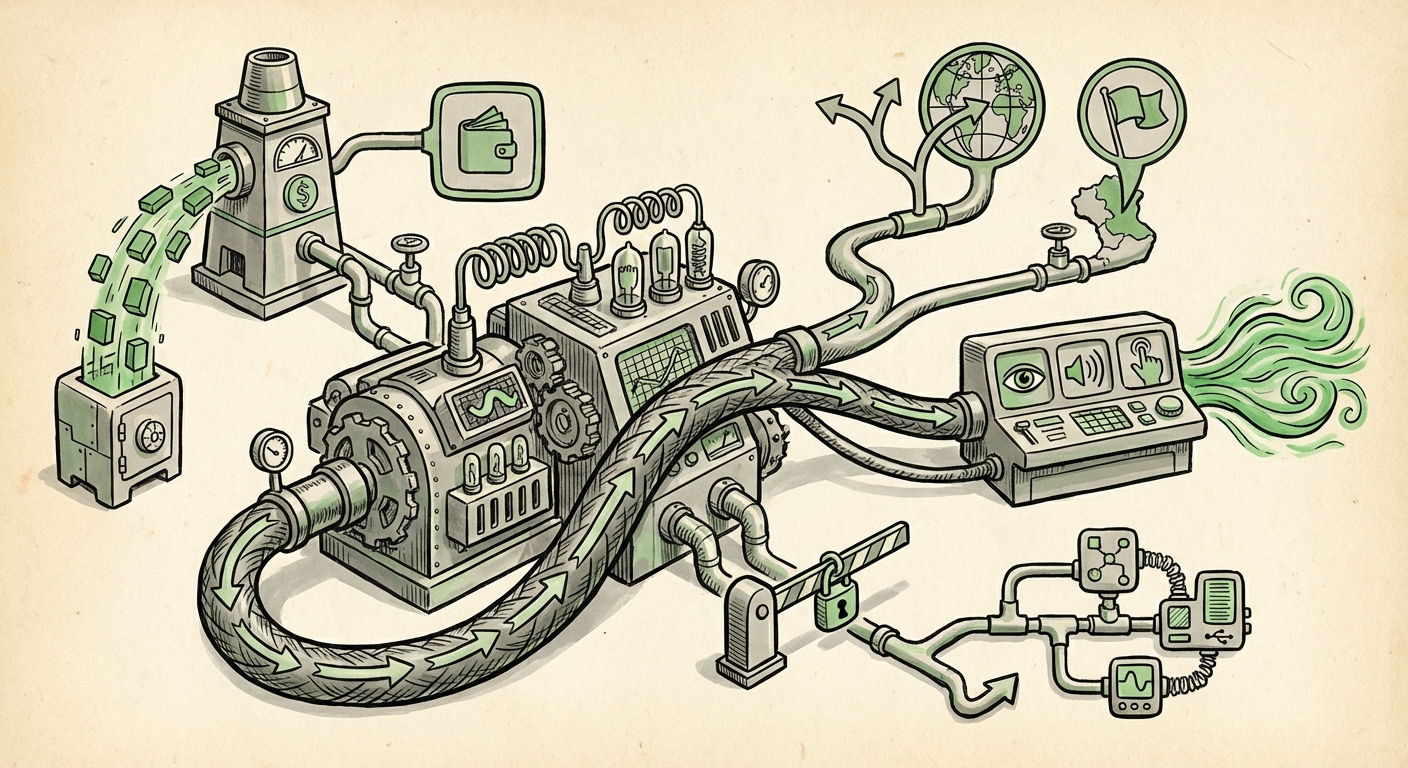
The phrase "transfer dynamics" is the study of exactly this boundary. It asks: which capabilities hop the fence from text to vision, how fast do they hop it, and what happens to the ones that don't?
This is where things get practical. If abstract reasoning transfers reliably, then the cheapest path to a strong vision model is to build the strongest possible language model first and let vision inherit the benefits. If it doesn't transfer, then pouring money into language capability is the wrong lever entirely, and you need a different strategy.
Why This Is the Right Question at the Right Time
The AI industry has spent years pushing language models forward. The assumption has been that this progress compounds, every gain in one area lifts everything else.
That assumption deserves scrutiny. And the framing of this work suggests it is being scrutinized.
Think about what it would mean if capability scaling laws hold differently for vision than for text. It would mean:
- Forecasting gets harder. You could no longer look at how much text a model has processed and guess how well it reads images.
- Data strategy changes. Visual capability might depend more on the quality and variety of images than on sheer volume of text.
- Product timelines shift. Teams building vision-heavy products would need their own roadmap, not a hand-me-down one from language teams.
- Scaling gets more expensive. If improvement in one sense doesn't lift the other, you have to invest in each separately. That is a real financial difference.
None of this means VLM progress is slowing. It means the path forward may be less of a straight line than many assumed.
What This Means for the Future of AI
Three big shifts follow from asking better questions about transfer.
1. The single-model dream gets more complicated
The long-term goal for many builders is one system that handles text, images, audio, and more, with skills flowing freely between them. This research direction suggests that dream may require more careful engineering than simply "add another input type." If transfer is partial, then multimodality is not a single problem, it is a set of distinct problems that happen to share a body.
2. Measurement becomes a competitive advantage
If capabilities transfer unevenly, then the companies that understand which capabilities transfer will out-build the ones that only look at overall scores. Published capability scaling laws and transfer dynamics are effectively a map of where effort pays off. That map is going to matter more than raw leaderboard position.
3. Vision gets its own research agenda
For years, vision research has leaned on language research for breakthroughs. If the transfer is one-directional or incomplete, that dependence starts to look like a bottleneck. Expect more focus on what is uniquely hard about seeing, spatial understanding, physical intuition, real-world grounding, rather than treating images as just another kind of text.
Practical Implications for Businesses
For anyone actually deploying AI, this is not academic. Here is what the framing means in operational terms.
Don't assume a text upgrade is a vision upgrade
When a new model version arrives, teams often assume everything improves at once. This line of research suggests you should test vision-heavy workflows on their own. Re-run your image tasks. Don't let a good text benchmark convince you that your document-processing or quality-inspection pipeline improved.
Split your evaluation by capability, not by model
Instead of one score for "how good is this model," build a scorecard: reading charts, reading handwriting, spotting defects, understanding scenes, following visual instructions. Different capabilities likely scale at different rates. Your procurement decisions should reflect that.
Budget for separate workstreams
If visual skill needs its own investment, better image data, better labeling, targeted fine-tuning, then your AI budget should not be a single line item. Treat language and vision as two programs that share a goal.
Revisit your risk assumptions
Partial transfer cuts both ways. It means a system that is excellent at text may fail in surprising ways on images, even in cases that seem obvious to a human. High-stakes visual use cases, medical, industrial, safety, accessibility, need human checkpoints precisely where transfer is weakest.
Actionable Steps You Can Take Now
- Audit your visual AI tasks. List every workflow where the AI looks at an image. Rank them by cost of failure.
- Test capabilities separately. Build a small, specific test set for each visual skill you depend on.
- Ask vendors the hard question. Not "how good is it on benchmarks?" but "what evidence do you have that text capabilities transfer to my visual use case?"
- Watch the research direction. Capability scaling laws and transfer dynamics are the vocabulary the field is moving toward. Teams that speak it will make better build-versus-buy calls.
- Keep humans where transfer is weak. Grounded, physical-world judgments are the most likely to be the weak spot. Design your review process around that.
The Broader Picture for Society
There is a public-interest angle here too. Vision-language models are increasingly used in accessibility tools, education, healthcare, and public services. If we overestimate how much capability carries over from language, we risk deploying systems that sound confident and competent but miss what's actually in front of them.
Understanding transfer is not just an engineering nicety. It is a safety issue. It tells us where a model's confidence is earned and where it is borrowed.
The Bottom Line
"What Transfers from Text to Vision?" is the kind of question that looks narrow and turns out to be foundational. It asks the AI field to stop assuming that progress in one ability automatically pays off in another, and to start measuring the connections between them honestly.
The bigger message for builders and buyers alike is this: more intelligence in text does not automatically mean more intelligence in sight. The companies that figure out which skills make the jump, and which stay behind, will build better products, waste less money, and deploy AI more safely. Everyone else will keep guessing.