SpaceX Just Launched 21 Data Satellites for the Space Development Agency, And It's a Much Bigger Deal for AI Than It Sounds
On October 10, 2026, SpaceX launched 21 data satellites for the Space Development Agency. If you blinked, you probably missed it. Rocket launches have become almost routine. But this one deserves a closer look, because it marks a quiet but important shift in how artificial intelligence will work in the coming decade.
Here's the short version: AI needs data. Data needs to move. And right now, most of the planet's data still moves through cables on the ground, towers on hills, and data centers in specific cities. When you put a working mesh of data satellites into orbit, you start to break that limitation. You can move information from almost anywhere on Earth to almost anywhere else, fast, and without needing a cell tower in sight.
That changes what AI can do, where it can run, and who gets to use it. Let's break down what actually happened, why it matters, and what businesses should be thinking about right now.
What Actually Happened
SpaceX launched 21 satellites designed to move data for the Space Development Agency. These aren't scientific observatories or weather instruments. They are data satellites, the plumbing of a space-based network. Their job is to receive information, relay it, and pass it along to other satellites, ground stations, or users below.
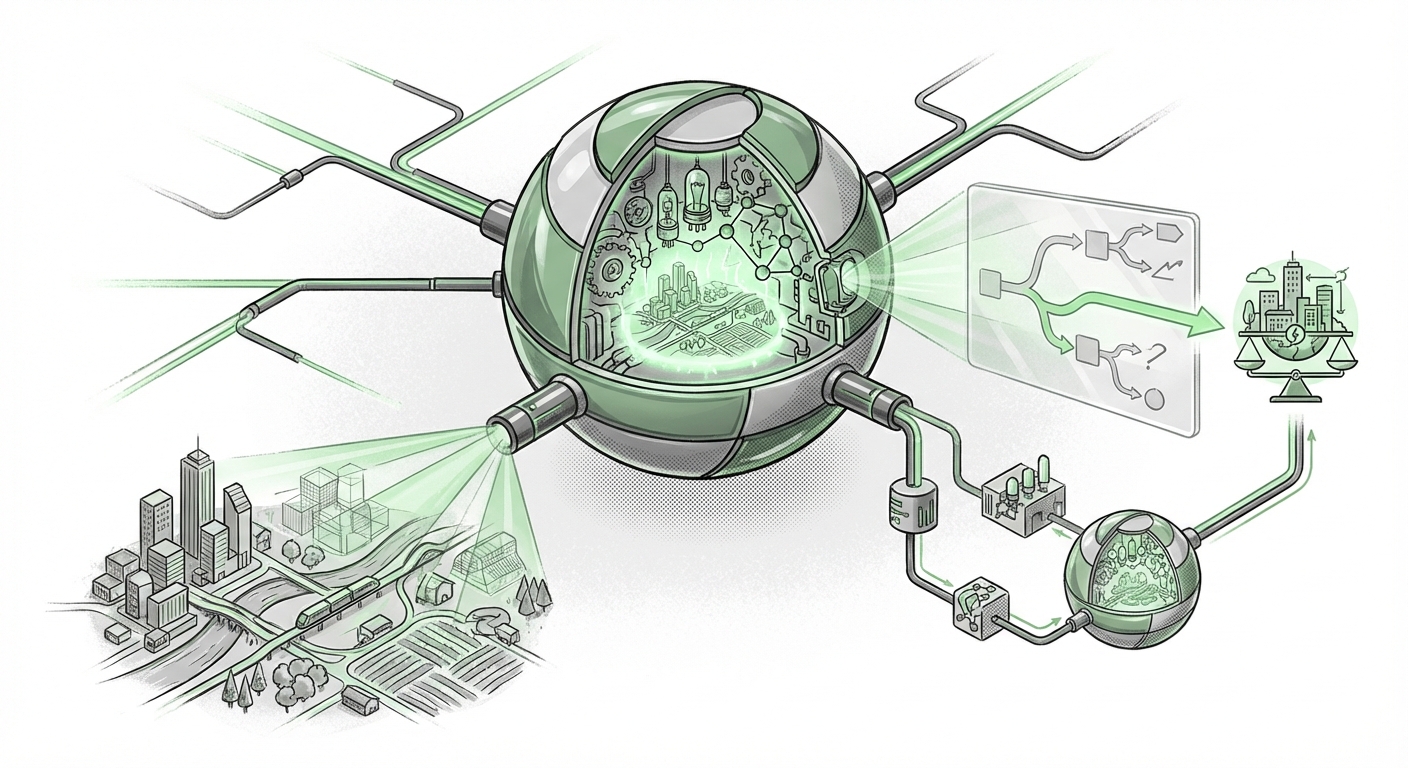
Think of them less like a single powerful computer and more like a set of really tall, really fast cell towers that happen to be orbiting the planet at thousands of miles per hour. Individually, each one is a node. Together, they form a mesh, a web of connections where data can hop from one satellite to the next until it reaches its destination.
The number matters too. Twenty-one satellites in a single launch points toward a proliferated architecture: many smaller, cheaper satellites working as a team, rather than a handful of giant, expensive ones. That design choice has huge implications for reliability, cost, and, most importantly for us, how much data can flow.
Why Data Satellites Are Really AI Satellites
The connection between satellites and AI isn't obvious at first. But it becomes clear when you look at the biggest bottleneck in AI today.
Most people assume the hard part of AI is the model, the brain that does the thinking. In reality, the hard part is often the data pipeline: getting raw information from where it's created to where a model can use it. That pipeline has limits. Bandwidth limits. Latency limits. Geography limits.
If a sensor sits in the middle of an ocean, a desert, a mountain range, or a rural farmland, getting its data into a data center quickly is genuinely hard. Fiber doesn't reach there. Cellular coverage is spotty or nonexistent. So the data waits, sometimes hours, sometimes days. And an AI model that gets data hours late can't help much in the moment.
Space-based data networks attack that problem directly. Orbit is a shortcut over the top of geography. A satellite can see a ship in the middle of the Pacific and a ground station in the middle of a continent in the same pass. When you have dozens or hundreds of these nodes linked together, you get something that looks a lot like a global internet backbone, but with coverage that reaches places wires never will.
That's the unlock. More coverage plus lower latency equals more AI in more places.
The Real Trend: AI Is Moving to the Edge (Including Orbit)
There's a second, subtler shift hiding in this launch. Satellites increasingly don't just move data. They process it.
Here's the problem: modern sensors generate an enormous amount of raw data. A high-resolution camera, a radar, a radio listener, each one can produce far more information than a downlink can carry. You physically cannot send everything to the ground. Something has to decide what's worth keeping.
Increasingly, that decision gets made by an AI model running onboard the satellite itself. The model looks at the stream, spots what matters, and sends down only the interesting part. A cloud of smoke. A ship that's off its expected route. A change in a field. Everything else gets discarded in orbit.
This is the same pattern happening everywhere in computing right now. Your phone runs AI locally instead of sending every photo to a server. A factory camera runs a vision model on the machine instead of round-tripping to the cloud. Satellites are simply the most dramatic example of edge inference, AI that runs close to where the data is born.
Data satellites make that pattern more powerful. Once you have a fast, always-available network in the sky, you can combine onboard AI with ground AI. The satellite does the first pass. The ground does the deep analysis. Both get better because the connection between them is fast and reliable.
What This Means for Businesses
You don't have to work in aerospace to care about this. Here's where the impact shows up in practical terms.
1. Operations in remote places get real-time AI
Mining, shipping, agriculture, energy, and disaster response all happen in places with weak connectivity. Today, AI support for those operations is often delayed or limited. A reliable orbital data layer changes that. A ship's engine can be monitored in real time by a model on shore. A field can be analyzed while the tractor is still driving. A fire can be spotted and tracked within minutes, not hours.
2. New data products become possible
When data can move freely from anywhere, entirely new products appear. Think about monitoring of supply chains across oceans, tracking of environmental change at a global scale, or insurance models that price risk based on live conditions rather than last year's reports. Each of these depends on data that historically was too slow or too expensive to gather continuously.
3. The "no signal" assumption starts to die
A lot of software is written with the assumption that connectivity might vanish. Apps cache data. Devices go offline. Systems build in forgiveness for gaps. As orbital networks mature, more of those assumptions get revisited. Products designed for "connected almost everywhere" can be simpler, faster, and more useful than products designed for "connected sometimes."
4. Resilience becomes an AI feature
A proliferated constellation of many satellites is harder to disrupt than a small number of large ones. For businesses that depend on continuous data, logistics, finance, agriculture, that resilience is not a nice-to-have. It's the difference between a model that works and a model that goes blind for six hours.
The Risks and Open Questions
Nobody should pretend this is all upside. A few real concerns deserve attention.
- Security. Every new node in a network is a potential entry point. A mesh of hundreds of satellites creates a large attack surface, and the data flowing through it is often sensitive.
- Governance. Data that crosses borders in orbit raises hard questions about whose laws apply. This is unresolved, and it will slow some use cases down.
- Orbital congestion. More satellites means more traffic and more debris risk. The regulatory and engineering challenges here are real and growing.
- Who benefits. Faster global data could concentrate advantage in the organizations that can afford to build on it, or it could spread capability to places that never had it. Which outcome wins depends on policy and pricing, not just technology.
Actionable Takeaways
If you're trying to figure out what to do with all this, here are concrete starting points.
- Audit your latency assumptions. Find the places in your business where decisions are delayed because data arrives late. Those are the first candidates for improvement.
- Separate "must be real-time" from "nice to be real-time." Only a fraction of your data actually needs to move instantly. Know which fraction that is.
- Start experimenting with edge inference. Running small models close to sensors reduces your dependence on any network, ground or space.
- Watch the policy conversation. Cross-border data rules for satellite networks are being shaped now, and they will determine what's legal to build later.
- Design for "mostly connected." Products that assume near-constant global connectivity can offer a better experience than those built around worst-case gaps.
- Track constellation growth, not single launches. One launch is a data point. A pattern of launches is a trend. The trend is what changes strategy.
The Road Ahead
It's tempting to treat a rocket launch as a spectacle and move on. But the more interesting story is what happens after the satellites are in place. Each new node makes the network slightly more useful. Each improvement in onboard AI makes the data flowing through it slightly more valuable. Those two curves reinforce each other.
The long-term picture is a planet wrapped in a layer of fast, mostly reliable data movement, with AI running at both ends and, increasingly, in the middle. When that layer is complete, the question stops being "can I get the data?" and becomes "what should I do with it?" That's a very different world for businesses, governments, and anyone building with AI.
Twenty-one satellites won't get us there on their own. But they're another brick in the wall. And the wall is rising faster than most people realize.