Retail Holiday Hiring Is Slumping Again, and AI Is Quietly Filling the Gap
Retail's holiday hiring push for 2026 is shaping up to be worse than last year's disappointing run. That is not just a footnote about temp jobs. It is a signal about how fast artificial intelligence is moving into the places where seasonal workers used to stand.
For decades, the holiday season worked like clockwork. Stores hired up. Warehouses bulged. Delivery vans multiplied. The number of seasonal jobs was a rough scorecard for how confident retailers felt about the months ahead. When those numbers drop, something bigger is usually going on behind the scenes.
This year, the drop points in one clear direction: retailers are leaning harder on AI, and leaning less on people they would have to hire, train, schedule, and let go again in January.
What Makes This Year Different
A soft holiday hiring season can happen for ordinary reasons. Shoppers might be cautious. Inventories might be bloated. Retailers might be playing it safe after getting burned before. All of that matters.
What stands out now is the pattern. Last year's holiday hiring was already seen as disappointing. Instead of bouncing back to normal, this year is tracking worse. Two weaker seasons in a row is not a blip. It looks more like a new baseline, and that baseline was set at the same time AI tools were being pushed into almost every corner of retail operations.
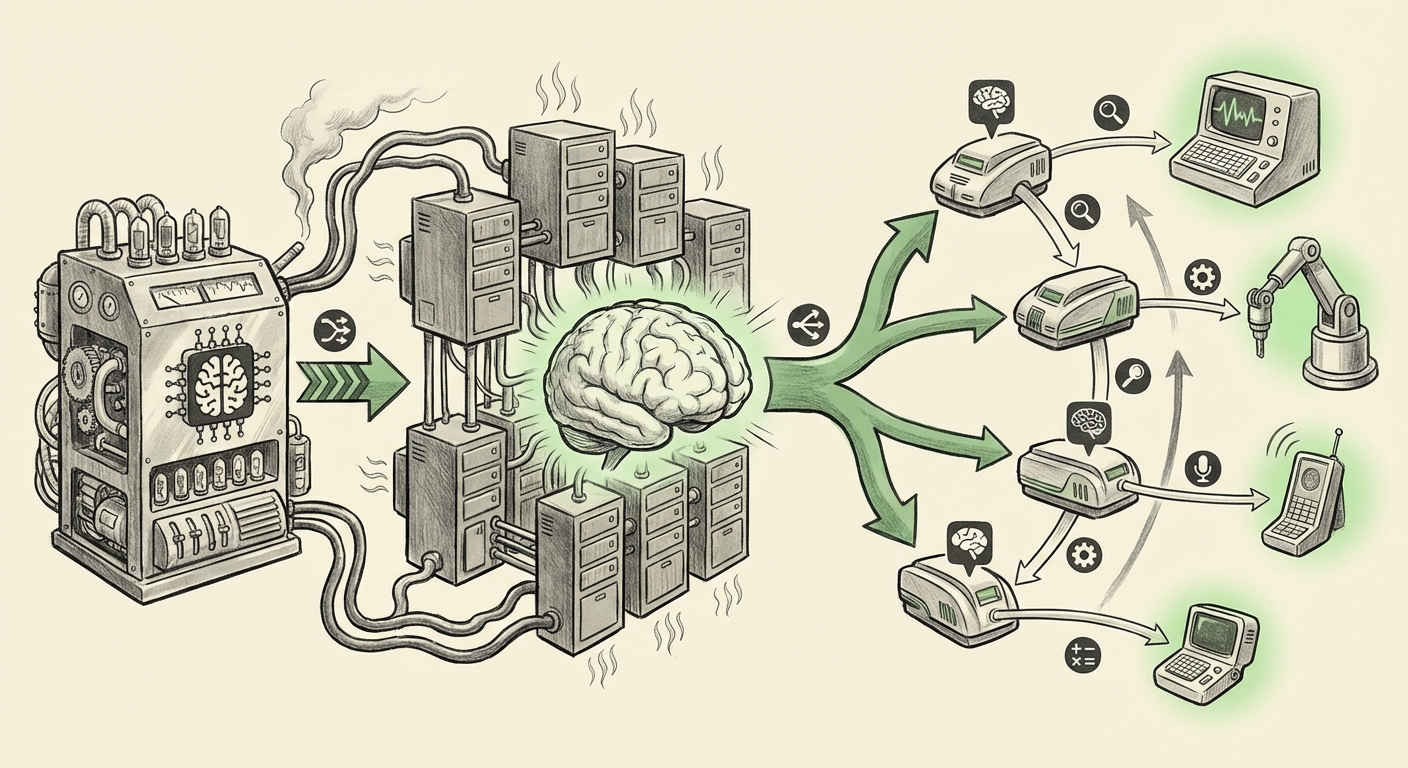
The timing is not a coincidence. Over the past few years, retailers have quietly wired AI into forecasting, scheduling, customer service, checkout, pricing, and warehouse work. Each of those systems removes a slice of seasonal demand for human labor. Add the slices together, and the holiday hiring push gets smaller.
Where AI Is Taking Over Seasonal Work
It helps to look at the holiday season as a chain of tasks. Each link used to require a burst of extra people. Today, more of those links are handled by software.
Forecasting and inventory planning
Predicting what shoppers will buy, and how much of it, used to be part guesswork and part experience. AI models now chew through years of sales data, weather patterns, local events, and social signals to produce forecasts that are far more accurate. Better forecasts mean fewer panic orders, fewer emergency hires, and fewer workers needed to sort out mistakes.
Scheduling and shift management
Holiday staffing used to mean a manager with a spreadsheet and a headache. Now, AI scheduling tools match worker availability to predicted foot traffic and order volume, often hour by hour. These systems are built to run lean. A store that once added six seasonal workers might now add four.
Customer service
Every holiday season brings a flood of the same questions: Where is my order? Can I return this? Is it in stock? Chatbots and voice assistants now handle a large share of these, day and night, without adding headcount. The humans who remain handle the hard cases, which means fewer of them are needed during peak weeks.
Checkout and store operations
Self-checkout lanes, mobile scanning, and computer-vision loss prevention reduce the number of cashiers and floor staff a store needs during a rush. This is not new, but each year the systems get better and the coverage gets wider.
Warehouse and fulfillment
Robots that pick, pack, and move goods have moved from experiments to everyday equipment. AI coordinates them so a warehouse can handle a holiday spike with a smaller temporary crew than it would have needed five years ago.
The Real Story: Not Job Loss, but Job Redesign
It would be too simple to say AI is replacing holiday workers one for one. The truth is messier and more interesting.
What is happening is a redesign of the seasonal workforce. The jobs that vanish first are the ones that are easiest to describe as a set of steps: greet, scan, answer, restock, route. Those steps are exactly what today's AI and automation handle best.
The jobs that remain are shifting toward supervision, exception handling, and relationship work. Someone still has to fix the robot, override the bad forecast, calm the angry customer, and manage the team. Those roles are fewer, but they often pay more and demand more skill.
That shift is good news for some workers and bad news for others. A person who can operate and troubleshoot AI systems has a future in retail. A person whose only qualification was availability during December does not.
What This Means for the Future of AI
The holiday hiring slump tells us several things about where AI is heading next.
1. AI adoption is now measured in payroll, not press releases. Companies have talked about AI for years. The clearest proof of adoption is not a demo video, it is a smaller seasonal hiring plan. When retailers stop staffing up, they are telling you the software works.
2. The next wave will target middle-skill work. The first wave of automation hit repetitive tasks. The next wave, powered by large language models and better robotics, will move into coordination, scheduling, and customer interaction, jobs that once felt safe.
3. Peak seasons are becoming the testing ground. Holiday spikes are the perfect place to prove AI systems under pressure. What works in December becomes the default for the rest of the year. Expect every slow season to accelerate the next round of automation.
4. The advantage will go to the flexible. Retailers that mix AI with a small, well-trained core team will outperform those that rely on a big pool of temporary workers. Speed and accuracy will beat sheer headcount.
Practical Implications for Businesses
If you run a business that depends on seasonal labor, the message is clear: standing still is the riskiest move.
- Audit your peak-season workflow. List every task that spikes during your busy season. Mark which ones AI or automation could handle, even partially.
- Invest in forecasting first. Accurate demand prediction is the foundation. It reduces waste everywhere else and often pays for itself within a season.
- Retrain before you replace. The workers who know your business are your best resource for running new systems. Give them the skills to supervise AI rather than compete with it.
- Plan for a smaller, sharper team. Design your peak staffing around a trained core crew plus AI tools, not a large pool of temps you scramble to hire.
- Watch the customer experience. Cutting staff too fast can backfire. AI should free people to help customers, not leave them stranded when something goes wrong.
Practical Implications for Society
The bigger picture is harder. Seasonal work has long been a first rung on the ladder, a way for students, caregivers, and people re-entering the workforce to earn money and gain experience. If that rung gets shorter every year, the ladder itself changes shape.
Policymakers and communities will need to think about three things:
- Training that matches the new jobs. The demand is not disappearing. It is moving toward technical and supervisory skills. Training programs need to keep up.
- Income stability. Fewer seasonal slots mean fewer short-term income options for people who rely on them.
- Fair transition. Automation benefits should not land only at the top. Companies that profit from AI-driven efficiency have a role to play in helping displaced workers move up, not out.
Actionable Insights for the Year Ahead
Here is what to do with all of this, whether you are a retailer, a technologist, or a worker.
- For retailers: Treat AI as a year-round strategy, not a holiday fix. The companies seeing the biggest gains are the ones that trained their teams and refined their tools long before the rush.
- For tech builders: Build for the frontline, not the boardroom. Tools that a store manager can learn in a day will win over tools that need a data team.
- For workers: Get comfortable with the tools. Learning how to work alongside AI systems is now the single best way to stay employable in retail and logistics.
- For investors: Watch seasonal hiring numbers as a leading indicator. They are one of the few public signals that show AI adoption in real dollars and real hours.
The Bottom Line
Retail's holiday hiring push for 2026 is weaker than last year's already disappointing run. On the surface, that looks like caution about the economy. Underneath, it looks like something more permanent.
AI is not waiting for a formal invitation into retail. It is already in the forecast, the schedule, the chatbot, the warehouse, and the checkout lane. Each season, it takes on a little more of the work that used to require a temporary hire.
That does not mean the holiday season is over for human workers. It means the work is changing, from doing the task to overseeing the system that does it. The retailers, workers, and communities that adapt to that shift fastest will be the ones that thrive. The ones that keep hiring the way they always have may find themselves with a bigger payroll and a smaller advantage.