When AI Gets the Wrong Story: The Source Fidelity Problem Shaping the Future of AI Content Systems
Here is what landed in our pipeline this week, tagged as an artificial intelligence trend story: Ameer Abdullah returned a kick in the final seconds, set up a game-winning field goal, and the Jacksonville Jaguars beat the Philadelphia Eagles on October 11, 2026.
That is a great football moment. It is not an AI story. Yet somewhere between intake and output, a system decided it was one.
A human editor spots that mismatch in about a second. An automated pipeline often does not spot it at all. And that gap, between what an AI system thinks it has been handed and what it has actually been handed, is one of the most consequential problems in AI right now. It is also one of the least glamorous, which is exactly why it keeps getting ignored.
The Real Story Is Not Football. It Is Routing.
Most public conversation about AI focuses on the model: how smart it is, how fast it writes, how well it reasons. That is like judging a football team only by its quarterback. The quarterback matters, but the play only works because eleven people know their assignment and the ball goes to the right place.
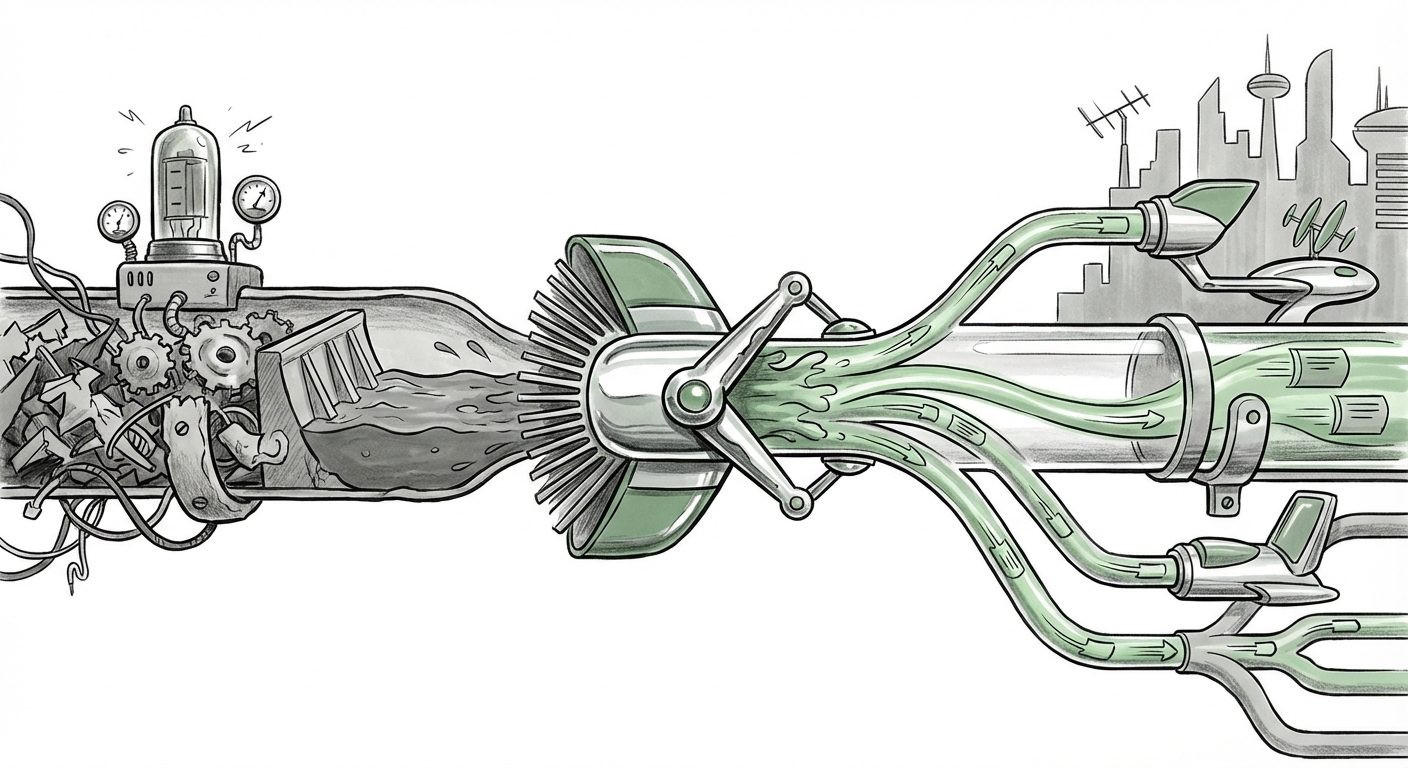
Modern AI systems are increasingly built as pipes. Something comes in, a document, a record, a bundle of text, a data feed. Something gets classified. Something gets generated. Something gets published, filed, or acted upon. The model sits in the middle of that pipe, and it is usually the most capable part of the whole chain.
The fragile part is the intake. The routing. The moment where a system decides what kind of thing it is looking at.
A return that turns into a game-winning drive is a perfect metaphor for what good AI operations look like. It looks chaotic from the outside. It is actually a chain of small, correctly executed handoffs. Miss one handoff and the whole play dies at the twenty-yard line.
Why Misfiled Inputs Are the Quiet Failure Mode of AI
When a large language model is asked to summarize or analyze something, it rarely says "I do not know what this is." It says something. That is the entire point of these systems, and it is also the entire problem.
Feed a model a sports recap and ask it to write an AI trends article, and you will often get an AI trends article, one built on football. The model did not lie. It answered the question it was given. The failure happened one layer up, where nobody checked whether the question matched the material.
Three things make this failure mode worse than it used to be:
- Speed. Automated systems publish in seconds. There is no natural pause where a mistake gets noticed.
- Fluency. Modern output reads confidently regardless of whether it is grounded. Confident wrong content is harder to catch than clumsy wrong content.
- Scale. One bad routing rule does not produce one bad article. It produces thousands before anyone sees the first one.
This is why the most valuable AI work happening inside organizations today is not prompt engineering. It is plumbing.
Trend One: Verification Is Moving Upstream
For the past few years, teams put their effort into checking output, reading drafts, running fact-check tools, adding human reviewers at the end of the line. That is expensive, slow, and it catches problems only after the work has been done.
The shift now is toward checking input. Does this document actually belong to the category it claims? Does the metadata match the content? Is the label on the envelope consistent with the letter inside?
It is a much cheaper check. Classifying a document takes a fraction of the effort of generating from it, and catching a mismatch at intake prevents every downstream error at once. In football terms, it is reading the defense before the snap instead of trying to fix things after the ball is in the air.
Trend Two: Provenance Becomes a Product Feature
Buyers increasingly want to know where information came from. Not as a legal formality, but as a trust signal. If a system says a fact, the user wants a trail back to the origin.
That means the future of AI tools includes packaging that looks a lot like shipping labels: what is this, where did it come from, when was it captured, what is it allowed to be used for. Systems that carry their own context are far harder to misfile.
The football bundle here illustrates the point nicely. It arrived with a label. The label was wrong. Without an independent way to verify the label, every step afterward inherited the error.
Trend Three: Agents Are Getting Narrower, Not Smarter
There is a popular image of the future where one giant AI assistant handles everything. The operational reality is moving the other way. The systems that work reliably are the ones with tight, well-defined jobs.
A narrow system that only handles sports recaps will never write an AI trends article about a kick return. A general system asked to do both will eventually do both badly.
Specialization is not a step backward. It is how you build a chain of handoffs where each link does one thing correctly, which is precisely how the play that beat the Eagles actually worked. Nobody on that field was doing everything. Everybody was doing their one job at the right moment.
Trend Four: Human Review Gets Redesigned, Not Removed
The naive version of human-in-the-loop is a person reading everything the machine produces. That does not scale, so teams quietly abandon it, and then they are surprised when quality slips.
The smarter version puts humans where judgment matters most: at the intake gate, at the category boundary, and at the exception. A reviewer does not need to read a thousand outputs. They need to catch the one input that does not belong.
This is a much better use of human attention, and it is the model most mature AI operations are converging on.
What This Means for Businesses
The practical stakes are higher than they look. A misfiled input is not just an awkward article. In an enterprise setting it can mean a contract clause summarized under the wrong policy, a customer record processed under the wrong rules, or a compliance document routed to the wrong team.
Three implications stand out:
- Cheap checks beat expensive fixes. A five-second validation at intake is worth more than an hour of cleanup downstream.
- Trust is a compounding asset. One visibly wrong output damages confidence in every correct output that came before it.
- Accountability needs an owner. "The AI did it" is not a defense. Somebody owns the routing rules, and that person needs to be findable.
The organizations getting real value from AI right now are not the ones with the most advanced models. They are the ones whose pipes do not leak.
What This Means for Society
At scale, misfiled inputs become a public information problem. When content is generated quickly and published confidently, the label on a story starts to matter as much as the story itself. A reader who is told something is about AI will read a football recap and assume they misunderstood, not that the system did.
The defense is not better writing. The defense is better annotation, better provenance, and a culture where it is normal, and cheap, to stop a piece of content before it moves. Systems that make it easy to say "this does not belong here" will do more for information quality than systems that make it easier to generate.
A Practical Playbook
If you run or buy AI content systems, these are the moves worth making now:
- Validate at intake. Confirm that the material matches its label before anything is generated from it.
- Force an explicit category decision. Make the system name what it is looking at rather than skipping straight to output.
- Give systems an escape hatch. A pipeline that can output "this does not fit any category" is safer than one that must always produce something.
- Log the chain. Keep a record of what arrived, how it was classified, and why. When something goes wrong, this is what saves you.
- Audit the boundaries, not just the output. Spend review time on the odd inputs, not the typical ones.
- Design for the misfire. Assume something will be routed wrong eventually. Make sure the cost is small and the discovery is fast.
The Four-Minute Drill for AI Teams
Great special teams units practice the return over and over. Not because returns are common, but because when one happens, everyone has to execute without thinking. The block that springs the returner, the lane discipline, the decision to take it out of the end zone, none of it works alone.
AI pipelines are the same. The exciting part is the return: a fast model, a big capability jump, a headline result. The part that decides games is the blocking, intake, classification, verification, provenance, handoff.
The story that arrived mislabeled this week is not a scandal. It is a signal. It shows exactly where the weak joints are in a system that otherwise looks impressive, and it shows why the next phase of AI adoption will be judged less on what models can produce and more on whether the pipes delivering the inputs are trustworthy.
The teams that win the next few years will not be the ones with the loudest model. They will be the ones whose ball ends up in the right hands at the right moment, every time, including on the plays nobody practiced for.