AI Takes the Controls: What Moon Cities and Drone Traffic Controllers Mean for the Future of AI
Two stories landed side by side in the news cycle on October 12, 2026. At first glance, they have nothing to do with each other. One is about the messy, unglamorous problems of building a city on the moon. The other is about a new class of software that acts like an air traffic controller, but for drones.
Look closer, and they are the same story. Both are about artificial intelligence moving out of the chat box and into the control room. Both are about machines making decisions in the real world, in real time, where a mistake is not an embarrassing answer, it is a crash, a leak, or a loss of life.
That shift is the biggest thing happening in AI right now. Bigger than any single model release. And these two headlines show exactly why.
Why a Moon City Is Really an AI Problem
A city on the moon sounds like a construction challenge. It is actually a control challenge.
Think about what has to happen every single minute in a habitat on the lunar surface. Air has to be cleaned and recycled. Water has to be captured, filtered, and reused. Power has to flow from solar panels and batteries. Temperature swings of hundreds of degrees have to be managed. Dust has to be kept out of seals and joints. And every one of those systems depends on the others.
Now add the hardest part: you cannot call home for help fast enough. A command sent from Earth to the moon takes time to arrive, and the answer takes just as long to come back. If something goes wrong, the people on the surface, or the robots doing the work, have to handle it themselves.
That is where AI comes in. A habitat like this needs software that can watch hundreds of sensors at once, spot a problem forming before it becomes a failure, and act. It needs to decide which system gets power when the batteries are low. It needs to tell a robot which repair to do first. It needs to keep working even when the plan it was given no longer fits the situation.
The problems that come up with moon cities, in other words, are not really about rockets. They are about autonomy under pressure. They are about what happens when AI has to handle the strange, rare, never-seen-before event, the "long tail" of things that go wrong.
And that is exactly the problem that every serious AI operator on Earth is now wrestling with too.
Drones Need a Brain in the Sky
Meanwhile, the airspace just above our heads is filling up.
Delivery drones, inspection drones, agricultural drones, emergency drones, the numbers keep climbing, and the flights keep getting closer together. Human air traffic controllers already manage the busiest parts of the sky. They cannot also hand-hold thousands of small aircraft flying at low altitude through cities, suburbs, and industrial sites.
So the job is going to software. An AI drone traffic controller has to do something quite different from a chatbot. It has to:
- Track many aircraft at once, in three dimensions, in real time.
- Predict where each one will be seconds from now, not just where it is.
- Spot conflicts, two paths that will cross, and resolve them before they happen.
- React to weather, restricted zones, and sudden emergencies like a failing battery.
- Explain its decisions, because someone will need to know why it told a drone to turn.
Notice how little of that sounds like "generating text." This is operational AI: software that is judged not on how clever it sounds, but on whether it keeps working when the world gets messy.
The Common Thread: AI Becomes Invisible Infrastructure
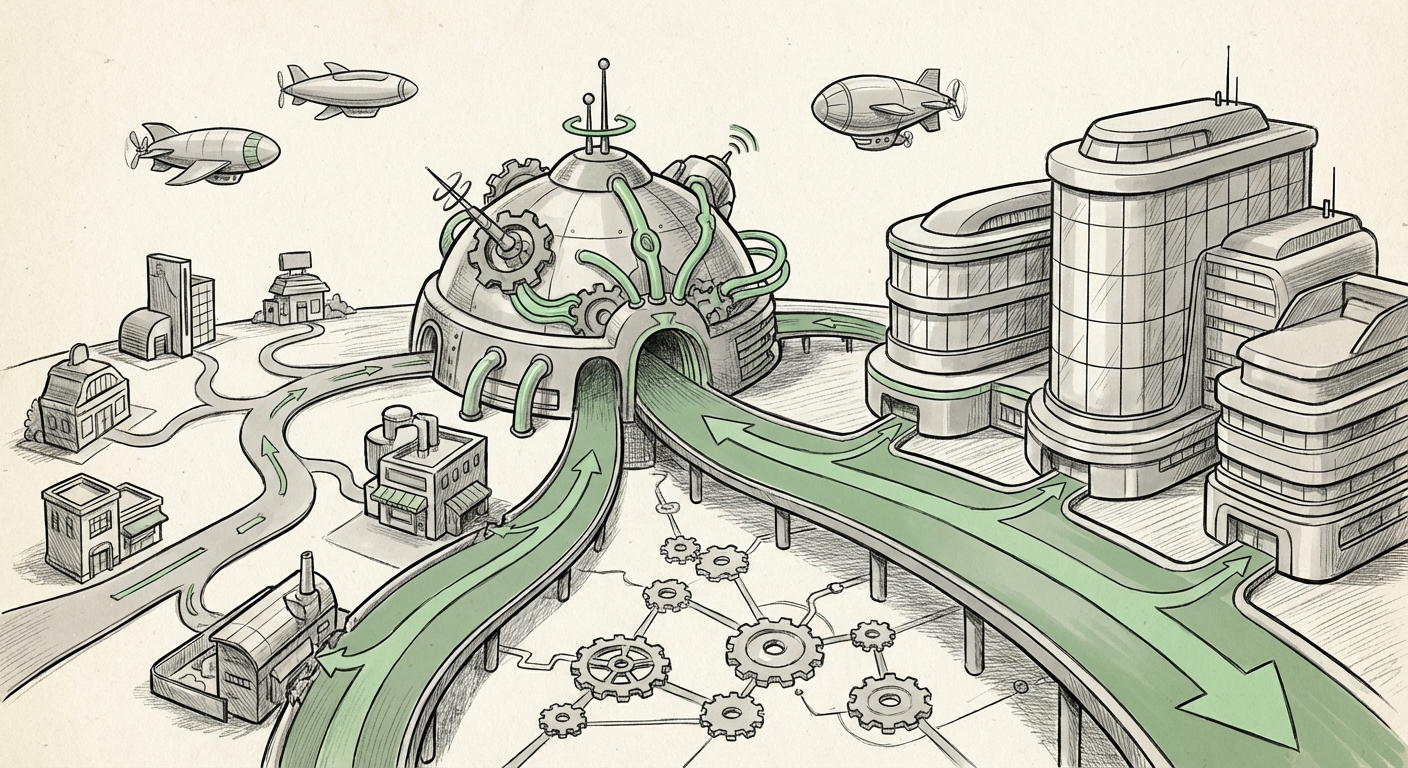
Put the moon city and the drone controller together and a pattern jumps out. In both cases, AI is not a product you talk to. It is a layer of infrastructure you stop noticing, until it fails.
That changes what "good AI" means. Three requirements show up again and again in both settings:
1. Real-time decisions
Some choices cannot wait for a human to click approve. The system has to act now and explain later. That puts a hard limit on how big and slow a model can be, and it pushes processing out to the edge, closer to the sensor, closer to the drone, closer to the habitat wall.
2. Verifiable behavior
In a chat, a weird answer is a joke. In a habitat or an airspace, it is a crisis. So operators need systems that can be tested against thousands of simulated disasters before they are trusted in the real world. Digital twins, software copies of the habitat, the sky, the factory, become the proving ground.
3. Graceful failure
No system is perfect. The question is what happens when it is wrong. Does it freeze? Does it do something dangerous? Or does it fall back to a safe mode, flag the problem, and hand control to a human who can still fix things? Safe failure is a design goal, not an afterthought.
What This Means for Businesses Right Now
You probably are not building a moon base. But you may be running a warehouse, a grid, a hospital, a port, or a supply chain. The lessons transfer directly. Here is what to do with them.
- Find your real-time bottlenecks. Look for places where decisions must be made faster than a person can reasonably decide. Those are your first AI targets, not the flashiest ones, the fastest ones.
- Build a simulator before you build the agent. If you cannot rehearse the AI against a realistic copy of your environment, you cannot trust it in production. Simulation is cheaper than an outage.
- Design the handoff, not just the automation. Decide in advance when a human takes over, what they see, and how quickly they can act. The handoff is where most failures actually happen.
- Treat explainability as an operations tool. Your engineers will need to know why the system did what it did. If the answer is "we don't know," you have a liability, not a product.
- Expect certification to become a moat. Proving that your AI is safe in a regulated environment is hard. That difficulty is exactly what will protect the companies that do it first.
- Clean your data now. Operational AI lives or dies on sensor quality. Messy inputs produce confident, dangerous outputs.
The Rules Are Chasing the Technology
Here is the uncomfortable part. The technology is arriving faster than the rulebooks.
Who is responsible when an autonomous system makes a bad call? The company that built it? The operator who switched it on? The person who wrote the safety limits? Right now, in most places, the answer is unclear, and unclear liability slows everything down.
Aviation offers a hint of what comes next. That industry built a safety culture over decades: strict testing, mandatory reporting, and a habit of learning from every near-miss. Space and drone operations are heading toward the same model, because there is no other way to make autonomy trustworthy. Expect to see licensed AI operators, required simulation records, and incident reporting systems become normal, first in the air, then in energy, transport, and healthcare.
Jobs Will Shift, Not Just Disappear
The common fear is that autonomous systems wipe out work. The more likely reality, seen in both the moon base and the drone corridor, is a reshuffling.
New roles appear fast: people who supervise fleets of agents, people who design simulations, people who write safety envelopes, people who investigate AI mistakes the way accident investigators do today. These jobs reward judgment, not just coding. They sit between the engineer and the manager, and there are not nearly enough people trained for them yet.
The organizations that win will be the ones that start building this workforce now, before the technology forces their hand.
What to Watch Next
Three signals will tell you how fast this is moving.
First, cross-domain borrowing. When techniques proven in spaceflight and air traffic start showing up in factories, power grids, and hospitals, the shift has gone mainstream.
Second, insurance and certification. When insurers and regulators start demanding evidence of AI safety testing as a condition of doing business, the market has changed shape.
Third, the quiet wins. The most important AI progress of the next few years may not produce a single viral demo. It will look like fewer delays, fewer accidents, and systems that simply work, unnoticed, in the background, doing the job.
The Bottom Line
A city on the moon and a swarm of delivery drones seem like opposite ends of the imagination. One is distant and grand, the other mundane and overhead. But they point to the same future: AI that does not talk about doing things, AI that actually runs things.
That future will be built on simulation, safety limits, clear human handoffs, and a lot of unglamorous testing. It will be slower than the hype suggests and far more consequential than the hype admits. And the businesses that start preparing for it now, by finding their real-time bottlenecks and building the guardrails first, will be the ones still standing when the machines take the controls.