Using AI to Solve the 2048 Game: What a 2014 Java Project Reveals About the Future of AI
In April 2014, a project appeared that used artificial intelligence to solve the 2048 game, and it was written in Java. On the surface, it looks like a weekend coding experiment. A puzzle game. A few hundred lines of code. Nothing that would change the world.
Look closer, though, and you see something far more important. That project is a miniature version of the exact thinking that now powers recommendation engines, self-driving cars, warehouse robots, and the chatbots your customers talk to every day. The tools have gotten bigger. The ideas have not changed much at all.
This article breaks down what that 2048 project represents, why game-solving has always been the training ground for real AI, and what it means for businesses and society as AI moves from puzzles into production.
The 2048 Project, Explained Simply
2048 is a sliding tile puzzle played on a small grid. You swipe in one of four directions. Tiles with the same number merge into one, doubling in value. A new tile appears after every move. Your goal is to reach the number 2048 before the board fills up and you run out of legal moves.
It sounds easy. It is not. The board state changes constantly, new tiles appear in random spots, and one careless swipe can trap you. Human players who get good at it develop intuition, rules of thumb they follow without really thinking about them.
The 2014 Java project took a different route. Instead of relying on human intuition, it handed the problem to an algorithm. Rather than guessing, the program could look ahead, weigh possible outcomes, and choose the move most likely to keep the game alive and push the score upward. It was artificial intelligence doing what artificial intelligence does best: turning a messy, branching problem into something a machine can reason about.
The Core AI Ideas at Work
Projects like this one usually lean on a handful of well-understood techniques. Understanding them matters, because the same building blocks show up everywhere in modern AI.
Search and Lookahead
The simplest approach is brute force: try every possible move, then every response, then every counter-response, and see which path leads to the best outcome. For a small puzzle, that works. For anything bigger, the number of possibilities explodes so fast that no computer can check them all.
So engineers add shortcuts. They prune branches that clearly lead nowhere. They stop searching after a certain depth and make a judgement call about how good the position looks. This is the same trade-off every AI system makes today: you can't examine everything, so you build a smart way to prioritize.
Heuristics: Teaching a Machine What "Good" Looks Like
A heuristic is a rule of thumb expressed as a number. In a tile puzzle, a good heuristic might reward keeping the biggest tile in a corner, keeping empty spaces open, or keeping tiles ordered from largest to smallest. Each of those is a proxy for "this position is likely to survive."
This is where the real lesson lives. The quality of the heuristic matters more than the raw speed of the computer. A program with great rules of thumb and modest hardware will beat a fast program with bad instincts almost every time. That principle has never stopped being true. In business AI, the "heuristic" is your data quality, your problem framing, and your success metric. Get those wrong and no amount of computing power saves you.
Handling Randomness
Because new tiles appear at random, the puzzle is not a pure strategy game. It is a game of chance mixed with skill. That means the AI has to reason about probabilities, not certainties. It has to ask, "If I make this move, what is the range of things that could happen next, and how bad is the worst case?"
This is exactly the situation real-world AI faces. Demand is uncertain. Traffic is uncertain. Customer behaviour is uncertain. The systems that succeed are the ones designed to perform well across a range of possible futures, not just the one you hoped for.
The Bridge to Modern Machine Learning
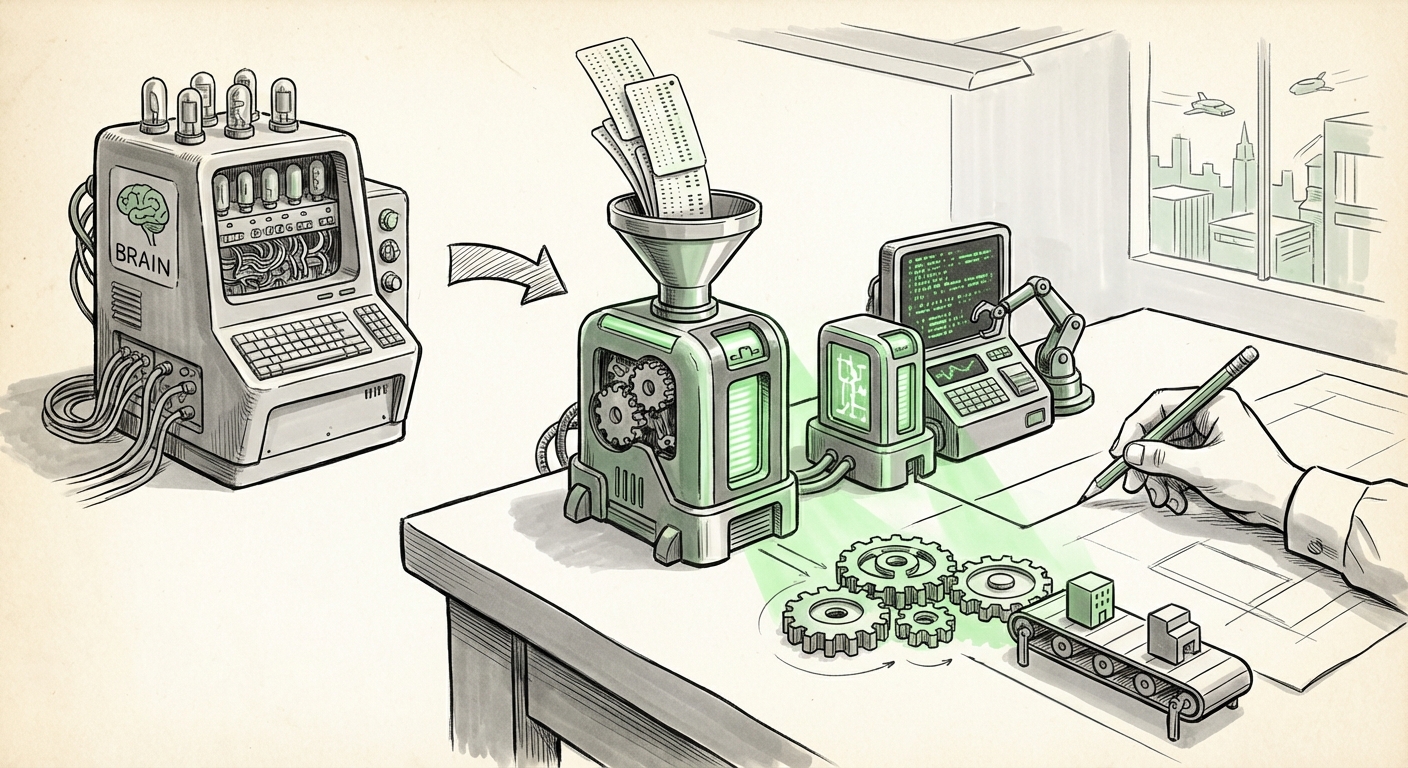
The 2014 project represents the "classic" style of game AI: hand-built logic, explicit rules, deterministic reasoning. Today's equivalent would likely learn those rules from experience instead, playing thousands of games and gradually discovering which moves pay off.
That shift, from hand-coded rules to learned behaviour, is the single biggest change in AI over the past decade. But it is a change in method, not in purpose. Both approaches are trying to answer the same question: given a situation, what is the best next action?
Why a Simple Puzzle Is a Serious AI Test
Games have always been the proving ground for AI, and there is a good reason for it. A game gives you something rare and valuable: a clean scoreboard.
- Clear rules. There is no ambiguity about what is allowed.
- Measurable outcomes. You either reached the target or you did not.
- Fast feedback. A program can play thousands of times without getting tired.
- No real-world consequences. Failure costs nothing, so it is safe to experiment.
That last point is the one businesses should pay attention to. The reason these hobby projects matter is that they let developers test bold ideas cheaply. A technique that fails in a puzzle costs an afternoon. The same technique discovered in a factory or a hospital costs far more.
This is why small experiments keep leading to big shifts. The people who learned to think in terms of search, scoring, and uncertainty while solving games are the same people now designing the systems that route deliveries, flag fraud, and summarize documents.
What This Means for the Future of AI
Three big takeaways stand out.
1. AI Progress Is Often Incremental, Not Sudden
The techniques behind a 2048 solver are not exotic. They are teachable, understandable, and reproducible. That is precisely why they spread. The biggest AI breakthroughs rarely arrive as total surprises, they arrive when a well-understood idea meets enough data and enough computing power to finally work at scale.
2. The Hard Part Is Defining Success
In 2048, success is obvious: reach the target, keep the board open, score more points. In business, success is rarely that clean. Do you want more revenue, fewer complaints, lower costs, or happier customers? You cannot optimize what you have not defined. The organizations that win with AI will be the ones that can state their objective precisely enough for a machine to chase it.
3. Domain Knowledge Still Rules
A solver needs to know that corners are valuable and empty space is precious. That knowledge came from humans who played the game. In the same way, the best business AI systems are built by people who deeply understand the domain being automated, not just the algorithms.
Practical Implications for Businesses
If you run a company, the lesson here is not "go build a game bot." It is that the fundamentals of applied AI are within reach, and they translate directly to commercial problems.
Start With a Bounded Problem
Pick something with clear rules and a clear score. A repeated decision with measurable outcomes. Customer churn prediction, inventory reordering, support ticket routing, all of these behave like puzzles. Bounded scope is what makes early AI projects succeed instead of stalling.
Invest in Your Heuristics
Your equivalent of a heuristic is your success metric and your data. If the metric is wrong, the AI will confidently optimize for the wrong thing. If the data is messy, the AI will learn the mess. Spend your effort here before you spend it on model choice.
Plan for Uncertainty
Real environments have randomness built in. Design systems that ask "what is the worst realistic outcome?" not just "what is the most likely outcome?" Risk-aware AI is safer AI, and safer AI is AI that stays deployed.
Let Cheap Experiments Run
Small projects are how teams build skill. They give engineers and analysts a safe place to fail, learn, and gain confidence. The cost is low. The compounding value is enormous.
Actionable Insights
- Define the objective before the model. Write down exactly what "winning" looks like in numbers.
- Build a small proof of concept first. Choose a problem with fast, cheap feedback.
- Measure against a human baseline. If your AI cannot beat a good person at the task, keep iterating.
- Treat data quality as a first-class engineering problem. It is the heuristic your system actually learns from.
- Design for the worst case, not just the average case. Assume randomness and plan for it.
- Keep humans in the loop for high-stakes decisions. Machines are good at ranking options, not at owning consequences.
- Upskill your team on fundamentals. Search, scoring, and uncertainty are teachable, and they outlast any specific tool.
Conclusion
Using artificial intelligence to solve the 2048 game in Java sounds like a small thing. It was published in April 2014, and it never needed a data center or a research lab to work. What it needed was a clear problem, a sensible way to score positions, and a willingness to let a machine make the call.
That is still the recipe. The scale has changed dramatically, and the methods have evolved from hand-coded logic toward systems that learn from experience. But the underlying pattern, define the goal, measure the outcome, handle uncertainty, and iterate, has not moved an inch.
The future of AI will not be built only by the biggest players with the biggest budgets. It will also be built by people who take a small, well-defined problem, apply the fundamentals carefully, and learn something real. That is how a puzzle solver becomes a business advantage. And it is how today's experiments become tomorrow's standard practice.