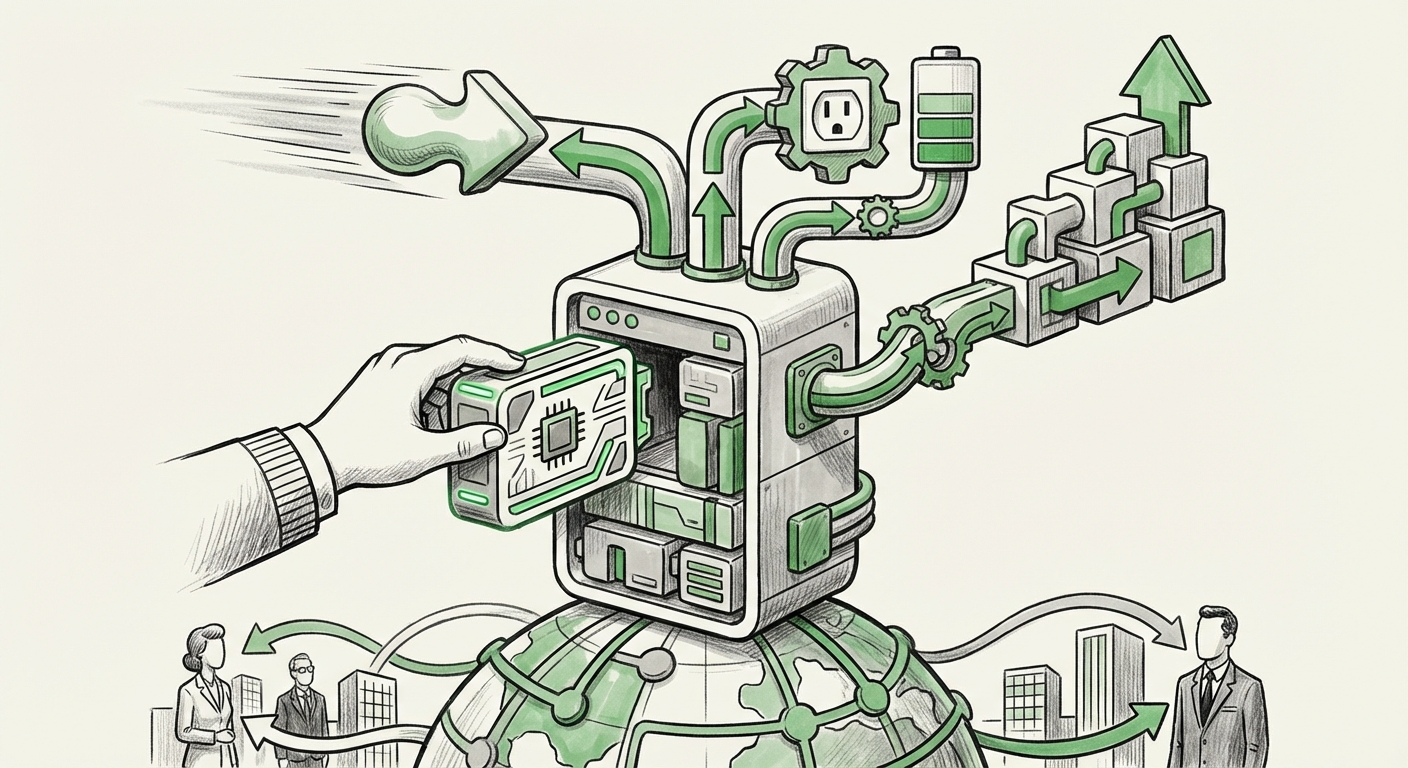
The Future of AI and How It Will Be Used: Agents, Multimodal Systems, and the Coming Trust Layer
For the last few years, most people have met artificial intelligence in the same way: a box on a screen. You type something. It types something back. That era is ending. The next phase of AI is not about better conversation. It is about action, software that does work, not just talks about it.
This shift matters more than any single product release. It changes who buys AI, what they buy, and what happens when the AI gets something wrong. Below is a clear-eyed look at where this is heading, what it means for businesses, and how leaders should prepare, without the hype.
From Chat to Action: Why Agents Are the Big Story
A chatbot answers a question. An agent completes a task. That difference sounds small. It is not.
An agent can read a document, pull data from three different systems, draft a response, send it for approval, log the result, and repeat the whole process tomorrow morning without being asked. It chains steps together and makes decisions along the way. It can also use tools, calendars, databases, email, code, browsers, the same way a human worker does.
This is the direction the entire field is moving. The question is no longer "Can the model write a good paragraph?" It is "Can the system reliably finish a job that takes a person an hour?"
That reframing changes everything downstream. When AI only chats, mistakes are cheap, you just ask again. When AI acts, mistakes have consequences. It might send the wrong invoice. It might delete the wrong record. It might promise a customer something the business cannot deliver.
So the real race is not about raw intelligence. It is about reliability. Whoever solves reliable action wins the enterprise.
The Cost Curve Changes Who Can Play
Running AI used to be expensive. It required specialised hardware, big cloud budgets, and a team of experts. That is changing fast.
Three forces are pushing costs down at the same time:
- Efficiency gains. Newer systems squeeze more useful output out of the same computing power.
- Smaller models. Many tasks do not need a giant model. A compact one tuned for a narrow job can run faster and far cheaper.
- Open and local deployment. More organisations can run models on their own hardware, which cuts per-use costs to near zero once the hardware is paid for.
The practical result: AI stops being a premium line item and starts being infrastructure. Like electricity or cloud storage, it becomes something you assume is available, priced by usage, and embedded quietly in everything.
When a capability becomes cheap, it becomes everywhere. That is the pattern to watch.
Multimodal AI and the Disappearing Interface
Text was never the natural way humans share information. We point, we show, we speak, we sketch. Modern AI systems increasingly handle all of these at once, text, images, audio, video, and live screen context.
This unlocks use cases that were impossible before:
- A technician points a phone at a machine and gets a repair plan narrated back in real time.
- A doctor's notes, scans, and lab results get read together as one picture.
- A warehouse worker speaks an instruction and the system updates inventory visually.
- A student photographs a page and gets a step-by-step explanation.
The interface is fading into the background. Soon, "using AI" will not be a separate activity. It will be a layer inside the tools people already use, spreadsheets, design software, call centres, factory floors, hospital systems.
Why this is a business problem, not just a tech one
When AI disappears into existing tools, the buying decision changes. It is no longer the IT department alone. It is operations, HR, finance, and customer service, each with budgets and specific pain points. Vendors that understand a workflow will beat vendors that only understand a model.
The Trust Layer: Where the Real Money Moves Next
Here is the trend most people are underestimating. As AI systems start doing real work, the most valuable layer is not the model. It is everything around the model that makes it safe to trust.
That trust layer includes:
- Verification. Checking the AI's output against real data before anything happens.
- Guardrails. Hard limits on what the system is allowed to do.
- Audit trails. A clear record of what the AI did, when, and why.
- Human checkpoints. Approval steps for high-stakes actions.
- Governance and compliance. Rules that satisfy regulators, insurers, and boards.
Expect this to become a major industry. Just as cybersecurity grew from an afterthought into a board-level concern, "AI assurance" is heading the same way. Companies that can prove their AI is controllable will charge a premium. Companies that cannot will be locked out of regulated markets.
Think of it like aviation. Nobody flies on an aircraft just because the engine works. They fly because of maintenance schedules, inspections, and certifications. AI is entering its certification era.
What This Means for Businesses
The winners in this next phase will not be the companies with the most AI. They will be the companies that use AI on the right problems.
1. Start with workflows, not tools
Do not ask "What can we do with AI?" Ask "Which process is slow, repetitive, and expensive?" Then see if AI fits. The best projects usually target work that is high-volume, rules-based, and currently consumes skilled people's time.
2. Measure outcomes, not activity
Number of AI tools deployed is a vanity metric. Hours saved, error rates cut, response times improved, revenue per employee, those are real. If you cannot tie an AI project to a business number, it will be cut when budgets tighten.
3. Build the trust layer early
Retrofitting controls after something goes wrong is painful and expensive. Decide up front what the AI can do alone, what needs a human, and how you will know if it drifts. This is also increasingly a legal requirement, not just good practice.
4. Keep humans on the edges
AI is strongest in the middle of a task and weakest at the boundaries, unusual cases, ethical judgement, relationships. Design roles around supervising and handling exceptions, not around being replaced entirely.
5. Own your data advantage
Models are becoming commodities. Your proprietary data, how your customers behave, how your equipment fails, how your processes really run, is not. That is the durable edge.
What This Means for Society
The stakes go beyond corporate efficiency.
Work changes shape, not just size. The tasks most exposed to AI are often the routine parts of knowledge work, drafting, summarising, checking, scheduling, translating. The tasks least exposed involve physical dexterity, human trust, and messy real-world judgement. Jobs will not vanish overnight, but the mix of skills inside a job will shift fast.
Access becomes the dividing line. If advanced AI is cheap and widely available, it can close gaps in education, healthcare, and small business productivity. If it concentrates in a few large players, it can widen them. Policy choices made now will decide which path we take.
Verification becomes a civic skill. When anyone can generate convincing text, images, and video, the ability to check a claim becomes as important as the ability to make one. Schools, newsrooms, and governments will need to treat that as a core competency.
Accountability needs to be clear. If an AI system denies a loan or flags a patient, someone must be answerable. "The algorithm decided" is not a defence that will hold up for long.
A Practical Playbook for the Next 12 Months
- Pick three workflows and map them step by step. Identify where an AI agent could take over a full chain of steps.
- Run a small pilot with hard success criteria, a specific metric, a specific deadline, a specific owner.
- Write down your AI rules before you need them. What can it do without approval? What can it never do? Who is accountable?
- Invest in evaluation. Test systems on your own real cases, not demo examples. Track failure rates over time.
- Train your people on supervision, not just prompting. The skill of the next few years is catching AI mistakes before they matter.
- Watch the cost line. As running costs fall, projects that did not make sense last year may make sense now. Revisit them.
The Bottom Line
AI is moving from a feature you visit to a layer that runs underneath your work. The conversation is shifting from what models can say to what systems can reliably do. That makes reliability, governance, and verification the new competitive battlegrounds, not raw model power.
For businesses, the opportunity is real but narrow: apply AI to specific, measurable, high-friction workflows, and build the controls before the scale. For society, the challenge is making sure the benefits spread widely and the risks are owned by someone. The technology will keep improving on its own. What we do with it is still a choice.