Barclays Says Aerospace & Defense Is Entering a "Generational Shift", And AI Is the Engine Behind It
Aerospace and defense is not a sector that changes quickly. Planes stay in service for decades. Fighter programs can take a generation to design, build, and retire. Procurement moves at the speed of paperwork. So when Barclays describes what is happening in the sector right now as a "generational shift," that word choice matters. A generational shift is not a good quarter or a hot stock. It is a change in the underlying rules of the game.
The most important part of that story is not the hardware. It is the software, and specifically, artificial intelligence. The same technology wave that gave us chatbots and image generators is quietly rewriting how militaries see the battlefield, how aircraft are maintained, and how factories build the machines that fly.
This article breaks down what a generational shift in aerospace and defense actually means, where AI fits in, and what businesses and workers outside the defense world should take away from it.
What "Generational Shift" Really Means
Analysts use phrases like this when several long-term cycles start moving at the same time. In aerospace and defense, that usually means three things lining up:
- Demand is changing shape. Countries are rethinking what they need, how much of it, and how fast they can get it.
- The technology stack is changing. Sensors, chips, networks, and software are improving fast enough to make new kinds of products possible.
- The suppliers are changing. New companies that build software first and hardware second are winning work that used to go only to legacy giants.
When those three cycles line up, you do not get a normal upswing. You get a rebuild. That is the generational shift Barclays is pointing at, and AI sits right at the center of all three.
Why This Is Really a Story About AI
Twenty years ago, the smartest part of a defense system was the metal. Today, the smartest part is the code. A modern aircraft, drone, ship, or satellite is best understood as a flying, floating, or orbiting computer with a body attached.
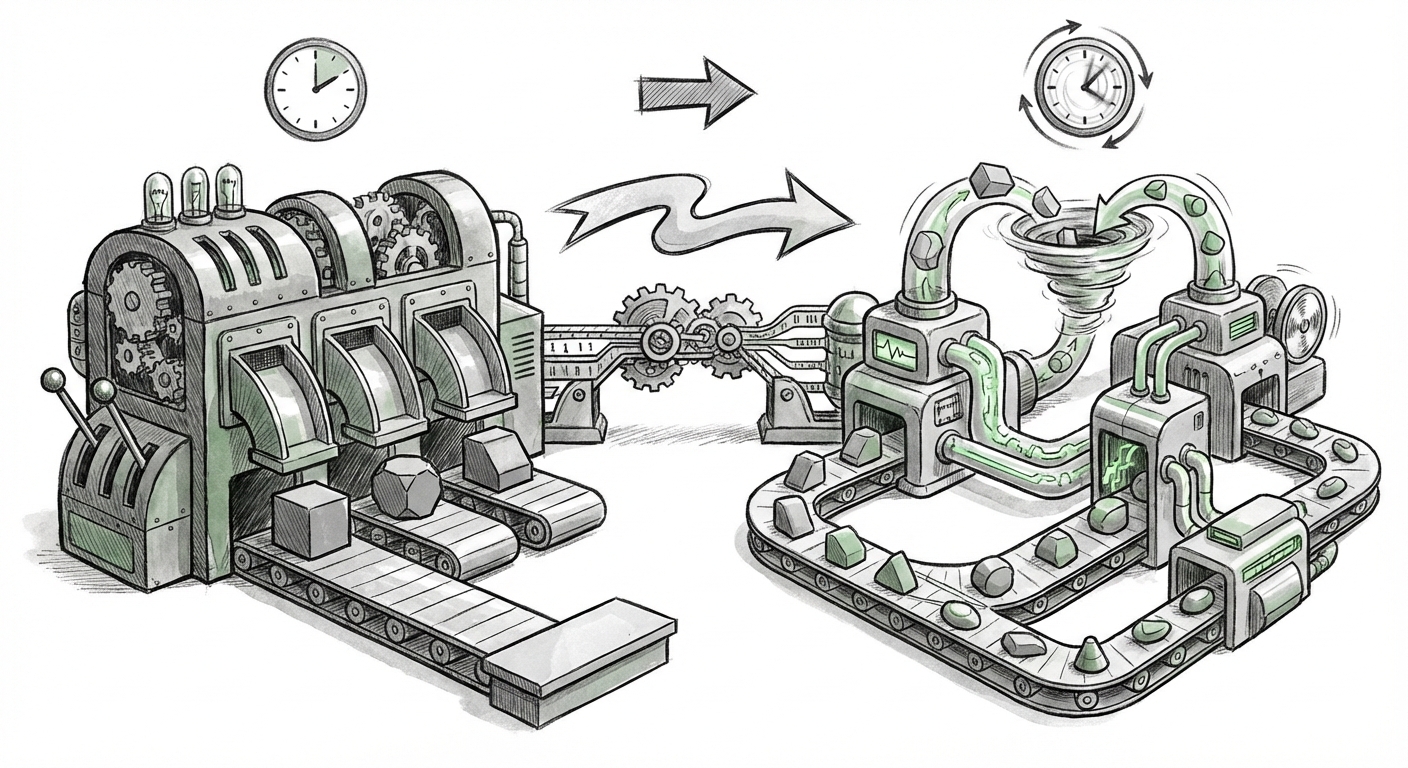
That flip changes everything about how value is created. Once a platform is defined by its software, it can improve without being rebuilt. New abilities can be shipped over the air. Old machines can learn new tricks. And the companies that write the best learning software, not the ones with the biggest factories, start to set the pace.
AI is the reason that flip is possible. Machine learning can spot patterns that human operators would never catch in time. It can process enormous streams of sensor data in milliseconds. And it can help make decisions when the volume of information is simply too large for a person to handle alone.
Where AI Shows Up First
1. Predictive Maintenance
Every hour a plane or engine sits on the ground costs money. AI models trained on sensor data can flag a failing part before it breaks, so maintenance happens on schedule instead of in an emergency. This is one of the least glamorous uses of AI in the sector, and one of the most valuable. It saves fuel, extends the life of expensive equipment, and keeps fleets ready.
2. Autonomous and Semi-Autonomous Systems
Drones, uncrewed vessels, and autonomous support aircraft are moving from experiments to programs. Full autonomy is hard, so the near-term reality is human-machine teaming: a person sets the goal, and the machine handles navigation, sensing, and low-level decisions. AI is what makes that division of labor work.
3. Data Fusion and Decision Speed
Modern operations generate more data than any team can read. Radar, signals, satellite imagery, acoustic sensors, and open-source feeds all pour in at once. AI fuses those streams into a single, usable picture and ranks what matters. The goal is not to remove humans from the loop. It is to give them a clearer view faster than an opponent can act.
4. Manufacturing and Supply Chains
Building aircraft is a nightmare of parts, suppliers, and certifications. AI-driven planning tools can predict shortages, adjust schedules, and catch quality problems earlier. In a sector where a single missing component can stall an entire production line, that is not a small win.
5. Training and Simulation
You cannot train a pilot or an operator on real missions as often as you would like. AI-powered simulation creates realistic, adaptive scenarios that change based on how the trainee performs. This lowers cost, improves readiness, and lets teams rehearse situations that are too dangerous or too rare to practice in real life.
From Hardware to Software: The New Playbook
The deepest change is cultural. Legacy defense work followed a slow, careful rhythm: define requirements, design for years, test, produce, and then support the platform for decades. That rhythm made sense when the technology inside a platform barely changed after it was built.
It makes much less sense now. If the software is the source of capability, then the ability to update fast becomes the real advantage. That pushes the sector toward shorter cycles, more open architectures, and continuous improvement instead of one-time delivery.
This is also why smaller, software-focused firms have been able to compete for work that once seemed locked up. They are not out-building the giants. They are out-iterating them.
The Risks Nobody Should Ignore
A generational shift in a defense context is not just an investment theme. It carries real risks that deserve clear-eyed attention.
- Trust and verification. AI systems must be testable before they are relied on. That is a hard problem when the models keep changing.
- Human control. There is broad agreement that people must stay accountable for consequential decisions. Designing that into fast systems is an engineering challenge, not just a policy one.
- Data and security. Models are only as good as their data, and a model trained on sensitive data becomes a target itself.
- Cost and talent. Skilled AI engineers are scarce and expensive, and they are being fought over across every industry.
- Spillover effects. Capabilities built for defense rarely stay there. The same tools raise hard questions when they reach commercial and civilian use.
None of these are reasons to stop. They are reasons to build carefully and to treat testing, governance, and transparency as part of the product, not an afterthought.
What This Means for Businesses Outside Defense
Here is the part most people miss. The AI advances driven by aerospace and defense do not stay in aerospace and defense.
Predictive maintenance techniques move to airlines, rail, shipping, and heavy manufacturing. Autonomous navigation research moves to logistics and delivery. Sensor fusion moves to agriculture, mining, and construction. Simulation and digital twins move to product design everywhere. Edge computing, running AI on the device instead of in a distant data center, moves to phones, cars, and factory floors.
In other words, the generational shift Barclays is describing is also a preview of how AI will be used across the whole economy: in physical systems, in real time, with real consequences.
That is a big deal. Most of today's AI conversation is about text, images, and office work. The next wave is about machines that move, sense, and act. It will be harder, slower, and more regulated, and it will touch far more of the economy.
Actionable Insights
- Watch the software share, not just the platform count. The clearest signal of this shift is how much of a program's value sits in code and data.
- Invest in data infrastructure early. AI is downstream of clean, labeled, well-governed data. Teams that fix their data first move faster later.
- Design for updates. Whatever you build, assume the model inside it will need to change. Modularity beats perfection.
- Treat testing as a first-class product. In high-stakes settings, the ability to prove a system works is as valuable as the system itself.
- Look for cross-industry spillovers. The techniques proving themselves in aerospace and defense are the ones coming to your sector next.
- Plan for hybrid teams. The winning pattern is not humans or AI. It is humans with AI handling the volume and speed, and people handling judgment and accountability.
The Bottom Line
Calling something a "generational shift" is a strong claim. But the logic behind it holds up. Aerospace and defense is being rebuilt around software, and AI is what makes that software useful in the physical world. That combination, smart code inside real machines, is the next chapter of the AI story, and it is arriving faster than most people expect.
For businesses, the lesson is not "get into defense." It is that the tools now being hardened in the toughest environments will soon be ordinary everywhere else. The companies that understand how AI behaves when the stakes are high will be the ones ready when those stakes arrive in their own industry.