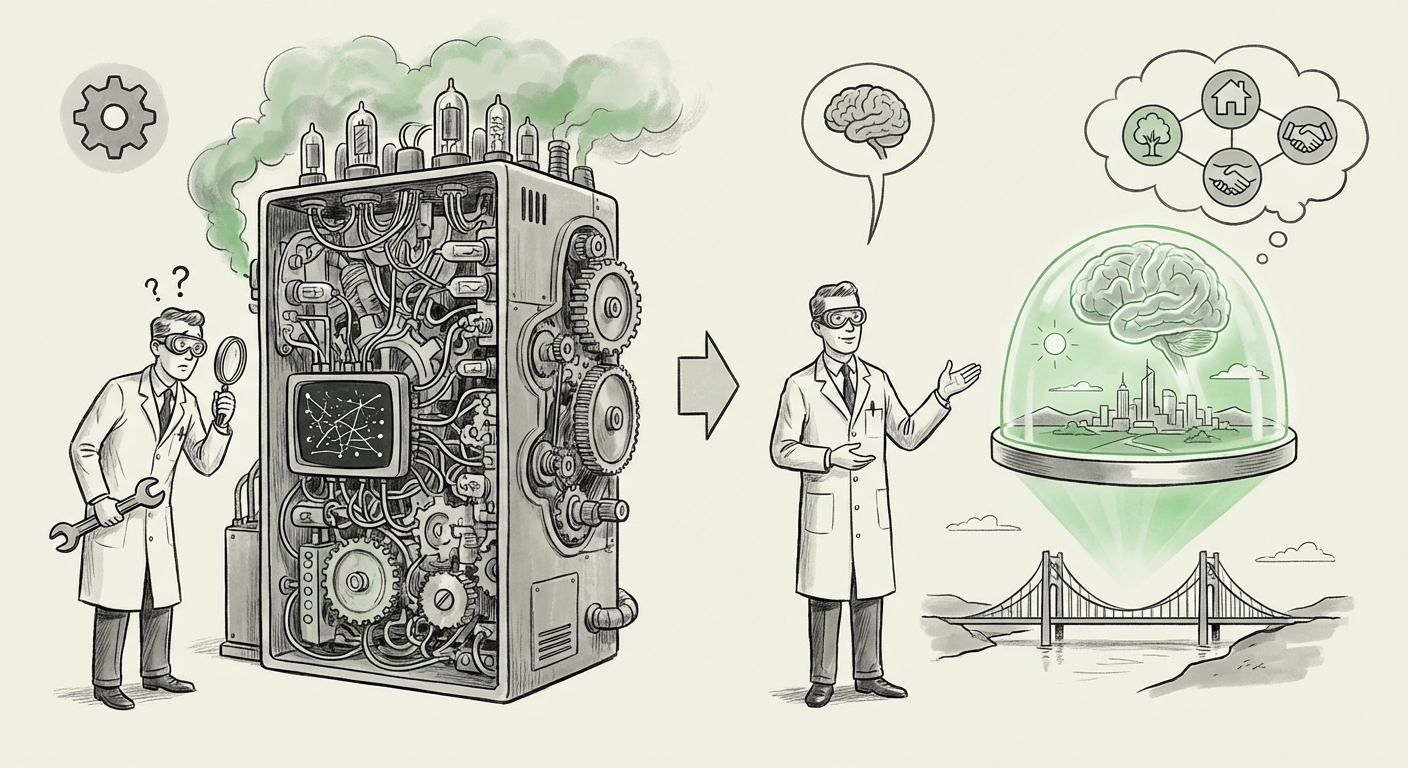
Declining Sperm Counts and the Rise of AI Health Tracking: What a Fertility Debate Teaches Us About the Future of AI
There is a health debate happening right now that sounds narrow but is actually enormous. It is the debate about declining sperm counts, whether the trend is real, how big it is, what is causing it, and what anyone should do about it. On the surface, this looks like a story about men's fertility. Underneath, it is a story about something much bigger: how we measure human health, who gets measured, and what we do with the data once we have it.
That is exactly where artificial intelligence enters the picture. The same questions raised by a fertility debate are the questions AI health tools will have to answer in the next few years. And the way we handle this one will set the pattern for everything that follows.
The Real Question Behind the Headlines
When people argue about declining sperm counts, they are not just arguing about a number. They are arguing about several things at once:
- Is the measurement reliable? Counting sperm is harder than it sounds. Two labs can look at the same sample and give different answers.
- What is a fair comparison? A drop in one region or one group does not automatically mean a global trend.
- What actually drives the change? Lifestyle, environment, stress, sleep, weight, chemicals, and age all play a role, and they overlap.
- Why does it matter? Fertility can be an early signal for heart health, hormone health, and overall wellbeing.
Notice that only the last item is really about babies. The rest is about measurement, data, and interpretation, the exact three areas where AI is strongest. That is why this debate is a preview of something much larger.
Why This Is an AI Story in Disguise
Modern AI systems are very good at three tasks: reading messy data, finding patterns humans miss, and making a first pass at a judgment call. Health care is full of all three problems. A fertility debate puts a spotlight on them in a way that is easy to understand.
1. AI Can Make Subjective Tests More Consistent
Classic semen analysis relies heavily on a trained human looking through a microscope and making a call. It is skilled work, but it is also subjective. Computer vision models can be trained to recognize and count cells, measure movement, and score shape, and they do it with the same rules every single time. AI will not replace the lab expert, but it can remove a lot of the wobble that makes long-term trends hard to trust.
2. AI Can Connect Dots Across Siloed Data
Right now, most health data sits in separate boxes. One box has lab results. Another has sleep and activity data from a wearable. Another has environmental exposure records. Another has medical history. AI's real power is pulling these apart and looking for connections. In a fertility context, that might mean spotting that a certain pattern of sleep, heat exposure, or stress shows up alongside changes in a lab result. In a general health context, the same technique becomes a broadly useful early-warning system.
3. AI Can Lower the Barrier to Asking for Help
Many people avoid talking about reproductive or sexual health. They delay seeing a doctor. A chat-based AI triage tool or an at-home test with an AI interpretation layer gives people a low-pressure first step. That step is not a diagnosis, but it can be the difference between doing nothing and eventually getting proper care.
From One Debate to Whole-Body Health
The most interesting lesson from this debate is that a controversial topic can become a doorway. Once people are willing to talk about sperm counts, they start asking about sleep, diet, stress, and the environment. Once they are tracking one health signal, they become more open to tracking others.
This is where AI health platforms are heading. The future product is not a fertility app, a fitness tracker, or a lab report. It is a layer that sits across all of them and produces a single, personal picture of what is changing and why.
Picture the pipeline:
- Capture: wearables, home test kits, lab results, and self-reported symptoms.
- Normalize: AI cleans and standardizes messy, inconsistent data.
- Analyze: models look for trends and flag what deserves attention.
- Explain: a language model turns the math into plain English.
- Act: the person is nudged toward a real clinician at the right moment.
Every step in that chain already exists in some form. The missing piece is trust, and trust is exactly what a public debate like declining sperm counts tests.
What This Means for Businesses
The commercial implications reach well beyond health care.
For Health and Wellness Companies
Expect competition to shift from hardware to interpretation. A device that measures something is easy to copy. A model that explains what the measurement means, in a way that a doctor will accept, is much harder. The winners will be companies that treat clinical credibility as a core feature rather than a marketing claim.
For Insurers and Employers
Reproductive and hormonal health is quietly becoming a benefits topic. Companies that offer coverage and support in this space are already using AI to triage, route, and track outcomes. The upside is earlier intervention and lower long-term costs. The risk is privacy. Employees will want to know exactly what data goes where before they trust a wellness program with sensitive information.
For Pharma and Research
Large-scale, real-world data is gold for research. AI can sift through it faster than any human team. But findings are only as good as the data going in. If a dataset under-represents certain groups, and many health datasets do, the conclusions will be skewed. This is a technical problem, but it is also an ethical one, and regulators are starting to pay closer attention.
The Risks Nobody Should Skip
It would be easy to write a hopeful article about AI fixing health. That would be incomplete. The same tools that detect patterns can also cause harm:
- Privacy: Reproductive and hormonal data is among the most sensitive information a person has. Loose handling is a serious problem, not a small one.
- Bias: Models trained on narrow populations produce narrow answers. A tool that works well for one group may quietly fail for another.
- Overconfidence: A neat chart does not mean a solid conclusion. AI can make weak evidence look convincing.
- Anxiety: Constant tracking can turn normal variation into a source of stress. Good design means knowing when not to alert.
Anyone building in this space should treat these as design requirements, not afterthoughts.
Practical Steps You Can Take Now
If you are a business leader, a developer, or just someone paying attention, here is what matters:
- Ask where the data comes from. Any health AI claim should come with a clear answer about training data and validation.
- Demand explainability. If a model cannot explain why it flagged something, it is hard to trust, and hard to defend.
- Treat consent as a feature. Clear, simple controls over sensitive data will become a competitive advantage.
- Build the human handoff. AI should route people to real care, not replace it.
- Watch the measurement problem. Inconsistent testing is the quiet killer of long-term health trends. Consistent, standardized capture is where AI adds the most value.
The Bigger Picture
The debate over declining sperm counts is a stress test for how we handle health data in public. It brings together hard science, uncertain evidence, personal privacy, and strong emotions. Every major AI health application will face the same mix.
If we get this one right, with careful measurement, honest models, real privacy, and a clear path to doctors, we build a template for the next decade of AI in health. If we get it wrong, we get noisy data, false alarms, and public distrust that sets the field back years.
The technology is ready. The hard part is everything around it: standards, trust, and the discipline to say "we are not sure yet." That is what this debate is really teaching us, and it is worth listening.