Microsoft Separates Decision-Making From Generative AI: What the New Model Means for the Future of AI
For the past few years, the AI industry has been chasing one big idea: build a single, giant model that can do everything. Write your emails. Summarize your documents. Plan your project. Approve your refund. Book your flight. The dream was a Swiss Army knife, one tool, endless uses.
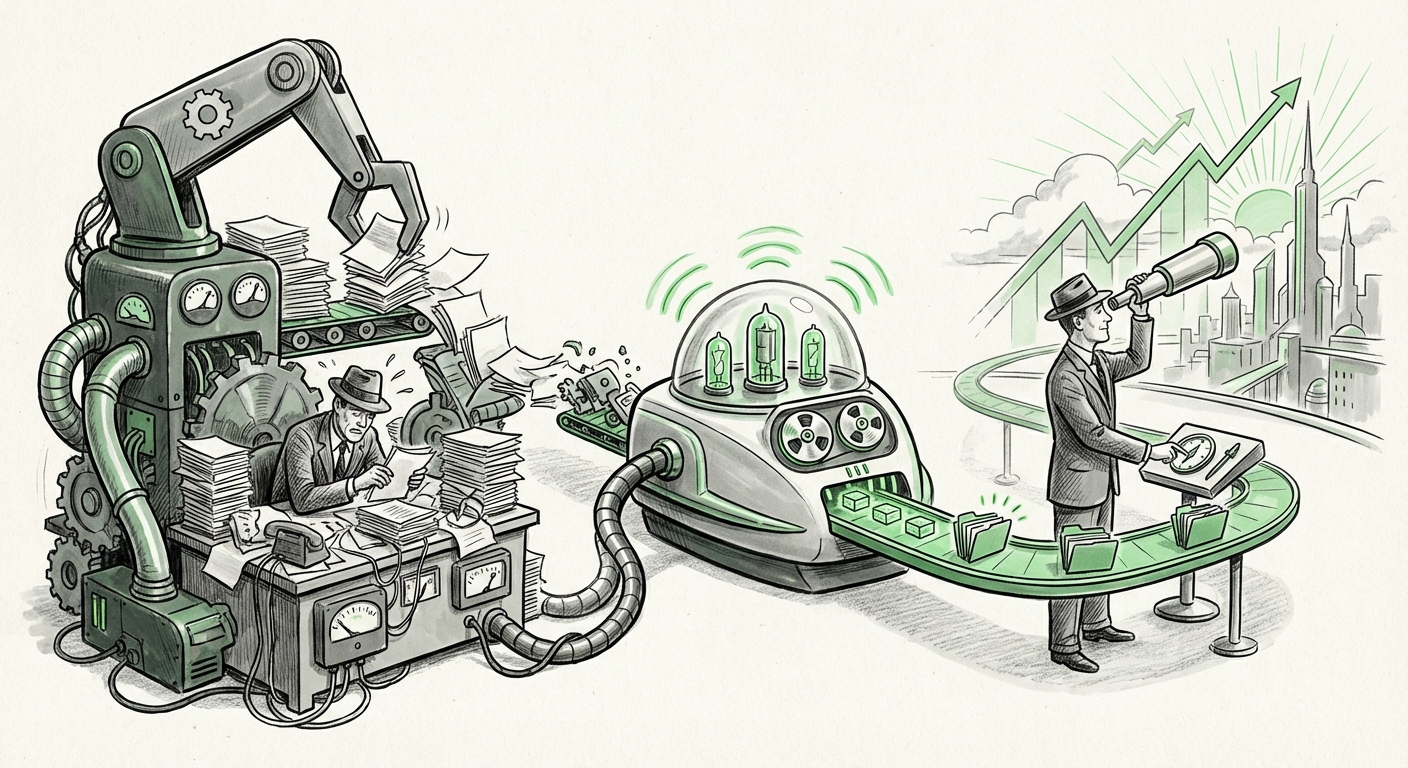
Microsoft is now making a bet that this approach has a ceiling. Its new model splits the job in two: one system to generate, and a separate system to decide. In other words, the part of AI that comes up with options is being pulled apart from the part that actually commits to an action.
That sounds like a technical detail. It is not. It may be the most important architectural shift in enterprise AI since the arrival of large language models, because it changes who is responsible when AI gets something wrong.
The Problem With Making One Model Do Both Jobs
Generative AI is, at its core, a prediction engine. It guesses the next most likely word, pixel, or step. That makes it brilliant at producing fluent, human-sounding output. It also makes it fundamentally unreliable as a decision-maker. Ask a generative model to approve a loan, and it is estimating what an approval looks like, not following a rule.
This mismatch creates real problems in real businesses:
- Inconsistency. The same input can produce two different answers on two different days, because the model is sampling from a range of possibilities rather than applying a fixed policy.
- Confabulation. Models sometimes invent a reason, a number, or a policy that does not exist, and they do it with total confidence.
- Audit failure. When a regulator or a customer asks "why was this decision made?", a probabilistic model offers a story, not a traceable reason.
- Cost and latency. Running a giant model for every small judgment call is slow and expensive.
Most companies have worked around this with human-in-the-loop reviews. But that defeats the purpose. If a person has to check every AI decision, you have not automated the decision, you have automated the typing.
What Separating the Two Layers Actually Looks Like
The logic behind Microsoft's split is that generation and decision-making are different cognitive jobs, and they deserve different tools.
The generator: flexible, creative, probabilistic
This is the layer everyone already knows. It reads messy inputs, a customer email, a scanned contract, a chat message, and turns them into clean, structured information. It drafts. It summarizes. It explains. It is the interface between human messiness and machine order.
Crucially, in this architecture, the generator does not get the final say. It proposes.
The decider: narrow, rule-bound, checkable
The second layer is where the new model sits. Its job is to take the structured output from the generator and apply a decision: approve or reject, escalate or close, route or hold. Because this layer is narrower, it can be built to be consistent, repeatable, and explainable. It can be tied directly to written policy. It can be tested against thousands of known cases before it ever touches a customer.
The critical benefit is separation of powers. If the generator hallucinates a detail, the decider has a chance to catch it, because the decider is not evaluating whether the text sounds right. It is evaluating whether the facts match the rules.
The handoff is everything
Most real-world failures will happen in the seam between these two layers. If the generator passes along a wrong number and the decider trusts it blindly, you have simply moved the problem. That is why the design of the handoff, what data gets passed, in what format, with what validation, becomes the central engineering challenge. Expect this interface, not the models themselves, to be where the next wave of AI competition plays out.
Why This Matters for Business Right Now
The biggest blocker to AI adoption in large organizations has never been capability. It has been accountability. Banks, hospitals, insurers, and government agencies cannot deploy systems that make consequential choices they cannot explain.
A separate decision layer changes that conversation in four important ways:
- Governance becomes possible. You can point to the exact rules a decision followed, version them, and change them without retraining a massive model.
- Risk becomes insurable. When decisions follow documented policy, they start to look less like an unpredictable black box and more like ordinary software, which is something auditors and insurers already know how to handle.
- Costs drop. Small, focused decision models do not need the compute of a frontier language model. That makes high-volume automation economically viable for the first time.
- Speed improves. Decision logic that does not require a giant model call can respond in milliseconds, opening up use cases where latency used to be a dealbreaker.
There is also a human benefit. When a system separates "what we think is happening" from "what we are going to do about it," employees can review each part on its own terms. A fraud analyst can focus on the rules. A content team can focus on the drafts. The two no longer collapse into one untraceable blob.
The Trust Problem With AI Agents
This shift arrives at exactly the moment the industry is racing to build AI agents, systems that do not just answer questions, but take actions. Agents are already being pointed at email inboxes, procurement systems, and code repositories.
Every honest conversation about agents hits the same wall: how much freedom do you give them? Too little, and they are useless. Too much, and one bad decision can cascade across a business process before anyone notices.
A dedicated decision layer offers a way out of that trap. The agent can be deeply creative in how it explores a problem while being rigidly constrained in what it is allowed to commit to. Autonomy in exploration, discipline in action. That is a far more defensible design than asking one model to be both imaginative and careful at the same time.
What This Means for the Future of AI
If this approach spreads, and the logic suggests it will, it reshapes several things at once.
Model specialization returns. The industry spent years assuming bigger was always better. A separate decision layer proves that some jobs are better served by smaller, narrower models that are cheap, fast, and testable. Expect a wave of purpose-built decision models for specific domains: lending, claims, compliance, logistics, scheduling, triage.
The stack becomes layered. Instead of one model as a product, we get assemblies: a generator, a decision model, a rules store, an audit trail, and a monitoring layer. Companies will compete on the whole assembly, not just the brain in the middle.
Evaluation gets real. You can score a decision model against a fixed set of cases the way you test any other software. That is a genuine step toward AI systems that can be certified rather than merely trusted.
Regulation gets a target. Lawmakers struggling with how to govern AI have repeatedly asked for transparency and accountability. An architecture that produces an explicit, documented decision is far easier to regulate than one that produces a paragraph of plausible text.
The Risks Nobody Should Ignore
This is not a clean win, and the trade-offs deserve honesty.
- Bottlenecks move rather than disappear. A rigid decision layer can become the new point of failure. If the rules are wrong, the system will be confidently, consistently wrong at scale.
- Brittleness. Narrow models can struggle with situations that do not resemble their training cases, exactly the moments when good judgment matters most.
- Responsibility laundering. Organizations may be tempted to blame "the rules" for outcomes no human actually intended. Rules are still written by people.
- Two-model complexity. More layers mean more things to monitor, version, and secure. Smaller companies without engineering depth may find this harder, not easier, widening the gap between AI leaders and everyone else.
Actionable Steps for Leaders
If the separation of decision-making from generation becomes standard, here is how to get ready now:
- Inventory your decisions. Before automating anything, write down the actual rules your business uses today. Most organizations discover these rules live in people's heads, not in documents.
- Separate "describe" from "decide" in your current pilots. Look at where one model is doing both jobs, and ask what would change if you split them.
- Build a test set of historical cases. Any decision model is only as good as the examples you check it against. Start collecting them now, including the edge cases.
- Design the audit trail first. Decide what a regulator, a customer, or your own legal team will need to see before you build the system, not after.
- Keep a human override that is genuinely used. A kill switch nobody ever pulls is not a control, it is decoration.
The Bigger Picture
The most interesting thing about Microsoft's move is not the model itself. It is the admission that fluent language and sound judgment are not the same skill, and that treating them as one has been holding AI back.
For a decade, the promise of AI has been framed as raw intelligence: bigger models, smarter answers. The next phase may be framed as something less glamorous but far more useful, structure. Systems that know the difference between thinking and doing, between suggesting and committing, between sounding right and being right.
That is a less exciting story than a machine that can do everything. It is also a much more believable one. And it is the version of AI that businesses can actually put into production, defend to a regulator, and trust with the decisions that matter.