Multimodality Explained: How Large Multimodal Models Are Rewriting the Future of AI
For years, artificial intelligence lived in a text-only world. You typed words, and the machine answered with words. That era is ending. The next chapter of AI is built on multimodality, the ability of a single system to understand and produce many kinds of information at once: text, images, audio, video, and more.
The model class driving this shift is the large multimodal model, or LMM. If large language models taught machines to talk, LMMs are teaching them to see, hear, and connect ideas across formats. This is not a small upgrade. It changes what AI can do, who can use it, and how businesses will build with it. Here is what multimodality actually means, why it matters, and how it will shape the future.
What Is Multimodality, Really?
A "modality" is simply a type of data. Written language is one modality. A photograph is another. A spoken sentence, a chart, a short video clip, and a sensor reading are all modalities too.
Traditional AI systems were built around one modality at a time. A language model handled text. A vision model handled images. A speech model handled audio. Each one was good at its own lane, but they did not truly share a mental picture of the world. To get them to work together, developers had to stitch separate tools together with messy plumbing.
Multimodality means one model handles several modalities at once, and, critically, understands the relationships between them. Ask a multimodal model about a photo, and it can describe the scene. Combine the photo with a written question, and it can reason about both together. Add a spoken follow-up, and it can keep track of the conversation across all three.
Where LMMs Fit In
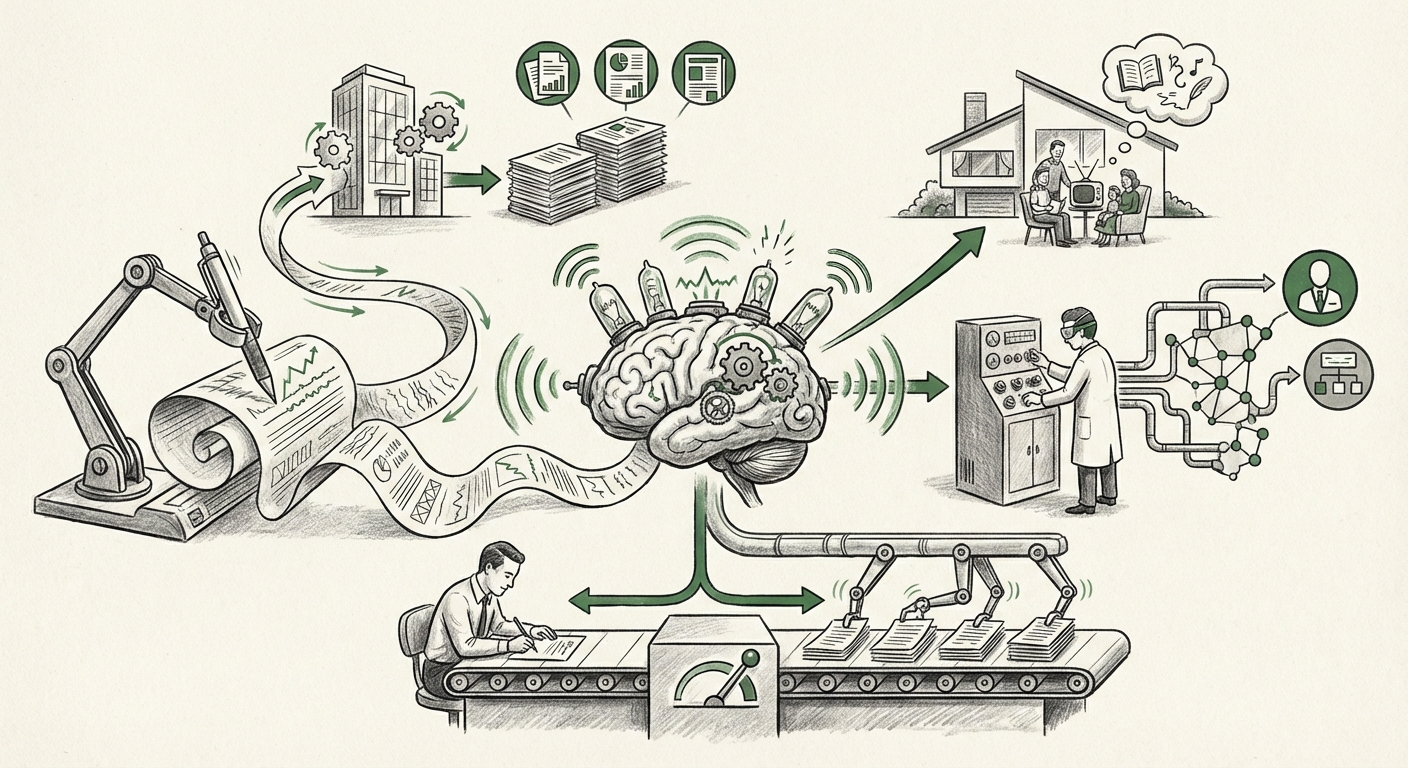
A large multimodal model takes the core idea behind large language models, train on massive amounts of data, learn general patterns, then adapt, and extends it across multiple data types. The model learns a shared internal representation, meaning it maps images, text, and sound into a common space where it can compare and combine them.
That shared space is the heart of the breakthrough. It means a picture of a broken machine part and the sentence "what is wrong here?" stop being two separate inputs. They become one blended question the model can answer.
Why Multimodality Is the Next Big Step
Text alone leaves out most of human experience. Think about how much of your day is visual or auditory: reading a face in a meeting, spotting a defect on a production line, recognizing a customer's tone of voice, glancing at a dashboard. Pure language models miss all of that.
Multimodality closes the gap in three important ways:
- It meets people where they are. Most humans do not want to write a perfect prompt. They want to point a camera at something and ask a question. Multimodal systems make that natural.
- It grounds AI in reality. Images and sensor data are harder to fake than a clever sentence. Reasoning over real-world inputs helps models be more concrete and useful.
- It unlocks new tasks entirely. Reading a document image, summarizing a video, describing a chart, or assisting a surgeon in real time are not text problems. They are multimodal problems.
In short, multimodality moves AI from a chat partner to a genuine assistant that can perceive.
How Large Multimodal Models Actually Work
You do not need a computer science degree to get the big picture. Here is the simple version.
1. Turning everything into a common language
Images, audio, and video are broken into small pieces, often called tokens, just like words in a sentence. Each piece gets converted into numbers the model can process. This is how a picture becomes something a model can "read."
2. Connecting the pieces
Specialized parts of the model, often called encoders, are trained to extract meaning from each type of data. An image encoder learns shapes and objects. An audio encoder learns sound patterns. A fusion step then blends those signals with the text so the model can reason across all of them at once.
3. Generating an answer
Once the model has a combined understanding, it produces output, usually text, but increasingly images, speech, or structured data. The same underlying knowledge is reused across formats, which is what makes the system feel coherent instead of bolted together.
The key insight: the model is not running five separate brains. It is running one brain that has learned to think across formats.
What This Means for the Future of AI
Multimodality is not just a feature. It is a direction of travel, and several big consequences follow.
Interfaces will get simpler, not more complex
As models understand more input types, the interface problem shrinks. Instead of designing elaborate forms and menus, products can let users show, speak, and point. Expect the "chat box" to be replaced by cameras, microphones, and shared screens as the default way people interact with AI.
AI agents will become genuinely useful
Autonomous agents, software that carries out multi-step tasks, need to perceive their environment. A text-only agent is blind. A multimodal agent can look at a screen, read a PDF, watch a video feed, and hear a phone call. That perception is what turns an interesting demo into a dependable worker.
Real-world industries will be the biggest winners
Text automation mostly touched office work. Multimodality reaches into the physical economy: medicine, manufacturing, logistics, agriculture, retail, construction, and safety inspection. These fields run on images, video, and sound, exactly what LMMs are built to handle.
Accessibility will improve dramatically
Multimodal systems can describe a scene to someone who cannot see it, transcribe and summarize speech for someone who cannot hear, and translate written materials on the fly. This is one of the clearest social benefits of the technology.
Evaluation and trust become harder
It is one thing to check whether a text answer is correct. It is much harder to judge whether a model interpreted an image correctly, especially in high-stakes settings. As LMMs spread, expect heavy investment in testing, benchmarking, and human review pipelines. Trust will become a competitive advantage.
Practical Implications for Businesses
The strategic question is not "should we use multimodality?" but "where does it create an edge?" Consider these high-value patterns.
Customer support that sees the problem
A customer photographs a damaged product or a confusing error screen. A multimodal assistant can identify the issue, pull the right solution, and respond, without a human ever asking "can you describe that again?" This cuts resolution time and reduces frustration.
Document and data-heavy workflows
Invoices, contracts, medical records, engineering drawings, and insurance claims are full of text, tables, stamps, and signatures. Multimodal models can read them together rather than treating each element in isolation. Back-office teams should expect major efficiency gains here first.
Quality control and inspection
Cameras already watch factory lines. Multimodal models can add reasoning on top: not just detecting a defect, but explaining what it likely is and suggesting a fix. The same logic applies to construction site safety, farmland monitoring, and warehouse audits.
Content and media operations
Searching, tagging, summarizing, and localizing video and image libraries has always been expensive. LMMs make it routine. Media companies, marketers, and e-learning teams can unlock archives that were previously too costly to organize.
Healthcare and life sciences
Combining images with clinical notes and lab data is exactly the kind of multi-source reasoning LMMs are designed for. The opportunity is large, but so is the need for rigorous validation, privacy protection, and regulatory care.
The Challenges Nobody Can Skip
Enthusiasm should be paired with honesty about the hard parts.
- Cost and compute. Processing images and video is far more expensive than processing text. Budgets and infrastructure must scale accordingly.
- Data quality and rights. Multimodal training needs vast, diverse, and legally usable datasets. Licensing and consent issues are real.
- Hallucination in new forms. A model can confidently misread a chart or invent detail in an image. Visuals can make wrong answers feel more trustworthy, which is dangerous.
- Privacy. Cameras and microphones collect sensitive information. Design must default to protecting the people being recorded.
- Bias across modalities. Poor representation in image or audio data can create uneven performance across groups of people.
- Integration debt. Most companies do not have clean pipelines for images, video, and audio. Multimodality forces data modernization.
None of these are reasons to wait. They are reasons to build carefully, start with contained use cases, and measure results.
Actionable Insights: How to Get Ready
If you are leading a team or a business, here is a practical playbook.
- Audit where your data is not text. Find the images, videos, audio, and scanned documents your organization already owns. That is your multimodality opportunity map.
- Pick one narrow, measurable use case. A single high-volume workflow, claim triage, defect review, support tickets with screenshots, beats a broad pilot every time.
- Define success before you start. Choose metrics like handling time, error rate, or cost per case. Multimodal projects fail when "it feels impressive" is the only benchmark.
- Keep a human in the loop for anything high-stakes. Use AI to draft and flag, and humans to approve.
- Invest in data hygiene now. Clean, tagged, well-governed data is the real moat. Models are increasingly commoditized; your proprietary data is not.
- Plan for cost and latency. Test at realistic volumes. A demo on ten images tells you nothing about a million.
- Train your people. The biggest gains often come from staff who learn to combine text, images, and voice in their daily work.
The Bigger Picture
Every major computing shift has followed the same pattern: the interface gets easier, the audience gets bigger, and the technology fades into the background. Multimodality is that shift for AI. When machines can see and hear as well as read, the barrier to using them drops to almost nothing.
That has two sides. It means enormous productivity gains, better accessibility, and new products we cannot yet imagine. It also means new risks around privacy, accuracy, and dependence on systems we do not fully understand.
The organizations that thrive will not be the ones that chase every model release. They will be the ones that connect multimodal capability to real problems, measure honestly, and build trust deliberately. The technology is arriving fast. The judgment about how to use it is still ours to make, and that, more than any model, will decide what the future looks like.