Small Brain, Big Wins: How URM Shows Tiny Recurrent Models Can Out-Reason Huge LLMs
For the last few years, the AI industry has followed one simple rule: bigger is better. More parameters, more data, more GPUs, more money. The biggest models were assumed to be the smartest ones, and everyone raced to build the next giant.
URM just punched a hole in that assumption. URM is a small, recurrent model, and it can outperform much larger large language models on reasoning tasks. That single result matters far more than it first appears. It suggests that the future of AI may not be about who can build the biggest model, but about who can build the smartest one.
This is a story about architecture beating brute force. And it has real consequences for budgets, energy use, product design, and the balance of power in the AI industry.
What URM Actually Demonstrates
The core finding is straightforward: when it comes to reasoning, problems that require multiple steps of thinking rather than a quick lookup, a small recurrent model can beat models that are dramatically larger.
That is a big deal because the entire commercial AI boom has been financed on the belief that scale equals capability. If that belief weakens, a lot of assumptions weaken with it.
Two words in that finding deserve unpacking. The first is small. Small means fewer parameters. Fewer parameters means less memory, less compute, cheaper hardware, and the ability to run on devices that are not giant data centers. The second is recurrent, and this is where the real engineering magic lives.
Why Recurrence Changes the Game
Most modern language models are "feed-forward" in spirit: you give them a problem, they push it through a fixed stack of layers once, and they produce an answer. The amount of thinking is fixed in advance. If the problem is easy, they still spend the same effort. If the problem is brutally hard, they also spend the same effort, and often get it wrong.
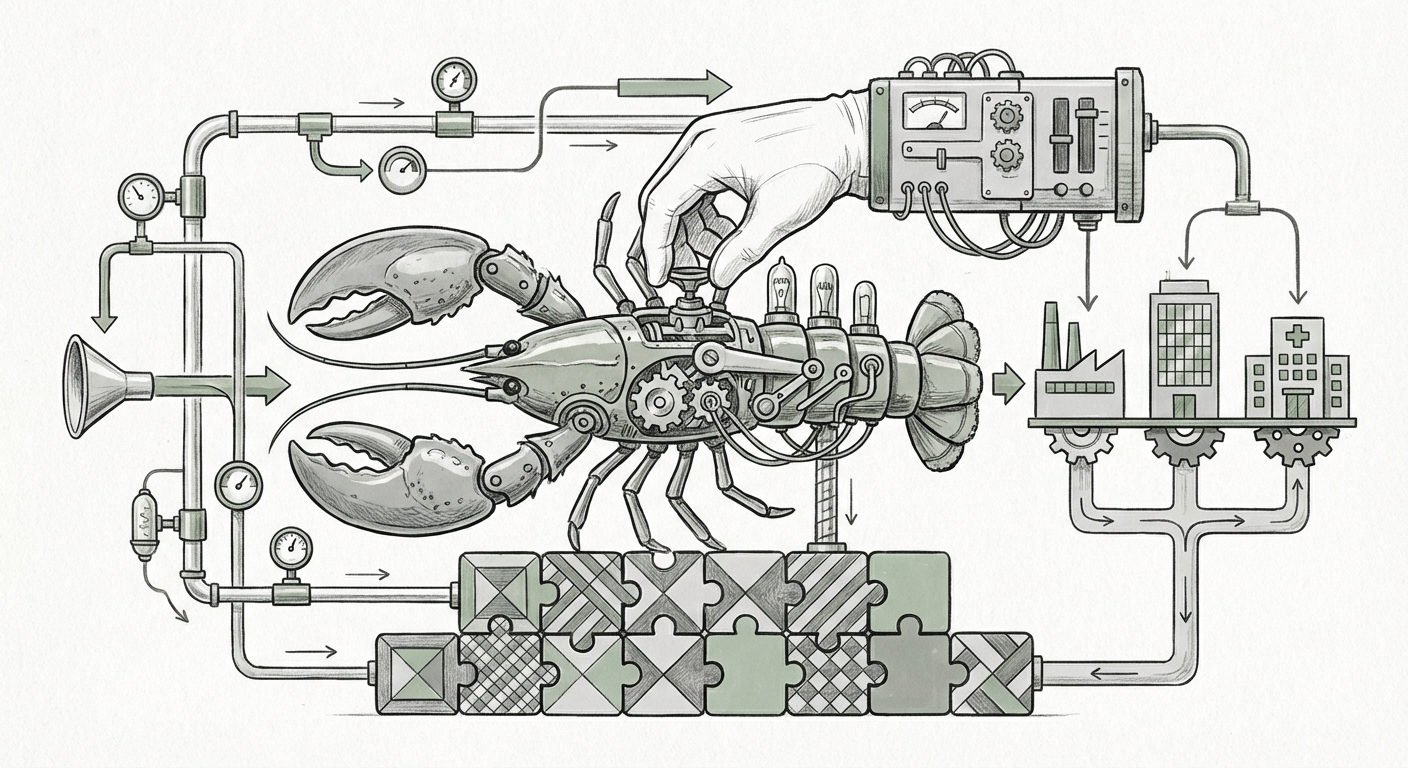
A recurrent model works differently. Instead of stacking hundreds of unique layers, it reuses the same smaller set of layers over and over, looping through them several times. Think of it less like a giant warehouse of knowledge and more like a small workshop where the same tools get used again and again on the same problem until it is solved.
This matters for three reasons:
- Iteration replaces size. A model can effectively "think longer" by looping more, rather than by being born bigger. That is a far cheaper way to add capability.
- Weights get shared. Because the layers are reused, the same parameters do far more work. You get more computation per parameter.
- Adaptive effort becomes possible. A recurrent design opens the door to spending more loops on hard problems and fewer on easy ones. That is much closer to how humans actually think.
The old criticism of recurrent approaches was that they were hard to train and unstable at scale. Results like URM suggest those barriers are falling. And when a barrier falls, an entire design space reopens.
The Economics of Thinking
Here is what most business readers should take away: reasoning is the most expensive thing an AI model does. Long chains of thought burn tokens, tokens burn compute, and compute burns money and electricity.
If a small recurrent model can reach the same or better reasoning performance as a much larger one, then the cost per correct answer drops, potentially by a lot. That changes the math on everything downstream:
- Inference costs fall. Serving a smaller model to millions of users is dramatically cheaper than serving a giant one.
- Latency improves. Smaller models respond faster, which matters enormously for interactive products.
- Deployment widens. Models that fit on modest hardware can run in places big models cannot reach, on-premise, in the field, in regulated environments, on edge devices.
- Energy demand eases. This is the quiet giant in the room. Data center power has become a genuine constraint on AI growth. Efficiency is no longer a nice-to-have; it is a strategic necessity.
In other words, URM is not just a research curiosity. It is a cost story, an energy story, and an access story all at once.
What This Means for the Future of AI
1. The "just scale it" era is ending, not dying, but narrowing
Scaling still works. Nobody should walk away from that. But the returns are getting harder to justify. When a small, cleverly designed model can match or beat a giant on reasoning, the smart money starts asking whether the next hundred million dollars of compute is really the best use of capital. Expect far more investment in architecture, training methods, and inference-time techniques, and less blind faith in parameter counts.
2. Reasoning becomes a design problem, not a spending problem
If capability can come from how a model computes rather than how much it knows, then the winners will be teams with deep architectural skill, not just the biggest checkbooks. That is genuinely good news for smaller labs, universities, startups, and researchers in countries without massive compute budgets.
3. Hybrid systems become the norm
The most likely future is not "small models replace big models." It is a layered world. A small recurrent reasoner handles the hard logic, planning, and multi-step problems. A large model handles broad world knowledge, open-ended conversation, and creative generation. Different jobs, different tools. Products will be built as systems, not as single monoliths.
4. Efficiency becomes a competitive weapon
Once one player proves that a smaller model can be smarter, every competitor has to answer it. Efficiency stops being an engineering afterthought and becomes a headline feature. Expect marketing language to shift from "our model has the most parameters" to "our model gets the right answer at a fraction of the cost."
Practical Implications for Businesses
For most organizations, the takeaway is not "go build a recurrent model." It is "stop assuming that only the biggest model will do."
Many companies are paying premium prices for frontier-scale models to do work that a smaller, well-chosen model could do just as well, or better. Tasks like structured extraction, routing, classification, code review, document analysis, and step-by-step troubleshooting are exactly where smart small models shine. If URM's lesson holds, the right question is no longer "which model is the most powerful?" It is "which model is powerful enough for this job, at the lowest possible cost?"
That shift has operational consequences. Procurement teams need to start comparing cost per successful task, not just benchmark leaderboard position. Engineering teams need to build systems that can swap models in and out, because the best choice will change every few months. Finance teams should be modelling inference spend as a first-class line item, because it is now a genuine strategic variable rather than a rounding error.
The Honest Caveats
It would be irresponsible to treat one strong result as a settled revolution. A few things need to be true before this changes the industry in a lasting way:
- It has to hold up beyond narrow reasoning tasks. Matching a large model on puzzles is not the same as matching it on messy, open-ended real-world work.
- It has to survive contact with production. Research wins often struggle when scaled to millions of users with tight reliability requirements.
- It has to be reproducible. The strongest signal will be other teams getting similar results with similar methods.
Still, the direction of travel is clear. The industry has been asking "how big can we make it?" for years. Now it is starting to ask "how well can we make it think?" Those are very different questions, with very different winners.
Actionable Insights
- Audit your AI spend by task type. Identify where you are using a frontier model for work a smaller model could handle. That is your fastest savings opportunity.
- Benchmark on your own problems. Public leaderboards tell you very little about your specific workflow. Build a small internal test set and run it against multiple model sizes.
- Design for model portability. Assume the best model will change. Keep abstraction layers thin so you can switch without rebuilding your product.
- Watch the efficiency frontier, not just the capability frontier. The most important AI news over the next year may be about cost per correct answer, not raw intelligence.
- Reconsider what you can run locally. As small models get smarter, on-premise and edge deployment become viable for more use cases, with real benefits for privacy, latency, and control.
The Bottom Line
URM's result is a reminder that AI progress is not one straight line pointing upward toward infinity. It branches. Sometimes the breakthrough is a bigger model. Sometimes it is a cleverer one.
For years, the industry bet everything on scale. That bet paid off spectacularly. But bets that pay off spectacularly tend to attract everyone, and when everyone crowds into the same strategy, the returns thin out. The next wave of advantage will come from people who figure out how to get more thinking out of less machinery.
A small model that reasons well is not just a cheaper model. It is a model you can put anywhere, in a laptop, a phone, a factory floor, a hospital, a car. That is the part of this story that should genuinely excite people. When intelligence gets cheap and portable, it stops being a luxury good and starts being infrastructure.
The giants will not disappear. But they will no longer be the only ones in the room. And that is exactly the kind of shift that reshapes industries.