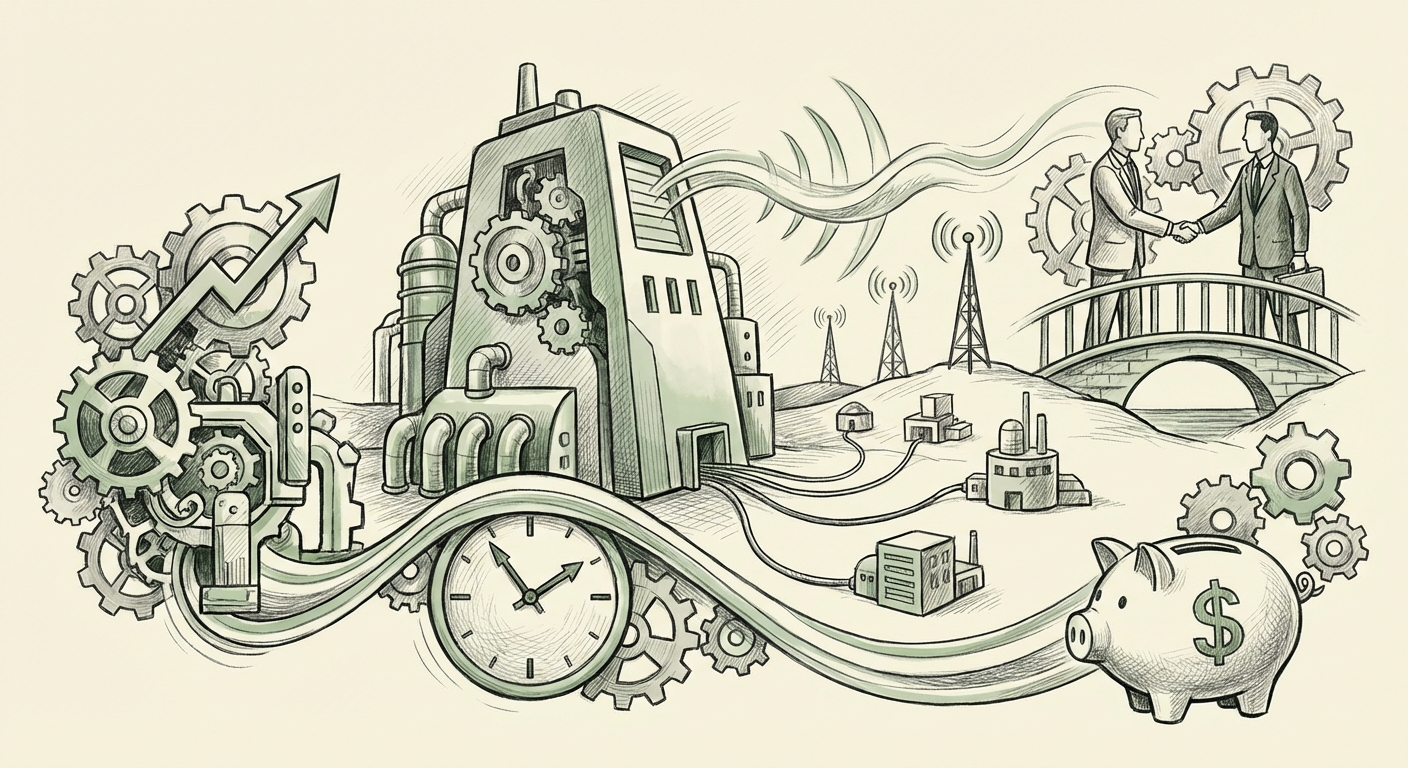
9 Best AI Gateways in 2026: Why This Ranking Matters for the Future of AI
Something quiet happened on the way to the AI revolution. The most important technology in the stack stopped being the model. It became the layer that sits in front of the model.
On October 14, 2026, a new ranking of the 9 best AI gateways landed, naming Bifrost, Portkey, LiteLLM, and Kong alongside five other platforms. On the surface, it reads like a buyer's guide, a shopping list for companies trying to pick software. Look closer, and it reads like a map of where the entire AI industry is heading.
Because when an entire product category goes from "nobody has heard of this" to "nine serious vendors and a published ranking" in a couple of years, that category has stopped being optional. It has become infrastructure.
What Exactly Is an AI Gateway?
Think of an AI gateway as a traffic controller for artificial intelligence.
When a company uses AI, it rarely talks to just one model from just one provider. It might use one model for writing, another for coding, a third for images, and a fourth for cheap, high-volume tasks. That means many keys, many bills, many formats, and many ways for things to break.
An AI gateway sits in the middle. Every request goes through it first. The gateway decides which model answers, tracks how much it cost, blocks bad or unsafe requests, logs what happened, and swaps in a backup if the main provider goes down.
Without a gateway, every team builds its own messy version of this. With one, the mess becomes a managed service with a dashboard.
That is why the ranking matters. It is not a list of nice-to-haves. It is a list of the plumbing that modern AI products now depend on.
The Names Tell the Story
The mix of names in the top of the list is the most revealing part.
Bifrost and Portkey represent the new generation, tools built from day one for a world with many models and many providers.
LiteLLM represents the open-source path, where teams want control, transparency, and the freedom to self-host.
Kong represents the old guard of API management moving into AI, bringing years of experience in routing, security, and scale.
Then there are five more entrants filling out the ranking. That spread, new startups, open-source projects, and established platforms, tells you the category is not a fad. When three very different kinds of companies all fight for the same spot, that spot is real. It means there is money there, and it means customers are demanding it.
Trend One: Nobody Believes in One Model Anymore
The single biggest idea behind the rise of AI gateways is that there is no single best model.
In the early days, teams picked one provider and built everything around it. That was simple, and it was also a trap. Models change fast. Prices change fast. A model that wins on reasoning this year may lose on cost next year. A new open-source release can appear overnight and undercut everything.
A gateway makes model choice a setting instead of a rewrite. You swap the model behind the gateway, and your application never notices.
This is the end of vendor lock-in as a business model. Companies that used to count on customers being stuck now have to compete on quality every single day. That is a huge shift, and it is good news for everyone building products.
Trend Two: AI Spending Is Now a Boardroom Problem
AI bills have a nasty habit of growing faster than revenue.
That is because AI costs are variable. Every request costs money. A feature that goes viral can turn into a surprise invoice. A bug that loops can burn thousands of dollars in an afternoon.
Gateways solve this by putting a meter on the pipe. You can set budgets per team, per customer, or per feature. You can route easy questions to cheap models and hard ones to expensive models. You can cache repeated answers so you only pay once.
Expect this to become standard practice. In the same way every company tracks cloud spending today, every company will track AI spending tomorrow. The gateway is where that number lives.
Trend Three: Trust, Safety, and Rules Move Into the Pipe
Governments are writing AI rules. Customers are asking hard questions. Lawyers are getting involved.
A gateway is the natural place to enforce all of it. It can block sensitive data from leaving the building. It can filter prompts and responses for harmful content. It can keep an audit trail showing who asked what, when, and which model answered.
This matters because compliance done at the application layer is chaos. Every team does it differently, and pieces get missed. Compliance done at the gateway is consistent. One checkpoint, one policy, one log.
The gateway is quietly becoming the compliance officer of the AI stack.
Trend Four: Observability, You Can't Fix What You Can't See
Traditional software gives you clear signals: an error, a slow page, a crashed server. AI is murkier. The answer came back, but was it good? Was it correct? Did it cost more than last week?
Gateways collect the data that makes AI measurable. Response times, success rates, cost per request, which prompts perform best, which models fail most often. That data is what turns AI from a magic trick into an engineering discipline.
For business leaders, this is the difference between a demo and a product. You cannot put an AI feature on a roadmap, promise it will save money, and then have no way to prove it. The gateway is where the proof comes from.
Trend Five: Agents Are Coming, and They Need Plumbing
So far, most AI traffic is a human asking a question and a model answering. That is changing.
AI agents, software that plans, takes actions, and calls other tools, generate far more requests than humans do. One agent task can trigger dozens or hundreds of model calls, often to different providers.
This is where gateways stop being convenient and start being essential. If thousands of agents are making decisions and spending money, you need a control point. You need limits, budgets, fallbacks, and a record of what happened.
The gateway is turning into the nervous system for machine-to-machine work. As agents multiply, that role gets bigger, not smaller.
What This Means for Businesses
For business leaders, the arrival of a ranked AI gateway market is genuinely good news. It means you no longer need to build this layer yourself.
The practical implications are straightforward:
- Your AI costs become predictable. Budgets and routing rules replace surprise invoices.
- You gain leverage over vendors. If a provider raises prices, you can switch without rebuilding.
- You can move faster. Teams test new models in days instead of months.
- You get a safety net. If one provider goes down, traffic reroutes automatically.
- You get evidence. Real usage data replaces gut feelings about what AI is delivering.
The risk is complacency. Some companies will treat a gateway as a checkbox and never look at the data it produces. That would be a mistake. The value is not in owning the tool, it is in acting on what the tool reveals.
What This Means for Society
The bigger picture is about control.
When AI runs through a central point, it becomes possible to say no. To block a harmful request. To stop a company from sending private data to a foreign server. To keep a record when something goes wrong.
Without that layer, AI spreads through an organization like water through cracks, impossible to see, impossible to govern.
There is a trade-off, of course. A central gateway is also a central point of failure and a tempting target. Who controls it controls what AI can do. That is a real question, and it deserves public attention as this category matures.
But the alternative, no visibility at all, is worse. A world where AI decisions happen invisibly, with no logs and no limits, is a world where accountability disappears. The gateway market emerging now is a sign that we are choosing visibility.
Actionable Insights: What to Do Next
If you are evaluating an AI gateway, or wondering whether you need one, here is a practical path.
First, count your models. If you use more than one AI provider, you have already outgrown manual management.
Second, find your pain. Is it cost? Latency? Compliance? Outages? Your answer should shape which of the nine platforms you shortlist.
Third, test with real traffic. Run a pilot on one non-critical feature. Watch the cost and reliability numbers for a month before expanding.
Fourth, check the exit. Ask how hard it is to leave. A good gateway should make switching easy, that is the whole point.
Fifth, decide on hosting. Open-source options give you control. Managed services give you speed. Pick based on your team, not on trends.
Sixth, plan for agents. Even if you are not using them today, assume you will be. Choose a gateway that can handle high-volume, machine-driven traffic.
Seventh, put someone in charge. A gateway without an owner becomes shelfware. Assign a person or team to watch the dashboard and act on it.
The Bottom Line
A ranked list of nine AI gateways sounds like a small piece of industry news. It is not.
It is evidence that AI has grown up. The exciting part of the last few years was the models. The important part of the next few years is everything around them, the routing, the budgets, the guardrails, the logs, the reliability.
That is unglamorous work. It is also the work that decides whether AI becomes a reliable tool that businesses trust with real money and real customers, or a clever demo that never quite survives contact with reality.
With Bifrost, Portkey, LiteLLM, Kong, and five others now competing openly for the top spots, the market is answering that question in public. The plumbing is no longer an afterthought. It is the product.
For anyone building with AI, the message is clear: pick your gateway as carefully as you pick your model. In 2026, it may matter just as much.