Hyundai's $15.5 Billion India Bet: What It Means for the Future of AI
When a car company promises to spend $15.5 billion in a single country by 2032, most headlines focus on cars, factories, and jobs. That's the obvious story. But there's a quieter story hiding underneath it, one about data, software, robots, and the artificial intelligence systems that will decide which automakers win the next decade.
Hyundai, the South Korean carmaker, has laid out a "strategic" investment of $15.5 billion in India, with a target date of 2032. That's a long runway and a very large number. And here's the key point for anyone watching the AI industry: you cannot spend money at that scale in the modern auto business without spending a huge share of it on intelligence, the software and machine learning that make vehicles think, factories adapt, and supply chains predict.
So let's break down what this announcement actually signals, and why it matters far beyond one company or one country.
Why an Auto Investment Is Really an AI Investment
Twenty years ago, a car was a mechanical product with a little electronics bolted on. Today, it's closer to a computer on wheels. A modern vehicle runs on millions of lines of code, streams data from dozens of sensors, and increasingly relies on AI for everything from lane-keeping to battery management to predicting when a part will fail.
That shift changes what a multi-billion-dollar expansion actually buys. It's no longer just land, steel, and stamping machines. It's:
- Connected vehicle platforms that collect and process data from every car on the road.
- Software teams that write and maintain the operating systems inside those cars.
- Factory automation where robots and vision systems handle quality control.
- Cloud and computing infrastructure to train and run AI models.
- Data pipelines that turn raw sensor feeds into usable business insight.
When you add those together, a carmaker's capital plan starts to look a lot like a technology company's capital plan. That's the real headline here.
Smart Factories: Where AI Meets the Assembly Line
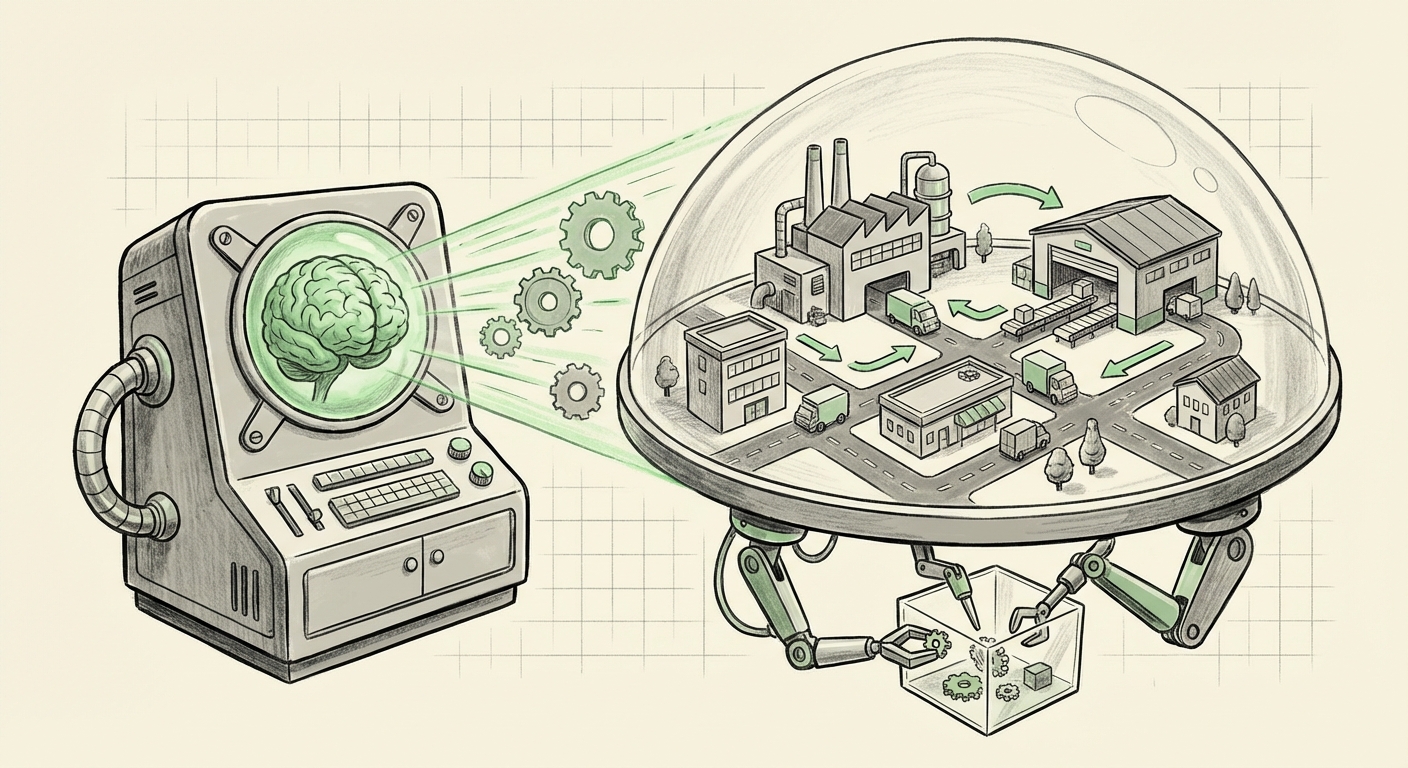
The most immediate place AI shows up in a plan like this is on the factory floor. Modern auto plants are becoming what the industry calls "smart factories," where AI quietly does the boring, high-stakes work.
Quality control that never blinks
Computer vision systems, cameras paired with AI models, can inspect thousands of welds, paint finishes, and panel gaps per hour. A human inspector gets tired after a few hours. A model doesn't. At the scale of a large manufacturing base, catching defects earlier saves enormous amounts of money and rework.
Predictive maintenance
Machines break. The question is whether they break on schedule or at 3 a.m. during a peak production run. AI models trained on vibration, temperature, and sound data can flag a failing motor or press days before it dies. In a plant running around the clock, that's the difference between a planned pause and a shutdown.
Digital twins
Manufacturers increasingly build a software replica of a factory, a "digital twin", and use it to test changes before touching the real line. Want to know if a new layout speeds things up? Simulate it first. This is one of the clearest examples of AI and simulation paying for themselves in industrial settings.
The Software-Defined Vehicle and Why Data Compounds
Here's the part that should make strategists sit up. Every connected car is a data-generating machine. It reports on how it's driven, how its battery behaves, what roads are like, and how its software performs. Multiply that by hundreds of thousands of vehicles and you get something valuable: a feedback loop.
More cars produce more data. More data trains better AI. Better AI makes the cars safer and more appealing. More appealing cars sell more units. The loop spins faster.
This is why automakers fight so hard over software. It's also why a long-horizon investment through 2032 makes sense. AI advantages in this industry aren't won in a single product cycle, they're compounded over years.
Localization is an AI problem too
India presents a specific challenge that AI is well suited to solve. Roads look different. Traffic patterns differ. Driving behavior, weather, dust, and road quality all vary from what you'd see in Seoul, Detroit, or Frankfurt. An advanced driver-assistance system trained mostly on European highways will not perform the same way on a crowded Indian arterial road.
That means the value of collecting and labeling local data is enormous, and it's a genuine AI engineering task. Companies that build regional data pipelines and retrain their models for local conditions create a moat that's hard to copy from a distance.
The Talent and Ecosystem Angle
You can't deploy AI at industrial scale without people. India has become one of the world's largest sources of software and data talent, with deep pools of engineers working on machine learning, computer vision, and embedded systems. An investment commitment of this size implicitly assumes access to that talent, and, in turn, helps deepen it.
There's a second-order effect worth noting. When a major manufacturer commits billions to a region, suppliers, software vendors, and startups tend to follow. That creates a cluster. And clusters are where AI tooling gets built, tested, and standardized.
Supply Chains: The Unglamorous AI Win
Ask any operations leader where AI has paid off fastest, and they'll often point to the supply chain, not the showroom. Demand forecasting, inventory planning, logistics routing, and supplier risk monitoring are all problems where machine learning excels.
Auto manufacturing is one of the most complex supply chains on Earth. A single missing chip can idle a line. AI models that predict demand swings, flag at-risk suppliers, and optimize shipping routes deliver returns that show up directly on the balance sheet. For a long-term expansion plan, this is where the earliest and most measurable AI payoffs tend to land.
What This Means for Businesses Outside the Auto Industry
If you run a company that isn't a carmaker, why should you care? Because the playbook is transferable.
- Long-horizon capital plans now include AI infrastructure. Budgets that used to be "buildings and equipment" are becoming "buildings, equipment, data, and models."
- Localization beats centralization for AI. Models trained on the wrong data underperform. Regional data strategy is a competitive issue, not a footnote.
- The compounding effect favors the patient. AI gains accrue over years, not quarters. Companies with a 2032 mindset will outpace those optimizing for next quarter.
- Physical industries are the next AI frontier. Much of the easy value in digital-only AI has been captured. The harder, bigger prizes are in factories, fleets, grids, and supply chains.
Risks and Open Questions
It would be naive to treat a big number as a guaranteed outcome. Several things could change the picture.
Execution risk. Large, multi-year investment plans move through shifting economic conditions, policy changes, and technology cycles. What looks strategic in year one may need rethinking by year four.
Talent competition. The demand for AI and software engineers is global. Building and retaining teams at scale is genuinely hard.
Data governance. Connected vehicles raise serious questions about privacy, security, and who owns the data. Getting this wrong invites regulatory friction and erodes customer trust.
Energy and compute. Training and running AI models is computationally expensive. Infrastructure planning has to account for that.
None of these are reasons to avoid the shift. They're reasons to plan for it carefully.
Actionable Insights
Here's what leaders in any industry can take away from this moment:
- Treat AI as capital, not a project. Fold model training, data infrastructure, and talent into your long-term investment planning.
- Build a data flywheel deliberately. Ask what data your products generate, who can access it, and how it improves your offering over time.
- Localize your models. A model trained on the wrong region, language, or environment will underperform, sometimes dangerously.
- Start with operations, not flash. Predictive maintenance, quality control, and forecasting deliver faster returns than headline-grabbing pilots.
- Measure in years, not quarters. The compounding nature of AI means patience is a strategy, not a compromise.
- Plan for governance early. Privacy, security, and compliance decisions get much more expensive once systems are already deployed.
The Bigger Picture
What's genuinely interesting about a $15.5 billion commitment through 2032 isn't the number. It's the timeline. It signals a company thinking past the current model generation, past the current battery chemistry, past the current regulatory regime, into a future where vehicles are software platforms, factories are semi-autonomous, and data is a core asset.
That's the future of AI in physical industry. Not chatbots. Not hype cycles. Robots welding, models forecasting, sensors streaming, and software updating overnight in millions of machines.
The companies that understand this early, whether they make cars, appliances, turbines, or packaged goods, will be the ones whose AI investments actually pay off. The ones that treat AI as a side experiment will keep wondering why their competitors seem to get better every year.
Watch the next few years of this expansion closely. Bright announcements are easy. What matters is what gets built, what gets measured, and how much intelligence ends up embedded in the machines.