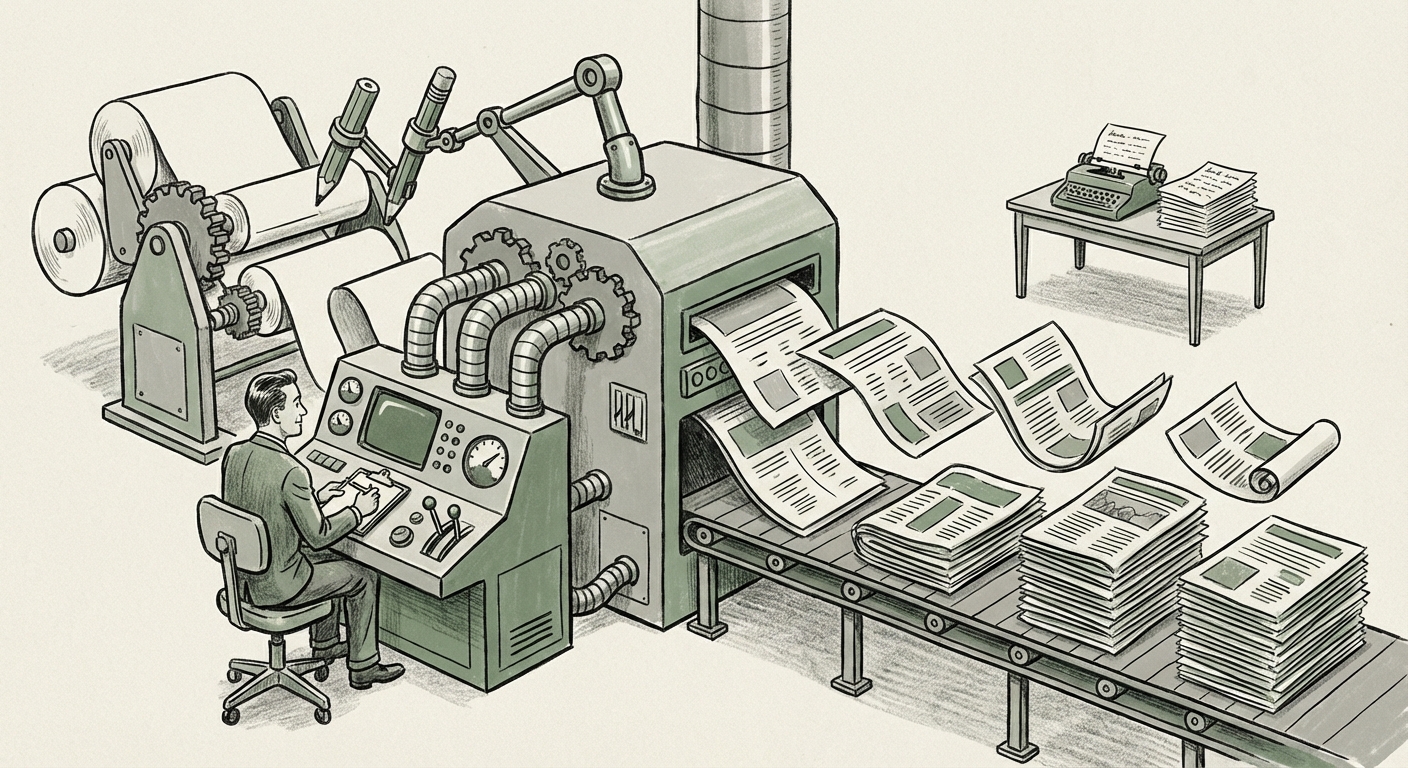
What John Cena's "Think About Death" Trick Teaches Us About the Future of AI
John Cena says something surprisingly simple about getting through hard days. Thinking about death, he says, helps him make a bad day shorter. Not happier. Not easier. Shorter.
It sounds like a throwaway line from a celebrity interview. But sit with it for a minute, because it hides a powerful idea about how humans handle hard things, and how badly our machines handle them right now.
People have a built-in clock. We know our time is limited, even if we try not to think about it. That clock changes how we act. It makes us stop arguing about small stuff. It makes us quit a bad job. It makes us end a bad conversation and go hug someone. Cena's trick is really a focus trick. When you remember that your time runs out, a bad day stops being something you sit inside. It becomes something you move through.
Now here's the part that matters for anyone working with AI: today's AI systems have no clock like that. They will happily keep generating, keep optimizing, keep going down a bad path forever. And that is quietly becoming one of the biggest problems in the entire industry.
Bad Days Are a Human Feature, and a Design Lesson
Think about what actually happens when you have a truly awful day. You don't need someone to write you a report explaining that the day is awful. You feel it fast. Then, usually, you act: you cut the meeting short, you leave the party early, you call it a night.
That ability to sense when something is going wrong and stop it early is one of the most valuable skills a person can have. It saves time, money, energy, and heartache.
It is also almost completely missing from most AI systems people are deploying today.
Most AI tools are built around one goal: produce more. More text, more images, more code, more recommendations, more actions. Ask an AI agent to improve a process, and it will keep improving it. Ask a chatbot to keep a conversation going, and it will keep talking. Ask a content system to generate ideas, and it will generate ten thousand of them without ever asking whether any of them are worth a minute of your life.
There is no moment where the machine thinks, "This is going badly. Let's end this quickly and move on."
Why "Shorter Bad Days" Is the Next Big AI Skill
This is where the industry is heading, whether companies realize it or not. The next jump in AI isn't about making models bigger or faster. It's about making them aware of cost, time, and stakes, and giving them permission to quit.
Some people call this "stopping rules." Others call it "budget-aware agents" or "self-correcting loops." The name matters less than the idea: an AI system should know how much it has to spend, in seconds, in dollars, in human attention, and it should give up on a bad approach before burning through all of it.
Picture the difference in real terms.
- Today: A support agent keeps trying to solve a customer's problem for twenty minutes, repeating the same failed steps, while the customer gets angrier.
- Tomorrow: The agent notices after three attempts that it is not working, stops, explains what it tried, and hands the problem to a human, who now has useful context instead of a mess.
Same technology. Very different outcome. The difference is a sense of limits.
The Business Case Is Boring and Enormous
For business leaders, this isn't philosophy. It's budget.
Every AI system that runs too long costs money. Cloud compute costs money. Human review costs money. Wasted customer patience costs money, often the most. A model that happily grinds away on a task it will never finish is not "working hard." It's leaking value.
This is already visible in the way companies talk about AI. Two years ago the question was, "Can the model do it?" Now the questions are sharper: How much does each answer cost? How many steps before it gives up? Who checks the output? What happens when it's wrong?
That shift, from "can it?" to "should it, and for how long?", is the same shift Cena is describing, just applied to software. It's the move from endless effort to deliberate effort.
Companies that build this discipline into their AI systems early will win on two fronts. They'll spend less, and they'll trust their tools more. Trust, not raw capability, is what turns a demo into something a business actually relies on.
The Human Side: AI, Meaning, and Why We Build Anything
There's a deeper layer here too, and it's worth saying plainly.
Cena's comment works because humans are meaning-making creatures with an expiration date. We care about outcomes because our time is finite. We want good days to be long and bad days to be short because we only get so many.
AI has none of that. It doesn't care whether a project succeeds. It doesn't get frustrated, bored, or grateful. It doesn't experience a bad day.
That's exactly why humans have to supply the "why" in every AI system that matters. The machine can generate options at a scale no person can match. But only a person can decide which option is worth doing, and which ones should be killed fast.
This is the real story behind all the hype about AI agents and automation. As machines get better at doing, the bottleneck moves to judging. The most valuable people in an AI-heavy workplace won't be the ones who can prompt best. They'll be the ones who can look at fifty AI-generated options and say, "This one. Trash the rest."
That's a skill, and it looks a lot like what Cena is talking about. Knowing what deserves your time, and being ruthless about everything that doesn't.
What This Means for Society
Zoom out, and the implications get bigger.
We are heading into a world where AI can produce almost anything in unlimited amounts: content, code, designs, responses, decisions. When supply is infinite, attention becomes the scarce resource. The winning systems won't be the ones that produce the most. They'll be the ones that produce the least, the smallest useful output, delivered at the right moment, and then shut up.
That's a hard idea for a tech industry built on engagement and scale. But it's where user trust lives. People are already exhausted by feeds that never end, notifications that never stop, and chatbots that never conclude. The products that break that pattern will feel like relief.
There's a risk too. If we teach AI to end things quickly, we have to be careful about what it ends. Cutting off a bad task is good. Cutting off a person who needs help is not. The judgment has to stay with humans, especially in areas like health, finance, hiring, and anything touching someone's safety.
A Practical Playbook
If you're building with AI, or just using it, here's how to apply the "make the bad day shorter" rule right now.
- Set a hard stop for every AI task. Define a maximum number of steps, seconds, or dollars before the system must pause and report back.
- Require a "give up" path. Every AI workflow should have a clear way to fail gracefully and hand off to a human, with context attached.
- Measure wasted effort, not just success. Track how often your AI goes in circles. That number is often more revealing than accuracy scores.
- Time-box pilot projects. Give every AI experiment a deadline and a kill switch. If it hasn't shown value by then, end it. Don't let it drift.
- Keep a human on the "stop" button. Until systems reliably understand stakes, someone must be able to pull the plug fast, and be rewarded for doing it.
- Judge output by usefulness per minute. Ten good answers beat a thousand okay ones. Ask your AI for less, not more.
- Review your own habits too. If a tool is making your days longer, you're allowed to cut it. That's the whole lesson.
The Road Ahead
The next few years of AI will not be defined by who has the most powerful model. It will be defined by who builds systems with limits built in, systems that know when to stop, when to ask, and when to walk away.
That's an unglamorous kind of progress. It won't make headlines the way a new model release does. But it's the progress that turns AI from an impressive toy into something people genuinely depend on.
And there's a quiet human lesson buried in all of it. The reason a bad day feels shorter when you remember your time is limited isn't sadness. It's clarity. It forces you to sort what matters from what doesn't.
We should want that same clarity from our machines.
Conclusion
John Cena's simple habit, thinking about death to shorten a bad day, isn't really about death at all. It's about focus. It's about refusing to let a bad stretch of time eat more of your life than it deserves.
That idea maps almost perfectly onto the biggest gap in AI today: machines that don't know when to stop. The winners of the next phase of this technology won't be the ones that generate the most. They'll be the ones that know when to quit, when to hand over, and when to leave you alone.
Build AI with a clock. Build it with limits. Build it knowing that attention, human attention, is the one thing that never comes back.