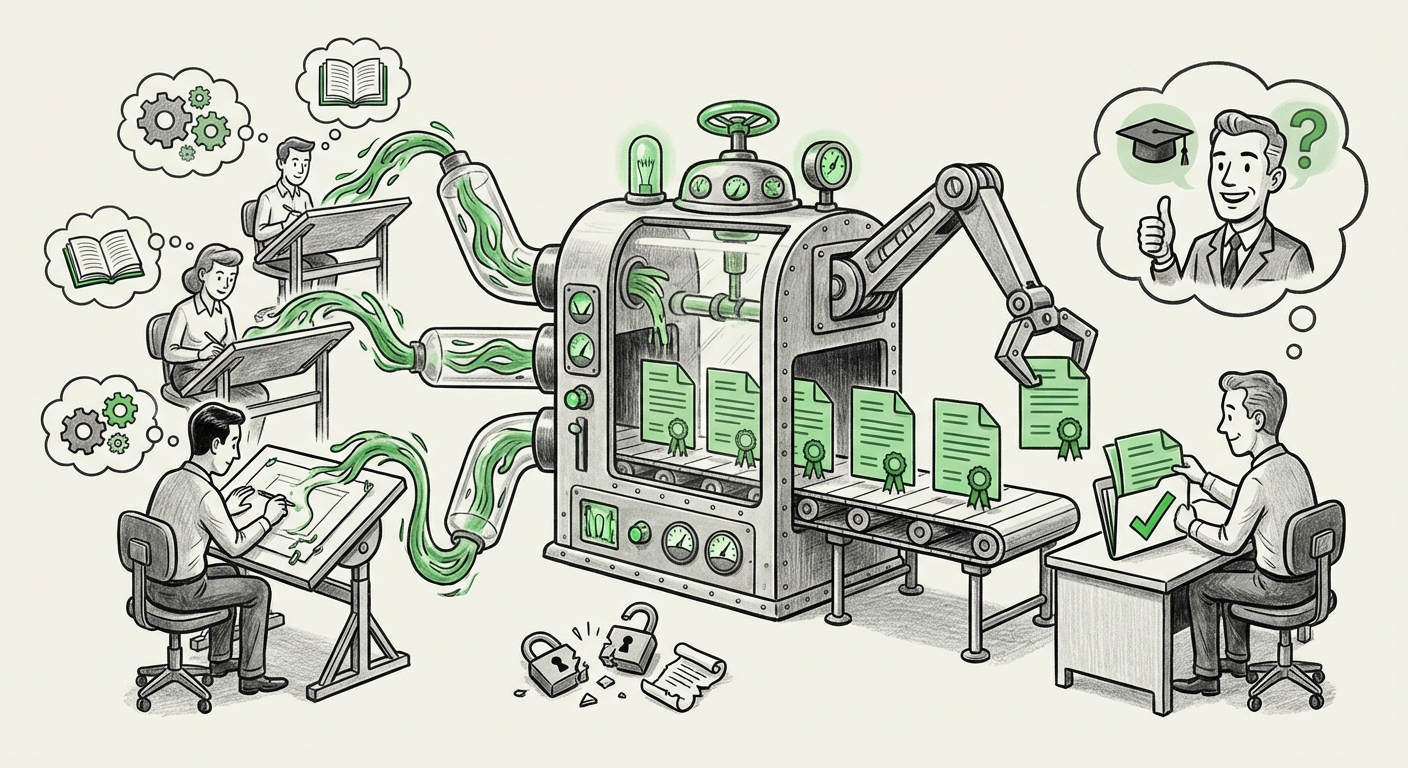
Source-Aware Verification for MCP Agents: Why AI's Next Big Leap Is Knowing Where Facts Come From
For years, the big question about AI was simple: is the answer right? That question is now outdated.
AI has changed shape. The most useful systems today are not chatbots that answer from memory. They are agents, software that reads files, calls tools, queries databases, browses pages, and then acts on what it finds. The plumbing that makes this possible is the Model Context Protocol, or MCP. It is a shared standard that lets an AI model plug into outside tools and data sources through one common connector, instead of a custom integration for every single system.
That shift is a leap forward. It is also a leap into a problem most teams have not yet named. When an agent pulls information from ten different places and blends it into one answer, the hard question is no longer whether a fact is true. The hard question is where that fact came from, how it traveled, and whether the agent had any business trusting it.
That is the idea behind source-aware verification. It is not just a technical upgrade. It is a change in what "AI accuracy" even means.
What MCP Agents Actually Do, and Why It Changes Everything
Think of MCP as a universal adapter. Before it, connecting an AI to a company's calendar, code repository, customer database, or document store meant writing separate custom code for each one. With MCP, a developer builds one connector, an MCP server, and any compatible agent can use it.
The result is an explosion of connections. An agent might now call a search tool, open a spreadsheet, read a policy document, check a ticket system, and summarize everything in a single reply. That is exactly what makes agents valuable. It is also what makes them fragile in a brand-new way.
Here is the core problem. To the model, text is just text. A carefully audited financial record and a random comment scraped from an open forum look identical once they land in the context window. The model has no instinct about whether a source is a peer-reviewed study or an anonymous post. If the retrieval layer does not carry that information, it does not exist.
Fact-Checking vs. Source-Checking: A Distinction That Changes Everything
Facts and sources are not the same thing, and confusing them causes real harm.
Fact-checking asks whether a claim matches reality. It is the question we have all been trained to ask about AI: did it get the number right?
Source-aware verification asks a question that comes earlier in the chain. Where did this claim come from? How many hands did it pass through? What is this source's track record? Is this source even appropriate for the decision being made?
These two questions can give opposite answers. A fact can be completely accurate and still be dangerous, if it arrived through a channel the agent should never have trusted, or if the agent cannot explain where it learned it. Meanwhile, a claim from a highly trusted source can turn out to be wrong.
There is a simple rule that captures this: in a blended answer, trust equals the trust level of the weakest input. Unless the system tracks which input contributed what, the strength of your best source is meaningless. One weak link sets the ceiling for the whole answer.
Why Source-Aware Verification Is Harder Than It Sounds
If this were as easy as adding a "source" field, everyone would already do it. Several forces make it genuinely difficult.
Provenance decays
Information rarely arrives in its original form. It gets copied, reformatted, summarized, translated, and pasted into a slide deck. By the time an agent reads it, the original author may be a footnote, a broken link, or completely absent. Provenance, the record of where something came from, fades with every hop.
Trust depends on context, not just identity
The same source can be perfectly fine for one task and completely unacceptable for another. A casual wiki page is great for brainstorming a slogan. It is unacceptable as the basis for a legal filing or a medical recommendation. A verification system that only asks "is this source reputable?" misses the real question: reputable for this task?
Sources can be manipulated
This is the sharpest edge. A document can contain hidden instructions aimed at the agent. A tool can return text designed to hijack the agent's next move. This is often called prompt injection, and it works precisely because models struggle to tell the difference between information and instruction. Source-aware verification helps here in a direct way: if the agent knows a piece of content came from a low-trust, untrusted origin, it can treat it as data to be examined rather than orders to be followed.
Volume defeats manual review
A single agent session can involve hundreds of tool calls, each returning pages of content. No human can trace that by hand. If source tracking is not built into the system automatically, it does not happen at all.
The Real Risks When Sources Go Unchecked
- Poisoned context: An agent acts on injected instructions hidden inside retrieved content, and the damage is done before anyone notices.
- Audit failure: A regulator, auditor, or board asks why the system produced a certain decision. If the source chain was never recorded, there is no answer. "The AI said so" is not a defense.
- Silent drift: A source that was reliable last quarter may now be stale, compromised, or abandoned. Without continuous source awareness, the system keeps trusting it.
- Compounding error: One bad input feeds an agent's next step, which feeds the step after that. A small unsourced error can snowball into a confident, fully wrong outcome.
- Lost accountability: When sources are untraceable, so is responsibility. Nobody can fix what nobody can trace.
What This Means for Businesses: Practical Steps
Source-aware verification is not a product you buy. It is a practice you build into how agents are designed. Here is where to start.
- Classify your sources. Build a simple trust tier list for every tool and data source your agents can reach. Some are authoritative. Some are useful but unverified. Some should be read-only, and never treated as authoritative for anything.
- Match trust to task. Define which trust tiers are acceptable for which decisions. A tier-1 source for a customer email draft might be tier-4 for a compliance report.
- Separate instructions from data. Retrieved content should almost never be able to issue commands to the agent. Make that a hard rule, enforced in the system, not a suggestion in a prompt.
- Require attribution in output. If an agent cannot point to where a claim came from, that claim should be flagged, softened, or dropped. An answer that shows its sources is worth far more than one that only sounds confident.
- Log the chain, not just the answer. Record which tools were called, what they returned, and which sources fed the final result. This is the difference between an auditable system and a black box.
- Red-team with poisoned inputs. Deliberately feed your agents documents containing hostile instructions. Find the gaps before someone else does.
- Add freshness and expiry rules. Sources should have a shelf life. Stale is a form of untrustworthy.
- Keep humans in the loop for high-stakes work. Source awareness makes human review faster and sharper, because the reviewer can see exactly what the agent leaned on.
What It Means for Society
The bigger implications reach well beyond the enterprise.
If AI agents become the primary readers of the internet, and the direction of travel suggests they will, then being readable as trustworthy becomes economically valuable. Publishers, researchers, and organizations that clearly document their sources, ownership, and edit history gain an edge. Those who don't risk becoming invisible to the systems that now do the reading.
That is mostly a good incentive. It rewards transparency. But there are two traps worth watching.
The first is a two-tier information web. If only large, well-resourced organizations can prove their provenance to an agent's satisfaction, smaller voices with equally good information could get filtered out, not because they are wrong, but because they cannot produce paperwork. Verification systems must be cheap and open, or they become gatekeepers.
The second is trust laundering. Bad information placed on a trusted domain inherits that domain's reputation. Source-aware verification has to look past "who published this" to "what is the chain of evidence behind it," or it will simply create a new way to be fooled.
And then there is accountability. When an AI agent makes a decision that harms someone, the question of who is responsible gets answered by the source chain. If you can trace the inputs, you can trace the responsibility. If you cannot, everyone shrugs, and that outcome serves no one.
The Future: Agents That Show Their Work
Picture the near future. You ask an AI agent a question and you get an answer with a source map attached, not a vague citation, but a visible chain showing which sources were used, how much each contributed, and how much the system trusted each one. Where confidence was low because a source was weak, the answer says so out loud.
This is where the field is heading, and it makes sense that it lands in the protocol layer. Source-aware verification works best when it is built into the way agents connect to tools, when every MCP connection carries metadata about origin, reliability, and freshness, rather than being bolted on afterward as a patch. Bolted-on verification is brittle. Built-in verification is durable.
The competitive consequence is simple and stark. "Where did you learn that?" will become a routine question asked of AI systems. The ones that can answer clearly will be trusted with more important work. The ones that cannot will be confined to low-stakes tasks, no matter how impressive their reasoning looks on a demo.
The Bottom Line
The race in AI is shifting. It is no longer only about building smarter models or connecting them to more tools. It is about building agents that know the difference between a fact and a finding, between a claim and a credible source. Getting the source right is not a refinement of the fact. It is the foundation the fact stands on.
Teams that treat source awareness as a core design principle, not an afterthought, will build AI that people can actually depend on. Everyone else will keep building systems that sound certain and cannot say why.