Apple's Folding iPhone "Duo": Why the Wait Matters for the Future of AI
There is a question hanging over the smartphone world in October 2026, and it is being asked with a wink: want Apple's folding iPhone? "Duo" you have patience? The joke lands because it captures something real. The foldable iPhone, the one hinted at with the name "Duo", is still a thing people are waiting for. Apple's rivals have been selling folding phones for years. Apple, as usual, has not rushed.
On the surface, this looks like a hardware story. A screen that bends. A hinge that survives a few hundred thousand open-and-close cycles. A price tag that makes people wince.
It is not just a hardware story. It is an AI story wearing a phone costume.
Here is the argument: the next wave of artificial intelligence is not about a chatbot answering trivia. It is about AI that lives on your device, sees what you see, hears what you hear, and acts on your behalf across many apps at once. That kind of AI needs something a normal phone has never had enough of, space. Screen space, yes, but also thermal space, battery space, and the mental space to show you two or three things at the same time.
A folding iPhone, whenever it arrives, is not really a bigger phone. It is the first Apple device designed around the assumption that an AI is doing part of the work.
The Patience Problem: Why Apple Waits
Apple's habit of arriving late and winning anyway is well known. The company rarely ships the first version of anything. It ships the version that ordinary people actually want to buy.
Foldables are a perfect example of a category with an awkward adolescence. Early models made headlines, then made returns. Creases. Hinges that loosened. Software that did not know what to do with two screens. Batteries that gave up by mid-afternoon.
So Apple's patience is not stubbornness. It is a bet that the category needs to mature before a mainstream audience will pay mainstream money for it. The name "Duo" matters here, because it suggests a two-part idea, something that opens into a second self. Not a phone that bends, but a device that becomes two things: a phone when you need a phone, and a workspace when you need a workspace.
That shift in framing is where AI enters the room.
Why a Foldable Is Really an AI Story
Think about what today's best AI assistants struggle with. It is rarely intelligence. It is context.
An AI can write a paragraph. It can summarize an email. But ask it to plan a trip, compare three options, book one, message your colleague, and update your calendar, and you quickly run into a wall. The wall is not the model. The wall is the screen, and the fact that you have to keep swiping between apps to supervise the work.
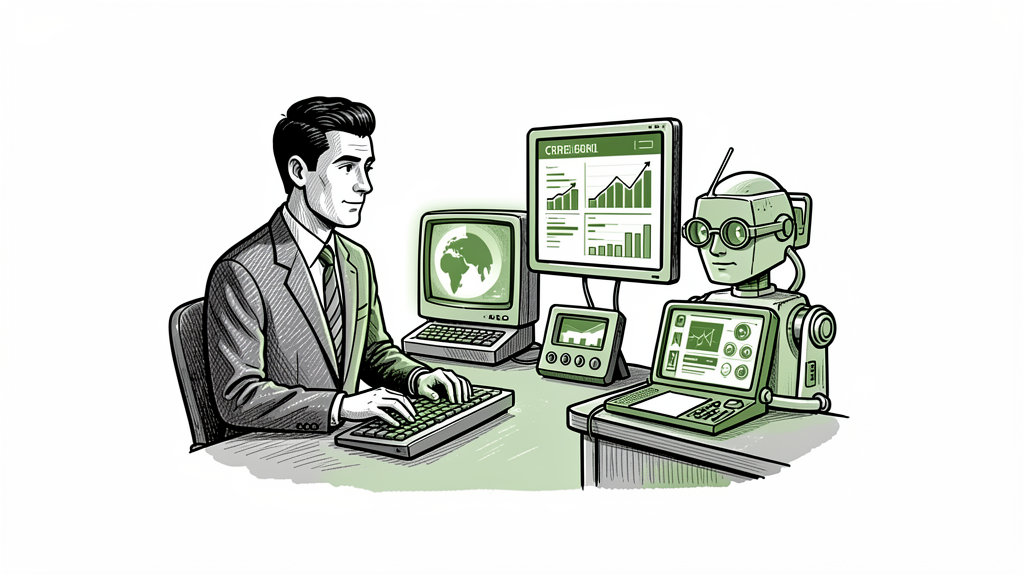
Now imagine that same task on a device that unfolds into a small tablet. Your email lives on the left. The AI's drafting pane lives on the right. A map or a calendar sits below. You are no longer switching between tasks. You are watching them happen.
That is the real product. The foldable form factor is what turns an AI from a command line into a dashboard. And dashboards change behaviour. People trust and delegate more when they can see what is going on.
Three AI behaviours a bigger canvas unlocks
- Parallel work: One panel for you, one for the agent. You edit, it drafts. You read, it searches. Both visible at once.
- Multimodal input: A larger screen plus a camera plus a stylus or hand gesture turns the device into something you can point at. Point at a form, get it filled. Point at a diagram, get an explanation.
- Ambient presence: Fold a device into a tent shape and it becomes a small, always-on assistant on your desk or kitchen counter. Same device, new role.
The Hinge, the Heat, and the Limits of On-Device AI
This is the part most coverage skips, and it is the part that decides whether the promise is real.
Running AI on a device instead of in a data center is a physics problem. Inference, the act of an AI producing an answer, generates heat and drains battery. Do it a lot, and the phone gets warm and dies faster. That is true today on a slab phone, and it is worse on a device that folds, because a hinge splits the internal volume in two.
A hinge is a mechanical joint. It cannot carry cooling. It cannot hold a giant battery. Engineers have to work around it. Where does the chip go? Where does the heat pipe go? Where does the radio antenna go so it does not get blocked when the device is half-open?
None of this is glamorous, and all of it is decisive. A foldable iPhone that runs heavy AI on-device has to solve four problems at once:
- Thermals: Spreading heat across two halves instead of one.
- Power: Fitting enough battery into two thin slabs while keeping the device light.
- Antennas: Keeping a strong signal in every hinge angle, from closed to flat.
- Durability: Making a moving part last as long as a solid one.
This is a strong argument for a hybrid AI model: light, private, always-available tasks handled on the device, and heavy reasoning handed off to servers. The foldable makes the split more visible, and more useful. Small jobs happen instantly, on the panel in front of you. Big jobs spin up elsewhere and stream back. The user never has to know or care where the line is, as long as it feels fast.
Software Is Where the Money Is
Hardware sells once. Software sells forever. The real value of a folding iPhone is that it creates a new kind of app that did not exist before.
Today, every app assumes a single tall rectangle. Designers build for one column. A foldable breaks that assumption, and in breaking it, opens the door to apps built around an AI teammate:
- A notes app where the AI reorganizes your thoughts in a second pane while you type in the first.
- A spreadsheets app where you describe what you want and watch the AI build the sheet beside your data.
- A video editor where the timeline lives on one half and the AI's suggested cuts appear on the other.
- A travel app that shows your itinerary on one side and a live, adjusting plan on the other.
The developers who figure this out first will win the next few years of app revenue. That is not hype, it is the same pattern that followed every major screen-size change in mobile history.
What This Means for Businesses
If you run a company, the folding iPhone is not a consumer curiosity. It is a signal about where work is heading.
1. Field and frontline work will move first. Technicians, nurses, inspectors, and sales reps already carry a phone and a tablet. A single device that does both, with an AI that reads a form, checks a manual, and files a report, removes a real cost and a real annoyance.
2. Your internal tools need to survive a wider screen. Many business apps are built for one narrow column. If a large share of your workforce ends up on a folding device, those layouts will look broken. Start designing for flexible widths now.
3. AI delegation needs an audit trail. The more an AI does across multiple apps at once, the more you need a record of what it did and why. The two-panel view is not just a nice design. It is a compliance feature.
4. Budget for the AI, not the hinge. The hardware will be priced at a premium. The value, however, comes from what the AI saves in hours. Frame the purchase that way and the math gets much easier.
What This Means for Society
There is a quiet risk buried in all this. The easier it becomes to watch an AI work, the more we will let it work unsupervised. Convenience is a powerful teacher.
Two things are worth watching:
- Attention: A device that can show three things at once is also a device that can fragment your focus three ways. Design choices here will shape how distracted the next decade feels.
- Privacy: On-device AI is genuinely better for privacy than cloud AI, because your data never leaves the phone. That advantage only holds if the split between on-device and cloud is honest and clearly explained.
The good news is that a visible, two-panel AI is easier to question than an invisible one. Screens make systems legible. Legible systems can be held accountable.
Actionable Insights: What to Do Now
- For developers: Build one feature this quarter that assumes a wide, split-screen layout. Test it. Learn what breaks.
- For IT leaders: Inventory which internal apps depend on a single narrow layout, and rank them by how many employees would be affected.
- For product managers: Ask what your app would do if the user had a second pane. If the answer is "nothing," that is a strategy problem, not a design problem.
- For consumers: Ignore the hinge. Judge the AI. A foldable that only folds is a gimmick. A foldable that gives an AI room to work is a tool.
- For investors: Watch the software ecosystem, not just the hardware launch. The durable value is in the apps that only make sense on a bigger, AI-aware canvas.
The Verdict: Patience Is a Strategy, Not a Delay
"Duo you have patience?" is a punchline, but it is also a fairly accurate summary of Apple's method. The company is not racing to be first. It is waiting for the technology underneath, the hinge, the battery, the chip, and now the AI, to be good enough that the average person never has to think about it.
That is the real lesson for anyone watching AI. The future of artificial intelligence will not be decided by who has the biggest model. It will be decided by who builds the best place for intelligence to live. Screens, shapes, hinges, batteries, these are not side quests. They are the delivery mechanism.
If the folding iPhone truly arrives under the name "Duo," it will not be remembered as the phone that bends. It will be remembered as the first iPhone designed around the idea that your AI needs somewhere to sit, and that somewhere needs to be big enough for two.