Microsoft's MAI-Base-2 Changes the AI Cost Equation: What 2.8 Trillion Parameters and 4x-12x Efficiency Really Mean
Microsoft has unveiled MAI-Base-2, a new artificial intelligence model that the company says was built with a mixture-of-experts design containing 2.8 trillion total parameters while activating only 80 billion parameters at a time. In the same announcement, Microsoft claims the model achieves 4x to 12x more pretraining FLOPs-efficiency than DeepSeek-V4-Pro-Base.
That last sentence is the one worth slowing down for. It is not a claim about being smarter. It is a claim about being cheaper to build and cheaper to run, and in the AI race of October 2026, that may matter just as much.
This article breaks down what Microsoft actually announced, why the numbers matter, and how this shift will show up in the tools, services, and budgets that businesses and everyday people deal with over the next few years.
First, What Did Microsoft Actually Announce?
The core facts from the announcement are straightforward:
- MAI-Base-2 is a model from Microsoft AI.
- It is a mixture-of-experts (MoE) model.
- It has 2.8 trillion total parameters.
- It activates 80 billion parameters per use.
- Microsoft claims 4x to 12x better pretraining FLOPs-efficiency compared with DeepSeek-V4-Pro-Base.
- The announcement came on October 16, 2026.
That is the whole of the headline. Everything else in this article is about what those numbers imply, and why the comparison to DeepSeek is the part that raises eyebrows.
Mixture-of-Experts, Explained Simply
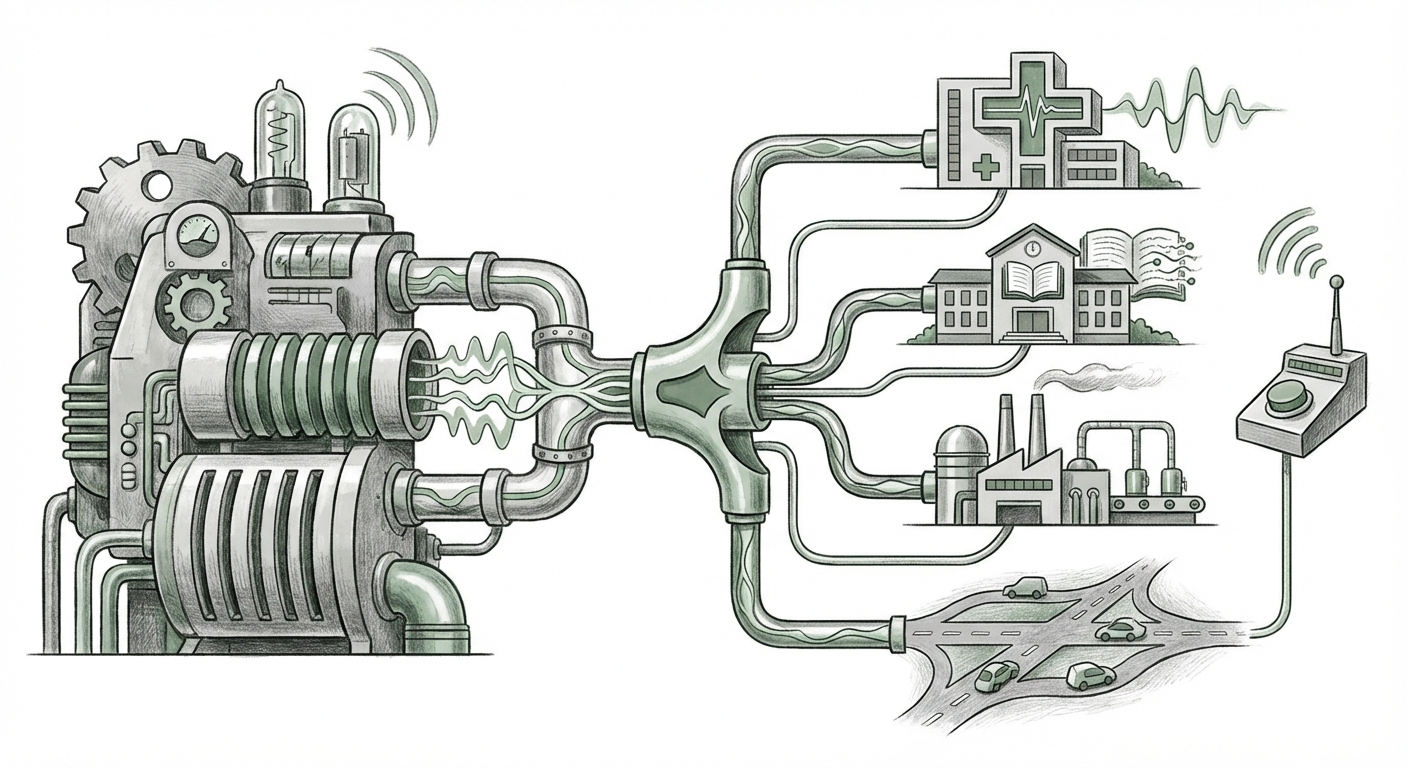
Imagine a giant company with 2.8 trillion employees. Now imagine that for any single task, writing a legal summary, answering a math question, translating a sentence, the company only wakes up 80 billion of them. The rest stay asleep.
That is roughly how a mixture-of-experts model works. Instead of running every parameter for every word it generates, the model routes each piece of input to a small set of specialized "expert" sub-networks. You get the storage capacity of a giant model with a much smaller slice of the compute bill.
The 2.8 trillion vs. 80 billion gap is the headline. It means MAI-Base-2 holds a vast amount of stored knowledge and capability, but only a thin slice of it switches on at any moment. In practice, that is supposed to mean large-model quality at small-model serving costs.
The catch, historically, has been that MoE models are harder to train. You still have to train all 2.8 trillion parameters. You still have to keep them in memory. And routing mistakes can waste enormous amounts of compute. So a claim of dramatically better FLOPs-efficiency is really a claim about training engineering, not just architecture.
Why "FLOPs-Efficiency" Is the Real Story
A FLOP is a floating-point operation, one basic math step inside a computer. Pretraining FLOPs-efficiency measures how much capability you get out of each math step you spend during training.
If Microsoft's claim holds up, it means MAI-Base-2 reaches a given level of ability using somewhere between one-fourth and one-twelfth of the training compute that DeepSeek-V4-Pro-Base needed to get to a similar place. That is a wide range, but even the low end is significant.
Why? Because training compute is the single biggest cost driver in frontier AI. It costs money, data centers, chips, electricity, cooling, and months of engineering time. It also costs energy, which means it costs carbon. And it costs time, because a training run that finishes in a quarter instead of a year changes how fast a company can iterate.
Here is the practical way to think about it:
- 4x efficiency means you can build four models for the price of one.
- 12x efficiency means you can build twelve.
- Even a modest efficiency gain compounds. If each generation of model gets cheaper to train, the whole field moves faster.
This is why the announcement matters more than a benchmark score. A benchmark tells you what a model can do today. An efficiency claim tells you what the entire industry can afford to do next year.
The DeepSeek Comparison Is the Point
Microsoft chose its comparison carefully. Naming DeepSeek-V4-Pro-Base as the baseline puts MAI-Base-2 in direct conversation with the lineage of open-weight models that made "efficient frontier" training a competitive battleground.
Over the past few years, the most disruptive story in AI has not been "who has the biggest model." It has been "who can get close to the biggest model for far less." That is the story DeepSeek-Derived models have told, and it rattled assumptions across the industry about how much money you actually need to compete.
Microsoft now appears to be answering on that same field. Instead of only arguing, our model is better, the company is arguing, our training pipeline is more efficient than the efficiency specialists. That is a notable strategic pivot. It signals that Microsoft AI is treating compute efficiency as a first-class product feature, not a research side-note.
There is also a competitive dimension worth naming plainly. If a hyperscaler can train frontier-scale models at a fraction of the compute, its cost structure changes. Cheaper training means cheaper inference downstream, because efficiency gains during training tend to translate into more favorable serving economics. And cheaper inference is what turns an AI model from a research demo into a product that millions of people can use daily.
What This Means for the Future of AI
1. Efficiency becomes the new leaderboard
For years, the public scoreboard was raw capability. Expect that to shift. Claims about FLOPs-efficiency, active-parameter counts, and cost-per-token will become as quotable as benchmark scores. Buyers will start asking two questions instead of one: How good is it? and What did it cost to make, and what does it cost to run?
2. Bigger models, smaller bills
Mixture-of-experts designs let labs keep scaling total capacity without scaling per-use compute in the same way. MAI-Base-2's 2.8 trillion total versus 80 billion active split is a textbook example of that pattern. The likely trajectory: models keep getting larger in storage while their running costs grow more slowly than their size suggests.
3. The gap between "frontier" and "affordable" narrows
When training gets 4x to 12x more efficient, the frontier stops being a club only the wealthiest labs can enter. More organizations can train competitive base models. That means more diversity in the model ecosystem, and more pressure on the handful of players who assumed compute scale alone would protect them.
4. Energy and carbon enter the conversation
Training efficiency is also energy efficiency. Every FLOP you don't spend is electricity you don't buy and heat you don't have to remove. As AI data center demand draws more public scrutiny, efficiency claims become part of the sustainability story, not just the finance story.
What This Means for Businesses
You do not need to run a giant model to benefit from a giant model getting cheaper. Here is how this filters down.
Costs should fall, but not automatically
Cheaper training creates room for cheaper inference. Whether that savings reaches your invoice depends on competition among providers. The practical move for businesses is to renegotiate and re-benchmark regularly. If you last priced your AI workloads a year ago, you are probably overpaying, and this announcement is another reason to check.
Model choice becomes a portfolio decision
Enterprises increasingly run more than one model: a small fast one for routine tasks, a large one for hard reasoning. Efficient MoE-style models make the large tier more affordable to keep on standby. That means fewer compromises like "we'll just use the cheap model for everything."
On-premises and private deployment get more realistic
Spreading usage across experts rather than firing every parameter makes serving more tractable. That matters for regulated industries that need to keep data close. Cheaper serving economics widen the set of organizations for which private deployment is even a conversation.
Watch the "efficiency claim" carefully
Be a skeptical buyer. Efficiency claims are usually measured against a specific baseline, on a specific training recipe. Ask: Efficient at what scale? Measured how? Compared against what? The 4x-12x range is wide precisely because results vary. Treat vendor efficiency numbers the way you treat fuel economy ratings, directionally useful, but your mileage will differ.
What This Means for Society
When the cost of building capable AI falls, access broadens. Small companies, universities, public health teams, and local governments can consider tools that were out of reach when only the largest labs could afford frontier training runs. That is genuinely good news for innovation and for competition.
It also raises familiar questions faster. Cheaper models mean more AI-generated content, more automated customer interactions, and more decisions made with machine assistance. The governance conversation, accuracy, bias, accountability, disclosure, does not get easier when deployment gets cheaper. If anything, it gets more urgent, because the volume goes up.
And there is the labor angle. Efficient models make automation cheaper, which expands the list of tasks where automation pays for itself. That shift is likely to show up first in high-volume, repeatable knowledge work: drafting, summarizing, routing, first-line support. The strategic question for workers and employers alike is not whether this happens, but how quickly teams redesign roles around it.
Actionable Takeaways
- Re-benchmark your AI costs quarterly. Efficiency gains mean last year's pricing assumptions expire fast.
- Ask vendors about cost-per-task, not just capability. Push for numbers tied to your workload, not generic benchmarks.
- Build a tiered model strategy. Route easy work to small models and reserve large models for hard problems.
- Treat efficiency claims as directional. Wide ranges like 4x-12x signal real gains and real variability.
- Watch the MoE trend. The total-versus-active parameter split is becoming the default way to describe a frontier model. Learning the vocabulary helps you read announcements critically.
- Revisit privacy and deployment plans. Cheaper serving makes private and on-premises options worth reopening if you ruled them out before.
The Bottom Line
Microsoft's MAI-Base-2 announcement is not primarily a story about a smarter chatbot. It is a story about the economics of building intelligence. A 2.8 trillion parameter model that only activates 80 billion parameters is a statement that scale and efficiency no longer have to be traded against each other. And a claimed 4x to 12x pretraining FLOPs-efficiency advantage over DeepSeek-V4-Pro-Base is a statement that Microsoft intends to compete on the frontier and on the balance sheet.
If that claim holds up under scrutiny, the ripple effects are broad: cheaper training, cheaper serving, more competitors, more deployments, and more pressure on prices across the AI stack. The winners will be the organizations that treat model efficiency as a moving target and keep re-evaluating their options, because in this market, the ground keeps shifting under everyone's feet.