Starlink, Ukraine, and the Overreliance Trap: What It Means for the Future of AI
On the modern battlefield, the most powerful weapon may not be a missile or a drone. It may be a small white dish pointed at the sky. Soldiers in Ukraine describe Starlink, the satellite internet network that keeps their units connected, as a "major card." It is the kind of tool that changes what is possible. It lets commanders talk in real time. It lets drones fly. It lets targeting data move in seconds instead of hours.
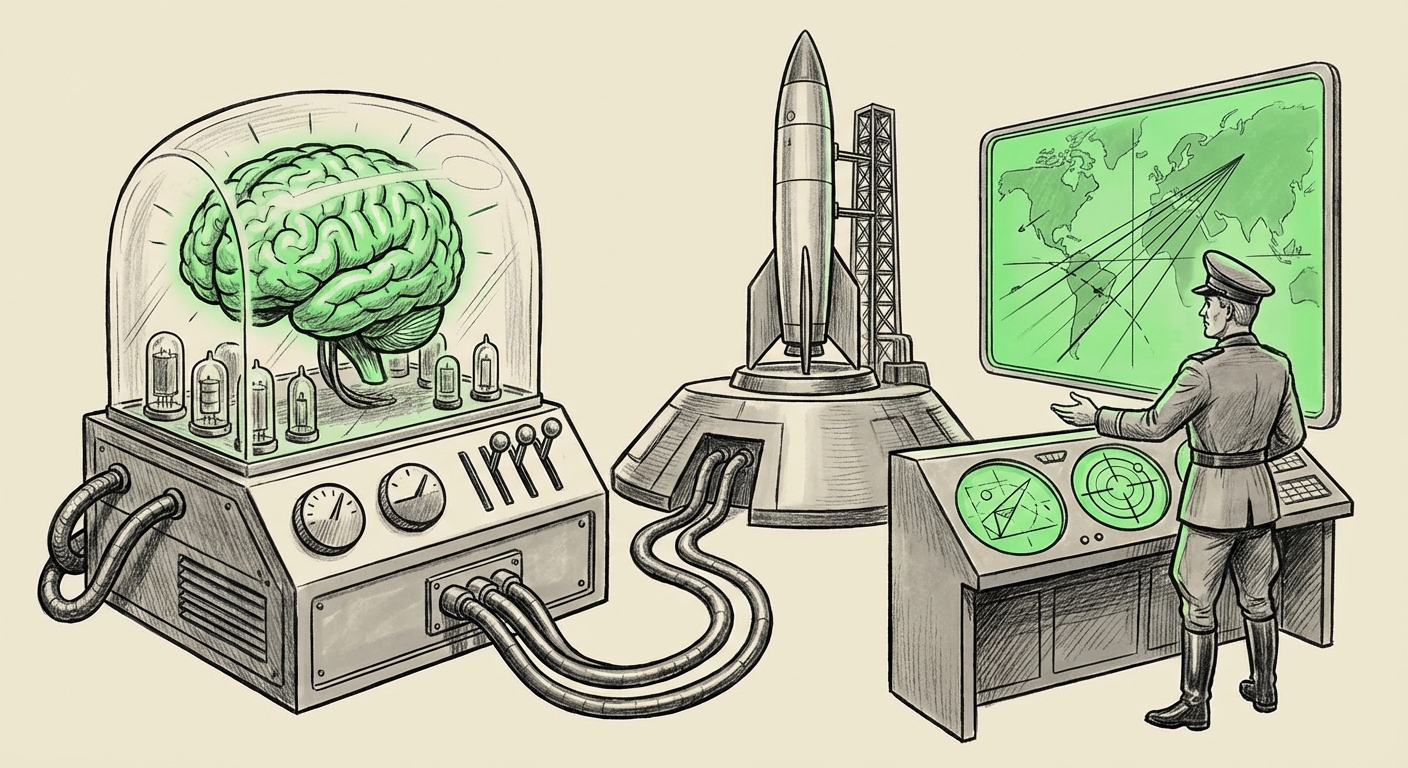
But a recent surprise restriction on the service told a different story. In a single moment, the connection soldiers had come to depend on changed. The lesson is bigger than any one war or any one company. It is a warning about what happens when the most important systems in our lives, including the artificial intelligence systems we are racing to build, all depend on a single point of failure that someone else controls.
Why a Satellite Dish Became a "Major Card"
Modern conflict runs on information. A drone needs a live video feed. A commander needs maps that update. A unit in a trench needs to know where the enemy is moving. None of that works without a reliable connection. Traditional networks, cell towers, cables, ground stations, are easy to knock out. A satellite constellation is much harder to destroy.
That is why Starlink became so valuable. It gave Ukrainian forces something close to a resilient, always-on nervous system. Soldiers did not just use it to make calls. They used it to fight smarter, faster, and with better information than they would otherwise have had.
When a technology becomes that essential, it stops being a gadget. It becomes infrastructure. And infrastructure has a rule that never changes: whoever owns the switch owns the outcome.
The Surprise Restrictions: A Trust Test Nobody Passed
The restrictions that appeared were unexpected. That is the part that matters most. It is not just that the service was limited, it is that the limit came as a surprise to the people depending on it.
Think about what that does to trust. An army can plan around a known weakness. It can build backups, train for outages, and work around gaps. What it cannot easily plan around is a change it did not see coming. Surprise is the real vulnerability here, and it is a vulnerability that has nothing to do with technology, it is about governance and control.
For soldiers on the ground, the message was blunt: the connection you rely on can change without your input, and there is nothing you can do about it in the moment.
The Overreliance Trap, and Why AI Is Walking Straight Into It
Overreliance is a quiet trap. It does not feel dangerous when things are working. It feels like efficiency. You stop building the backup because the main line is reliable. You stop training people to work without it because why would they need to? You move everything onto the platform that works best.
Then the platform changes, and you discover you have built a house with one pillar.
This is exactly where artificial intelligence is heading right now, and the Starlink story is a preview of the risk. Here is why:
- AI lives in the cloud. Most advanced AI models do not run on your laptop. They run in massive data centers, and you reach them over the internet. Cut the connection and the intelligence disappears.
- A handful of companies control the pipes. A very small number of firms own the compute, the models, and the networks that deliver them. That concentration is efficient. It is also fragile.
- We are wiring AI into critical systems. Logistics, healthcare, defense, energy grids, financial markets, all are being handed to AI systems that assume the connection never breaks.
- Few organizations test the failure case. Plenty of teams test whether the AI is accurate. Very few test what happens when the AI suddenly is not there.
The soldiers in Ukraine learned this lesson in a way no business ever wants to. The rest of us can learn it for free.
The Real Question: Who Holds the Kill Switch?
Every powerful technology raises the same question underneath all the excitement: who can turn it off?
For most of the internet era, that question felt theoretical. It no longer does. When one provider can change terms of service, throttle access, restrict a region, or simply go down, every organization built on top of that provider inherits the risk.
For AI, the stakes go up another level. An AI system does not just deliver content, it makes decisions. If an AI system handling hospital triage, supply chains, or threat detection goes dark, the humans behind it may not be ready to step back in. Skills erode when machines take over. That is the second half of the overreliance trap, and it is the half people forget.
Edge AI: The Push to Build Intelligence That Does Not Need Permission
The response to this risk is already forming, and it has a name: edge AI.
Edge AI means running models locally, on the device, the vehicle, the drone, the sensor, the laptop, instead of sending everything to a distant data center. It is slower to update and often less powerful, but it keeps working when the connection does not.
This is the same instinct that made soldiers want a system they controlled rather than one they rented. Three forces are pushing edge AI forward:
- Smaller, more efficient models. The industry is getting better at squeezing useful intelligence into smaller packages that run on modest hardware.
- Cheaper, faster chips. Specialized processors now make on-device inference practical for far more use cases.
- Hard lessons. Every outage, restriction, or geopolitical shock adds another reason to keep critical intelligence close to home.
The future of AI is unlikely to be purely cloud or purely edge. It will be a hybrid: heavy thinking in the cloud when available, essential thinking on the device when it is not. The organizations that design for that split today will be the ones still standing when the connection wobbles tomorrow.
What This Means for Businesses Right Now
You do not need to be a military planner to act on this. The same logic applies to any company betting its operations on AI.
1. Map your single points of failure
List every AI system your business depends on. Then ask: what happens if it goes offline for an hour? A day? A week? If the answer is "we stop," you have found a risk worth fixing.
2. Build the manual fallback before you need it
Keep humans trained and ready to take over. The worst time to learn how to run a process by hand is during an outage.
3. Diversify your providers
Multi-cloud and multi-vendor strategies cost more and add complexity. They also mean no single decision by a single company can shut you down.
4. Push critical intelligence to the edge
Identify the AI functions that must never stop, safety, security, core operations, and plan to run them locally.
5. Write the "what if" clause into your contracts
Ask hard questions about service changes, restrictions, and notice periods. Get answers in writing before you depend on anyone.
Five Trends to Watch Next
Sovereign AI. Countries and large regions will keep pushing to build and host their own models and compute, treating AI like a utility rather than a product.
Resilience as a selling point. "Works when the internet doesn't" will become a feature companies advertise, not an afterthought.
Smaller models, bigger reach. Compact models running on devices will bring AI to places where fast, reliable connections never existed.
New rules for critical infrastructure. Expect regulators to start treating AI providers more like telecom and power companies, with obligations attached to that role.
Trust as the real currency. In a world where switches can flip without warning, predictability may become more valuable than raw capability.
The Bigger Picture
The story coming out of Ukraine is not really a story about satellites. It is a story about dependency. A tool that felt like a superpower turned out to be a lease, and the terms could change at any moment.
Artificial intelligence is on the same path, only faster. We are handing more decisions, more workflows, and more critical functions to systems that live far away and answer to someone else. That can be a smart trade, as long as it is a conscious one.
The lesson from the front line is simple enough for anyone to apply: never let your most important capability be someone else's on-off switch. Build the backup. Train the people. Keep the essential intelligence close. And always ask who is holding the switch, before you find out the hard way.