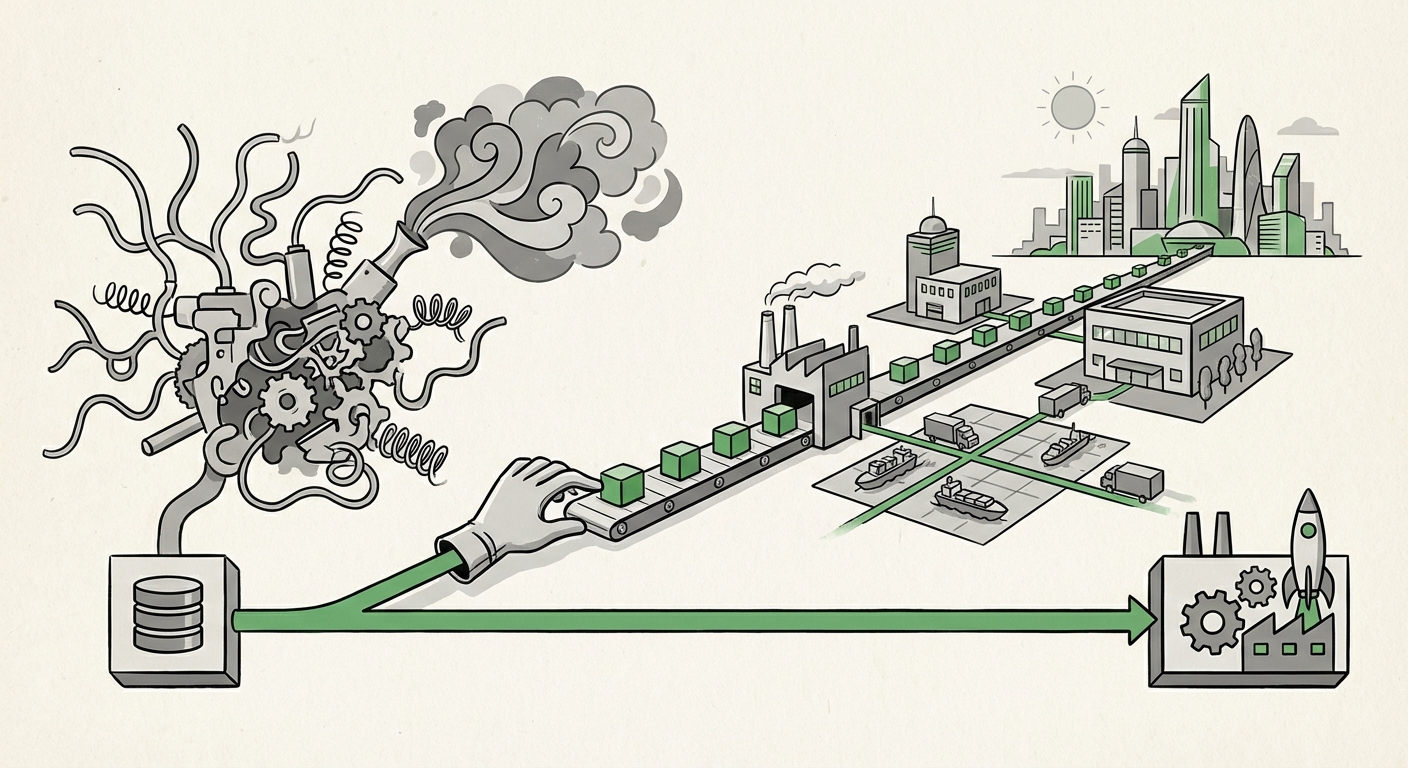
White House's China AI Response Signals Weakness, What It Means for the Future of AI
When a leader feels strong, they act like it. They lay out a plan, move fast, and dare others to keep up. When a leader feels shaky, they react. They scramble, point fingers, and spend more energy explaining why the other guy is dangerous than why they themselves are winning.
That is the heart of the problem with the White House's response to China's rise in artificial intelligence. The response itself lacks confidence in America. And that matters far beyond politics. Confidence, or the lack of it, shapes which chips get built, which researchers stay, which companies invest, and which country sets the rules for the most important technology of our lifetime.
This is not a small story about one press conference or one policy speech. It is a signal about how the world's biggest AI powers see themselves right now. And signals like this move money, talent, and long-term strategy.
The Tell: Why a Defensive Response Looks Like a Weak Hand
In poker, players call it a "tell." It is a small habit that gives away what someone is really holding. In technology policy, the tell is tone.
A confident response to a rival's progress sounds like this: Here is our plan. Here is what we are building. Here is why we will still be first.
A nervous response sounds like this: They are cheating. They are a threat. We must stop them.
The White House's posture toward China's AI advances leans heavily on the second style. It focuses on what China should not be allowed to do, rather than on what America is going to do better. That framing quietly admits something uncomfortable: that the United States is no longer sure it wins on its own merits alone.
To be clear, limits and safeguards are a normal part of national strategy. Every major power uses them. The problem is not that restrictions exist. The problem is when restrictions become the whole strategy. When the plan is mostly "stop them" and only slightly "build us," it reads as fear, not strength.
Why Confidence Is the Real AI Advantage
Artificial intelligence does not advance because of speeches. It advances because of a few very practical ingredients:
- Compute, the chips and data centers that train and run models.
- Energy, the power to keep those data centers running around the clock.
- Talent, the researchers and engineers who invent the next breakthrough.
- Capital, the investors willing to fund years of work before profit arrives.
- Trust, the belief that rules will be stable enough to build on.
Notice what ties all five together: confidence. Nobody pours billions into a country they think is losing. Nobody uproots their family to join a research lab in a place that sounds scared. Nobody designs a ten-year product roadmap around policies that seem to change with the news cycle.
So when a government's AI message sounds defensive, it does not just hurt morale. It chips away at every one of those five ingredients at once. That is the real cost, and it is much bigger than any single policy fight.
Three Places the Confidence Gap Shows Up
1. The Talent Race
The best AI researchers are mobile. They go where the work is exciting, the funding is steady, and the welcome is warm. If the dominant message coming out of Washington is "we are losing," some of them will start looking at offers elsewhere, including from countries that are loudly and proudly recruiting.
A confident country says: Come here, build here, we back you. A nervous country makes it harder for those same people to enter, stay, and start companies. The message and the paperwork have to match.
2. The Compute and Energy Race
AI runs on electricity and silicon. Building enough of both takes years of planning and a willingness to approve big projects. That requires a government that acts like it expects to be a leader for decades, not one that is busy reacting to headlines.
Here, the comparison is stark. A country that believes in its own future permits the power plants, the data centers, and the supply chains. A country that is unsure stalls, studies, and second-guesses. Speed becomes the advantage, and hesitation becomes the tax.
3. The Open Model Race
One of the biggest shifts in AI is the rise of open models, powerful systems that anyone can download, run, and improve. Chinese labs have been aggressive here, releasing capable open models that spread fast because they are free to use.
That spread is a form of influence. Every developer who builds on a foreign model learns that model's habits, limits, and quirks. Over time, that shapes the global default. A response built only on blocking access does not compete with that. It just leaves the field open.
The confident move is to out-build and out-share, not only to out-block.
What a Confident AI Strategy Would Actually Look Like
Strip away the politics and the recipe is not mysterious. It looks like this:
- Lead with a vision, not a veto. Explain what America is building and why it will be the best place in the world to build AI.
- Fund the boring stuff. Energy grids, data centers, chip factories, and math education are not glamorous, but they decide who wins.
- Keep the doors open for talent. A clear, fast path for top researchers is worth more than a dozen speeches about competitiveness.
- Set rules that stay put. Companies can handle strict rules. What they cannot handle is rules that flip every few months.
- Compete on openness. Support American open models and shared tools so the global default is built at home.
- Separate security from swagger. Protect what truly must be protected, and be honest about the rest instead of treating everything as a crisis.
None of this requires believing the other side is weak. It requires believing your own side is strong. That is the missing ingredient right now.
What This Means for Businesses
For companies, the practical takeaway is simple: do not build your AI strategy around the assumption that policy will be stable or that the United States will automatically stay ahead.
That does not mean panic. It means planning for more than one future.
- Diversify your model options. Do not let a single vendor, a single country, or a single rule change decide whether your product works. Keep both closed and open models in your toolkit.
- Watch the tone, not just the text. Policy language is a leading indicator. When a government starts sounding defensive, expect tighter controls and more uncertainty to follow.
- Build for portability. If your AI features can move between providers with modest effort, you have insurance that most competitors will not have.
- Track talent, not just tech. Where top researchers choose to go in the next few years will predict where the next breakthroughs happen.
- Plan for energy and cost. Compute is only getting more central. Budget for it like you budget for payroll.
What to Watch Next
A few signals will tell you which way this is heading:
- Does the messaging shift from stopping China to building America?
- Do visa and immigration rules for technical talent get easier or harder?
- How fast do new data centers and power projects get approved?
- Do American open models gain global users, or do foreign ones keep spreading?
- Do AI rules stay steady long enough for companies to plan years ahead?
Each one is a small test of the same question: does the country act like it expects to win?
The Bigger Picture
The AI race is often described as a contest of chips and algorithms. It is really a contest of belief. Technology follows money, and money follows confidence. Talent follows opportunity, and opportunity follows confidence. Rules work only when people trust they will last, and that trust is confidence too.
That is why the tone of the White House's response to China matters so much. It is not just a political story. It is an economic one. A defensive posture tells investors, researchers, and allies that the United States is managing decline rather than building an advantage. Even if the underlying technology is still the best in the world, the story being told can become self-fulfilling.
The good news is that confidence is a choice, not a resource. It cannot be mined or imported. It has to be decided. A country that stops explaining why its rival is scary and starts explaining what it is going to build next changes the entire conversation, and the entire market.
For anyone working in or around AI, that is the real lesson here. Watch the strategy, but watch the tone even more closely. The tone tells you what comes next.
TLDR: The White House's response to China's AI progress sounds more defensive than confident, and that tone carries real costs. Confidence drives the five things AI actually needs, compute, energy, talent, capital, and stable rules. A strategy built mainly on blocking a rival leaves the field open, especially as open models spread influence worldwide. For businesses, the takeaway is to diversify model providers, build portable AI systems, and treat policy tone as an early warning signal. The country that acts like it expects to win is the one most likely to.