Why AI Is Going All-In on Specialization, And What It Means for Your Business
For a few years, the story of artificial intelligence was simple: bigger was better. Build one giant model, feed it everything, and let it handle any task you throw at it. That idea captured the world's imagination. It gave us chatbots that could write poems, debug code, and plan vacations in the same conversation.
But a new idea is taking hold, and it is quietly reshaping the entire industry. The future of AI is not one giant brain that does everything. The future is specialization, many smaller, focused systems that do one thing extremely well.
This shift is not a fad. It is inevitable. And understanding why it is happening will tell you a lot about where AI is heading and how your business should prepare.
The Generalist Dream Hit a Wall
General-purpose AI models are remarkable. They can reason across topics, switch between languages, and handle tasks they were never explicitly trained for. That flexibility is why they spread so fast.
But flexibility has a cost, and that cost shows up in three places.
First, accuracy. A model trained to be decent at everything is rarely excellent at anything. Ask a general model a deep question about tax law, hospital billing codes, or industrial safety rules, and you often get an answer that sounds right but is subtly wrong. In a casual chat, that is fine. In a real business process, it is a liability.
Second, cost and speed. Huge general models are expensive to run. They take time to respond and they burn a lot of computing power. If all you need is to sort support tickets or read a meter, using a giant model is like hiring a consultant to answer the phone.
Third, trust and control. Regulated industries need systems they can explain, audit, and contain. A general model that knows a little about everything is hard to certify for a narrow, high-stakes job. A specialized system is easier to test, easier to limit, and easier to defend when a regulator asks questions.
Put those three pressures together and the logic becomes clear. When a task is important, repetitive, and narrow, a specialist wins.
Why Specialization Is Inevitable
The word "inevitable" gets used too freely in tech. But here it fits, because specialization is driven by forces that do not go away.
1. Economics always push toward efficiency
Businesses do not buy intelligence in the abstract. They buy outcomes. They want a system that resolves a claim, flags a defect, or drafts a compliant report, reliably and cheaply. Once a general model proves a task is possible, the next move is always to make it cheaper and more reliable. Smaller, focused models are the classic answer. This is the same pattern we saw with computing itself: from mainframes to servers to phones and tiny sensors. Power spreads out and gets closer to the work.
2. Data is the real moat, and data is specific
The most valuable AI advantage a company can have is not access to a general model. Everyone has that. The advantage is proprietary data about a specific domain, decades of repair logs, claims histories, test results, or customer conversations that nobody else has. That data is deep, narrow, and messy. It only pays off when it is used to train or tune a system built for that domain. General models cannot absorb your unique edge. Specialists can.
3. Trust is built one job at a time
People and organizations do not hand over important work to a system that might do anything. They hand it over piece by piece, starting with the tasks that are well understood and easy to check. Each success earns the right to take on more. That is a specialization path by design.
Specialization Is Happening Inside the Models Too
Here is a detail that surprises many people: specialization is not just about building many separate small models. It is also happening inside the biggest ones.
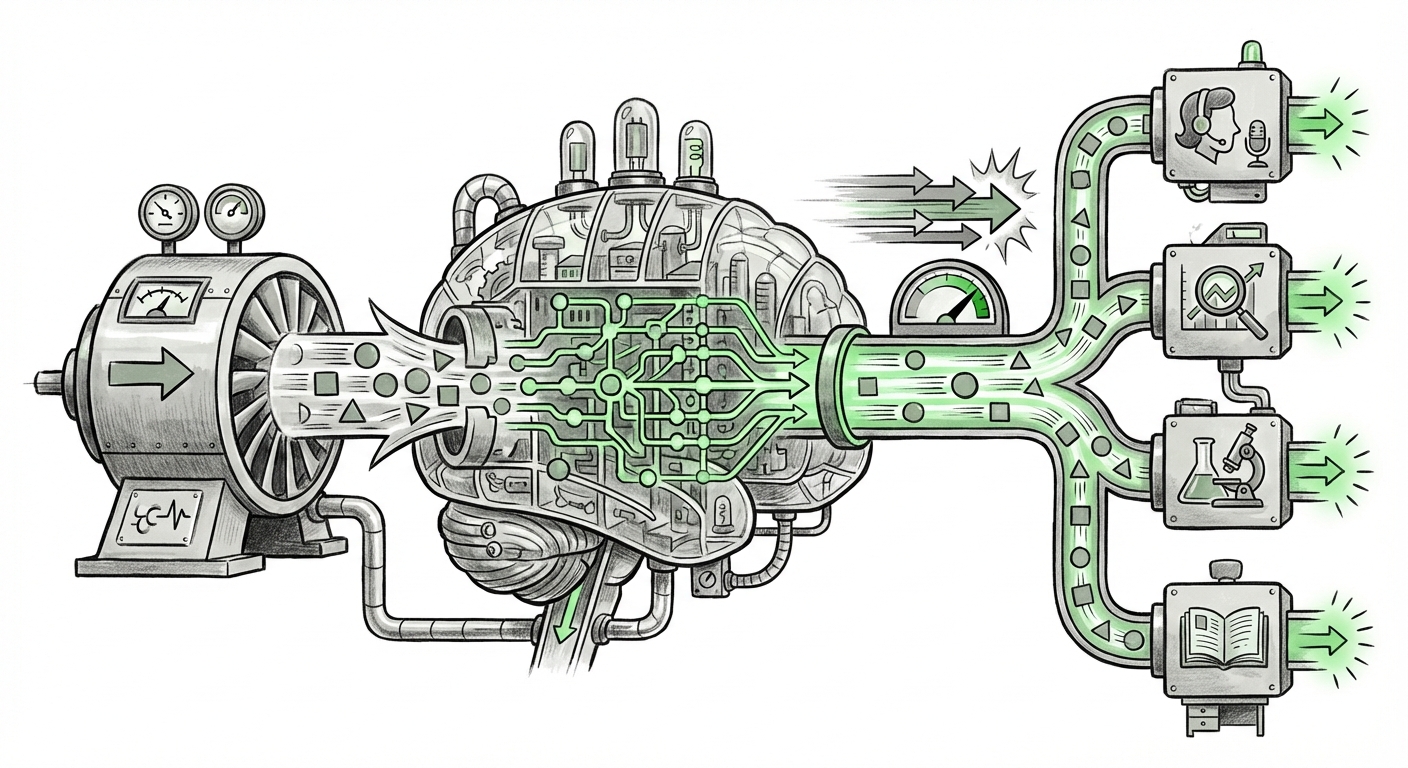
Modern large models increasingly use a design where different parts of the network activate for different kinds of input. Think of it as a huge company made of many expert teams. When a question about chemistry comes in, the chemistry team wakes up. When a coding question comes in, the coding team handles it. The whole company does not have to work on every request.
This matters because it shows the trend from both directions. At the top, giant models are becoming collections of specialists. At the bottom, small focused models are taking over narrow jobs. And in the middle, organizations are assembling teams of models that each play a role.
The old debate, "one big model or many small ones?", is the wrong question. The real answer is both, arranged in layers.
Agents Are Specialization in Action
The clearest example of this shift is the rise of AI agents. Instead of one model trying to do everything, an agent is a system that plans, uses tools, and calls on other systems to finish a job.
A single agent might:
- Read an incoming request and decide what kind of task it is
- Call a specialized model to extract data from a document
- Query a database or an internal tool for the facts it needs
- Hand the result to another specialist that checks for errors
- Return a finished answer or action
Notice what happened. The intelligence is not in one place. It is spread across a set of focused parts that each do a small job well. That is specialization. It is also how real expertise works in human organizations, you do not ask one person to be your lawyer, doctor, and accountant at once.
What This Means for Businesses
If specialization is the direction of travel, the practical question is: what should you actually do?
Stop asking "which model is best?"
That question made sense in the generalist era. The better question is: which task do we want to solve, and what is the cheapest, most reliable system that solves it? Sometimes that is a large general model. Often it is a smaller tuned one. Sometimes it is a classic rules engine with a model wrapped around it.
Treat your data like the asset it is
Your competitive edge in AI will come from data nobody else has, organized well enough to be useful. That means cleaning it, labeling it, and giving it a home. Companies that treat their domain data as a strategic resource will pull ahead. Companies that leave it scattered will keep renting generic intelligence that their competitors can rent too.
Build a portfolio, not a single bet
Wise teams are assembling a mix: one or two powerful general models for hard reasoning and rare tasks, plus a growing set of narrow specialists for the high-volume work. This keeps costs down, speeds up responses, and reduces the blast radius when something goes wrong.
Start narrow, prove value, then expand
The fastest path to a real return is to pick one painful, repetitive, well-defined process. Automate it with a focused system. Measure the result. Then move to the next one. Specialization rewards patience and stacking wins, not one giant moonshot.
What This Means for Society
The move toward specialization has effects far beyond the boardroom.
On the positive side, focused AI can bring expert-level help to places that never had it. A small clinic, a rural school, or a solo lawyer could gain tools that used to exist only inside large institutions. Specialized systems can also be cheaper and greener to run, because they do not need to think about everything at once.
On the cautionary side, specialization can deepen the moat around whoever owns the best data. If a handful of firms control the deepest pools of domain data, the benefits concentrate. There is also a risk of narrow systems making narrow mistakes, a specialist that is confidently wrong inside a tiny, critical slice of work can be harder to catch than an obvious generalist error.
There is a human angle too. As AI takes over defined tasks, the value of judgment, context, and knowing which problem to solve goes up. The workers who thrive will be the ones who direct specialists rather than compete with them.
How to Prepare: Actionable Steps
- Map your workflows. List the repetitive tasks that eat the most time and are easiest to check. Those are your first candidates.
- Grade your data. Find the domain data you own that others do not. Rate how clean and usable it is. Fix the gaps.
- Match the tool to the job. Use big general models for messy, rare, or creative work. Use small specialists for high-volume, well-defined tasks.
- Build in evaluation from day one. You cannot trust a specialist you never test. Set clear pass/fail measures before you scale.
- Plan for a team of systems. Design so that specialized parts can be swapped out as better ones appear, instead of locking everything into one vendor.
- Keep a human in the loop for high-stakes calls. Specialization raises the bar for oversight, not lowers it.
The Road Ahead
The generalist era showed us what AI could do. The specialization era will show us what AI actually delivers at scale, reliably, affordably, and inside the real constraints of business and society.
This is not a step backward from ambition. It is the natural next step of any technology that grows up. Electricity started as a few giant central stations and ended up in every device, shaped for each purpose. Computing followed the same path. AI is now on it too.
Specialization is not a limitation. It is how a powerful tool becomes a useful one. The organizations and people who understand this early will not just adopt AI, they will shape it into something that works for them.