Linear Knowledge Before Fine-Tuning: The AI Finding That Explains Why Some Models Learn and Some Just Memorize
Every company building with AI runs into the same frustrating wall. You train or fine-tune a model, it looks great on the data it has seen, and then it falls apart the moment you ask it something slightly new. Meanwhile, a different model, trained in almost the same way, suddenly "gets it" and handles situations nobody taught it directly. Why the difference?
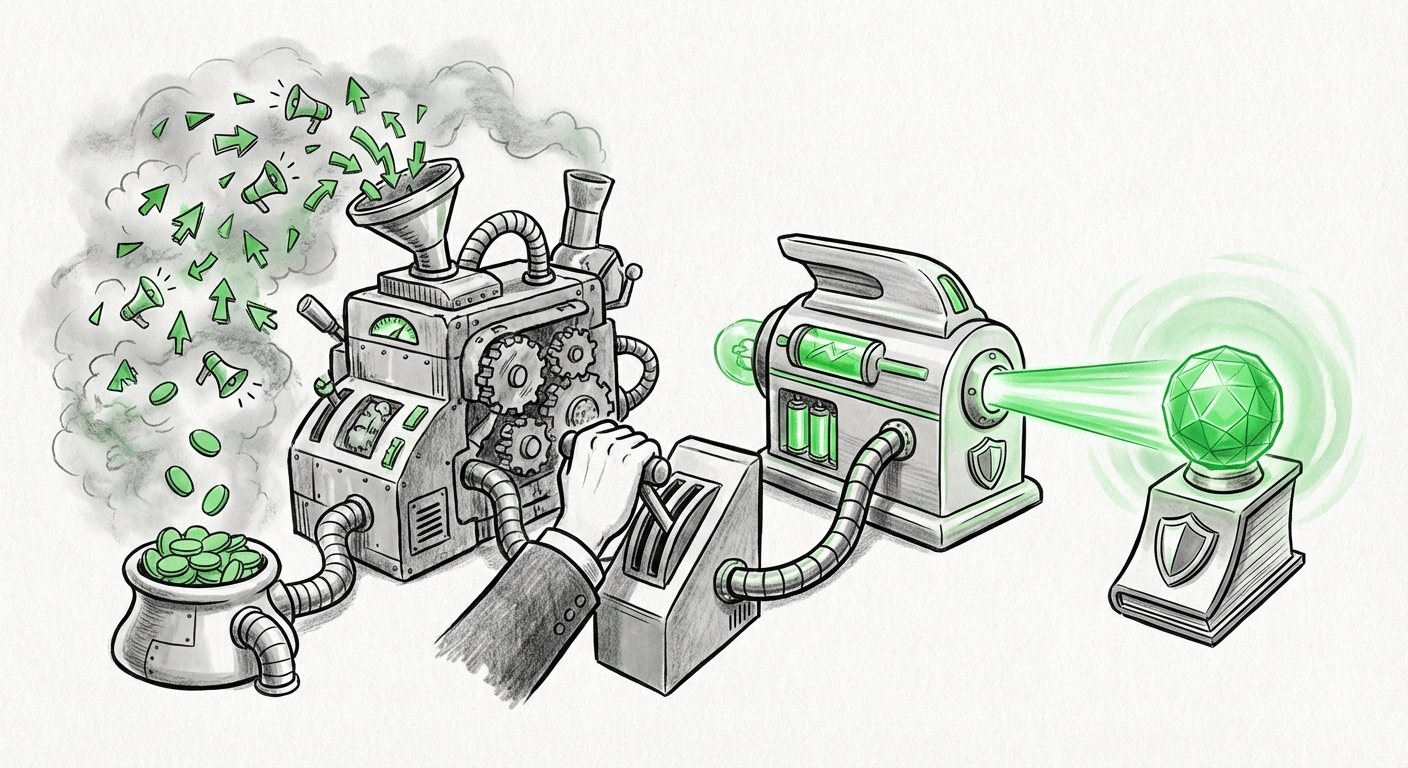
New research published in October 2026 offers a striking answer, captured in a single sentence: knowledge that is linear before fine-tuning generalizes after it. That is a dense claim, but unpacking it changes how we should think about training, fine-tuning, evaluation, and deployment of AI systems. It suggests that generalization is not something fine-tuning creates out of thin air. Instead, fine-tuning exposes knowledge that was already organized in a useful way inside the model before anyone touched it.
What Does "Linear Knowledge" Actually Mean?
Inside a large AI model, everything is numbers. When the model processes text or images, it produces long lists of numbers called activations. Those numbers shift around depending on what the model is "thinking" about.
A representation is called linear when a concept sits along a simple, straight direction in that number space. Think of a giant warehouse with thousands of aisles. If the concept "refund policy" lives straight down aisle 42 at a fixed distance, you can point to it, compare it, add it to another concept, or subtract it. If instead that same concept is smeared randomly across every aisle, you cannot do much with it at all.
Linear structure is powerful precisely because it is easy to manipulate. You can combine directions, measure distances, and swap one concept for another without retraining anything. Non-linear, tangled knowledge is much harder to work with, it behaves more like a memorized fact than a real understanding.
Why Fine-Tuning Is the Real Test
Fine-tuning is the process of taking a model that already knows a lot and teaching it something specific, a company's tone of voice, a legal domain, a coding style, a support workflow. It is the standard move for anyone who wants a general model to become a specialist.
But fine-tuning has a reputation problem. Sometimes it produces a model that truly generalizes: it handles new cases, edge situations, and questions it never saw in the fine-tuning data. Other times it produces what engineers call a "brittle" model, one that parrots the training examples and collapses outside them. Same technique, wildly different outcomes.
The finding at the center of this work says the outcome is largely decided before fine-tuning begins. If the knowledge was already stored in a linear, well-organized way during pre-training, then fine-tuning has something solid to build on. The specialization clicks into place and extends outward. If the knowledge was tangled and non-linear, fine-tuning can only paper over the surface. The model memorizes, and generalization never arrives.
The Core Claim, Explained Simply
Here is the idea in plain language:
- Before fine-tuning: a model has already formed internal representations of concepts during pre-training.
- Linear representations: those concepts are stored as clean, separable directions rather than messy, mixed-up ones.
- After fine-tuning: models whose knowledge was linear generalize to new situations. Models whose knowledge was not linear mostly memorize.
The important word is before. This is not a claim about what happens during fine-tuning. It is a claim about a hidden property the model already carries. Fine-tuning is the moment that property becomes visible.
If this holds up, it reframes the entire conversation. Instead of asking "how do we fine-tune better?", the better question becomes "how do we build models whose knowledge is linear in the first place?"
Why This Matters for the Future of AI
1. It Turns a Mystery Into a Measurable Signal
Today, teams find out whether fine-tuning worked by testing the model after the fact. That is expensive and slow. If linearity of internal knowledge is an early warning sign, it could become a diagnostic, something you check before you spend money on a specialist model. That shifts AI development from trial-and-error toward something closer to engineering.
2. It Changes How We Grade Models
Model rankings today focus on raw capability: how well a model answers questions, writes code, or solves puzzles. This finding suggests we may also need to measure the structure of what a model knows, not just how much. A model that scores slightly lower on a benchmark but stores knowledge in cleaner, more linear form might be far more valuable once adapted to a real business problem.
3. It Reframes "Memorize vs. Understand"
Everyone in AI talks about the gap between memorizing and understanding. This work gives that gap a possible mechanism. Memorization may be what you get when knowledge stays tangled. Understanding may be what you get when knowledge is arranged in a way that can be extended. That is a big conceptual step, and it applies far beyond any single model or product.
4. It Points Toward Cheaper Specialization
If generalization potential is mostly decided before fine-tuning, then the smartest investment is in the base model and the data that shapes it, not in endlessly re-tuning a model that was never set up to generalize. That has real cost implications for any organization burning budget on fine-tuning runs that keep disappointing.
What This Means for Businesses
Most companies do not train foundation models. They rent or adapt them. So what does this finding change on the ground?
First, pick base models more carefully. Instead of only comparing headline benchmark scores, ask how well a model adapts to new domains with limited examples. That is a much closer proxy to whether its internal knowledge is organized in a generalizable way.
Second, treat fine-tuning failures as information. If a model memorizes your training examples but cannot handle new cases, the problem may not be your dataset. It may be that the underlying model never had that knowledge in a usable form. Throwing more data at it may simply not fix it.
Third, invest in evaluation that tests the edges. Test on situations deliberately different from your training data. If the model generalizes there, the fine-tuning worked for the right reasons. If it only succeeds on near-copies of its training examples, you have a memorizer, not a specialist.
What This Means for Society and Safety
There is a larger stake here too. A model that generalizes is more useful, but also more unpredictable. A model that only memorizes is easier to control but far less capable. As AI spreads into healthcare, law, education, and public services, knowing which kind of model you are dealing with becomes a safety question, not just a performance one.
If generalization can be predicted from internal structure before deployment, that is also a governance opportunity. Regulators and auditors could eventually ask for evidence that a system's knowledge is organized in a way that supports reliable behavior, rather than relying purely on black-box testing after the system is already live.
There is a caution too. Linearity being useful does not mean every linear feature is desirable. Clean, separable representations are also easier to manipulate. Understanding structure better cuts both ways, and the safety community will need to keep pace.
Actionable Insights
- Test before you tune. Before a big fine-tuning project, run a small adaptation test to see how quickly a base model picks up a new domain. Fast, clean pickup is a signal worth noting.
- Judge models on adaptability, not just raw scores. Ask vendors how their model performs on unfamiliar tasks with few examples.
- Design edge-case evaluations. Build a test set that is deliberately unlike your training data. Generalization lives there.
- Stop assuming more data fixes everything. If a model memorizes, the fix may be a different base model, not a bigger dataset.
- Track structure, not just output. As tooling matures, internal representation quality may become a standard part of model selection.
- Plan for unpredictability. Generalized models need stronger guardrails and monitoring than memorizing ones.
What to Watch Next
The obvious open questions are practical ones. Can linearity be measured cheaply, without deep access to a model's internals? Can it be encouraged during training rather than merely observed afterward? Can it be predicted before a company commits months and millions to a specialization project?
If the answer to any of these turns out to be yes, the AI industry gets something it badly needs: a way to tell, in advance, whether a model is going to learn or just repeat. That would save enormous amounts of money and time, and it would make AI adoption far less of a gamble.
The Bottom Line
The phrase "knowledge that is linear before fine-tuning generalizes after it" sounds like a narrow technical detail. It is not. It is a claim about where real learning actually lives, not in the fine-tuning step, but in the structure of understanding a model builds long before anyone specializes it.
For builders, that means the base model matters more than ever. For businesses, it means adaptation success is partly predictable, and worth testing early. For society, it means the difference between an AI that repeats and an AI that reasons may be something we can eventually see coming.
The models that will matter most in the next few years are not necessarily the ones that know the most. They may be the ones whose knowledge is arranged in a way that lets them grow. Understanding that arrangement is quickly becoming one of the most valuable skills in AI.