Google's AI “Drop-Out” Story: Why the Real Reason Changes the Future of AI
For months, the tech world has been told a simple story: Google “fell out” of the AI race. The story is easy to repeat. It fits the old idea of a winner-take-all market. But the easy story is probably the wrong one.
The actual reason matters. It is not just about one company's product cycle. It is about how AI creates value, who captures it, and what “winning” will mean over the next decade.
The Race Was Always Scored on the Wrong Scoreboard
Most AI coverage uses a scoreboard built for a different sport. The scoreboard counts model launches, benchmark scores, demo videos, and viral moments. Those things are visible. They are easy to rank. But they are not the same as real-world adoption.
Businesses do not buy a benchmark. They buy a workflow that saves time, reduces errors, or serves customers better. That requires reliability, security, cost control, integration, and support. A model can top a public test and still fail in a real company.
When a major player appears to step back from visible launches, the market often calls it a loss. That label is lazy. It assumes the only way to compete is to be the loudest. But in a maturing technology market, the loudest player is not always the winner.
The Real Shift: AI Is Becoming Infrastructure
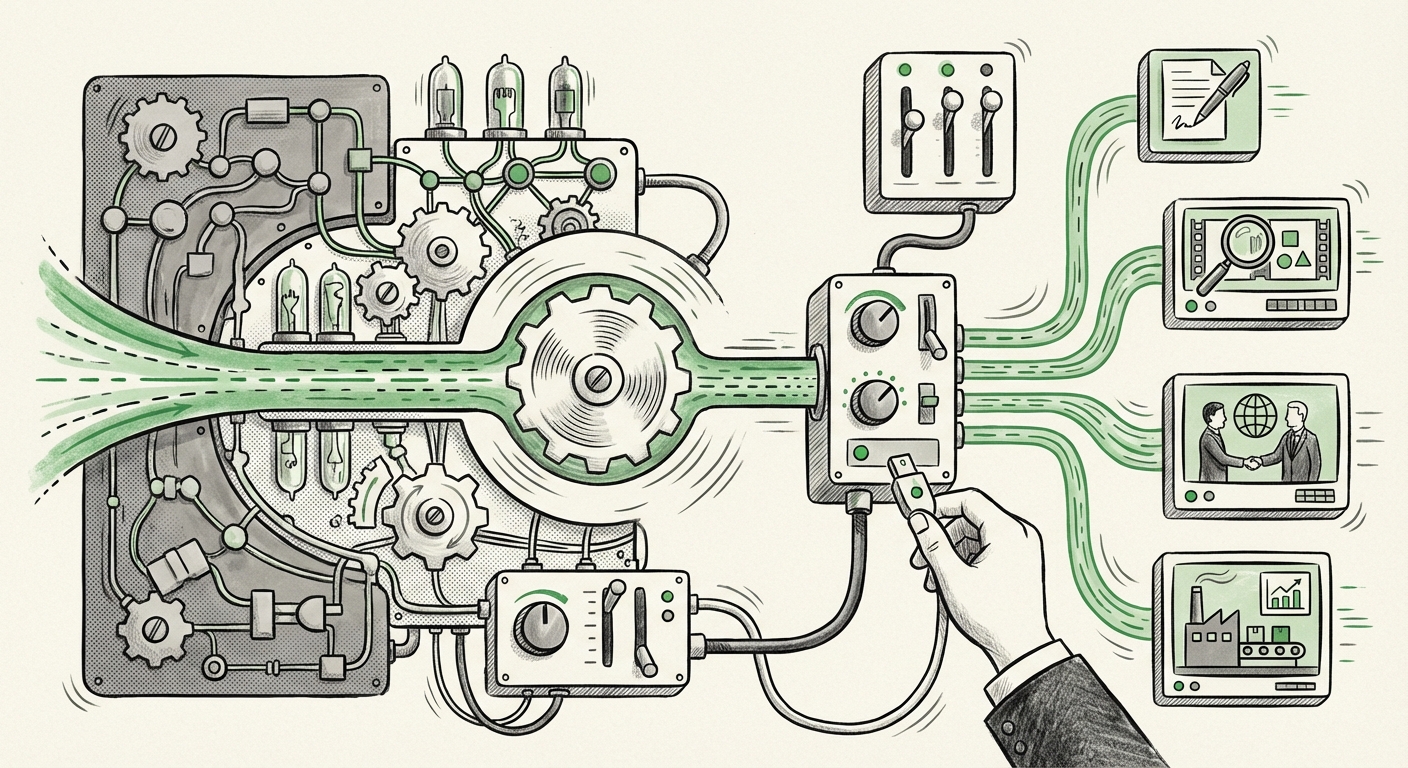
The reason that changes everything is structural. AI is moving from a product race to an infrastructure race. In the product phase, the prize goes to the company with the best demo. In the infrastructure phase, the prize goes to the company that can deliver AI cheaply, safely, and everywhere.
Infrastructure businesses are different. They are judged on uptime, price per unit, security, and integration. They are also judged on trust. A company will not put a critical process on a platform that might disappear or change terms overnight.
This shift changes the meaning of “falling out.” A company can leave the visible front line and still be winning. It can focus on data centers, chips, cloud services, developer tools, or enterprise contracts. Those areas are less exciting on social media. They are more important in the long run.
Why the “Winner-Takes-All” Story Is Dangerous for Businesses
The winner-takes-all story is not just wrong. It is expensive. When leaders believe one vendor will own the future, they overcommit. They sign long contracts. They build deep integrations. They stop watching the market. Then the market changes, and they are stuck.
AI is changing too fast for that approach. Models improve. Prices fall. Regulations shift. New providers emerge. A business that ties its core processes to one provider is taking a risk that has nothing to do with the quality of the model.
The safer approach is optionality. That means designing systems so you can switch models without rebuilding everything. It means testing more than one provider. It means keeping your data portable. It means knowing what you would do if your main vendor raised prices or changed terms.
What This Means for the Future of AI
The future of AI will not look like a single race with one finish line. It will look more like a power grid or a cloud market. Several large players will run the core infrastructure. Many smaller players will build specialized tools on top. Businesses will mix and match.
This is good news for buyers. Competition will push down prices and improve reliability. It is also good news for innovation. Specialized providers can focus on one industry or one task. They do not need to win a general benchmark to be useful.
But it is bad news for anyone waiting for a single “best” AI. There will not be one. There will be trade-offs. One model will be cheaper. Another will be faster. Another will be better at a narrow task. Another will be better for regulated data. The winning strategy is to know your needs.
The Business Playbook: How to Prepare for a Multi-Player AI Market
If the AI market is becoming multi-player, then the right response is not to pick a favorite. It is to build a capability. Here is a practical playbook.
- Start with outcomes, not model names. Define the business result you want: faster claims, fewer errors, better support, lower cost. Then test models against that result.
- Run your own tests. Public benchmarks are a starting point, not a decision. Use your own data. Use your own edge cases. Measure accuracy, speed, and cost together.
- Build a switching layer. Keep model calls behind a simple internal interface. That way a new model can be swapped in without rewriting every app.
- Track unit economics. Know what each AI task costs. A model that is 10% better but 5x more expensive may not be better for your business.
- Treat data as a strategic asset. Keep control of your data. Understand where it goes. Make sure you can leave with it.
- Set up AI governance early. Assign owners for risk, security, privacy, and quality. Do not wait for a problem to create a process.
- Train people to verify. AI can be confident and wrong. Staff need simple habits for checking outputs before they reach customers or money.
- Plan for model churn. Assume the model you use today will be replaced. Design for change, not permanence.
What This Means for Society
The shift also matters outside the boardroom. If AI becomes infrastructure, then access to AI becomes like access to electricity or broadband. It shapes who can start a business, who can get a job, and who can use public services.
That raises hard questions. Will small businesses be able to afford good AI? Will rural areas get the same access as cities? Will the benefits be spread out, or will they pool around the companies that already own the data and the computing power?
Trust is the other issue. Infrastructure must be reliable. It must be safe. It must be accountable. If AI is built into health, finance, education, and government, then failures are not just inconvenient. They can be harmful. The companies that win the infrastructure race will need to earn public trust, not just market share.
The Next Phase Will Reward “Boring” Things
The next phase of AI will be less about magic tricks and more about maintenance. It will reward documentation, security reviews, support teams, clear pricing, and steady uptime. These things are boring. They are also what customers need.
This is why the “falling out” story is a distraction. It focuses on the drama of the race. It misses the work of building the track. The companies that do the boring work will be the ones that last.
For business leaders, the message is simple. Do not ask, “Who is winning the AI race today?” Ask, “What will I need when there are five strong providers and none of them is perfect?” That question leads to better decisions.
The Bigger Lesson: A “Drop-Out” Can Be a Strategic Move
In mature markets, companies often leave one arena to win another. They exit a low-margin product. They stop chasing a benchmark. They move resources to a place where they have an advantage. From the outside, it looks like a retreat. From the inside, it is a reallocation.
That is the real reason the Google story changes everything. It challenges the assumption that the AI race is a straight line. It is not. It is a set of overlapping markets with different rules. The company that looks behind on one scoreboard may be ahead on another.
This does not mean every retreat is smart. Some companies do fall behind. But the lesson is to ask better questions. Why did they step back? What are they building instead? Where is the value moving? Those questions are more useful than a leaderboard.
Conclusion
The story of Google “falling out” of the AI race is not really a story about one company. It is a story about a market growing up. The early phase rewarded noise. The next phase will reward reliability, cost, integration, and trust.
For businesses, the smart move is to stop chasing a single winner. Build flexibility. Test on your own terms. Know your costs. Protect your data. Prepare for a world with many good AI providers and no perfect one.
For society, the task is to make sure this infrastructure is broad, safe, and accountable. The AI race will not end with one champion. It will end with a new layer of technology that shapes daily life. The real question is not who falls out. It is who gets to use it, and on what terms.