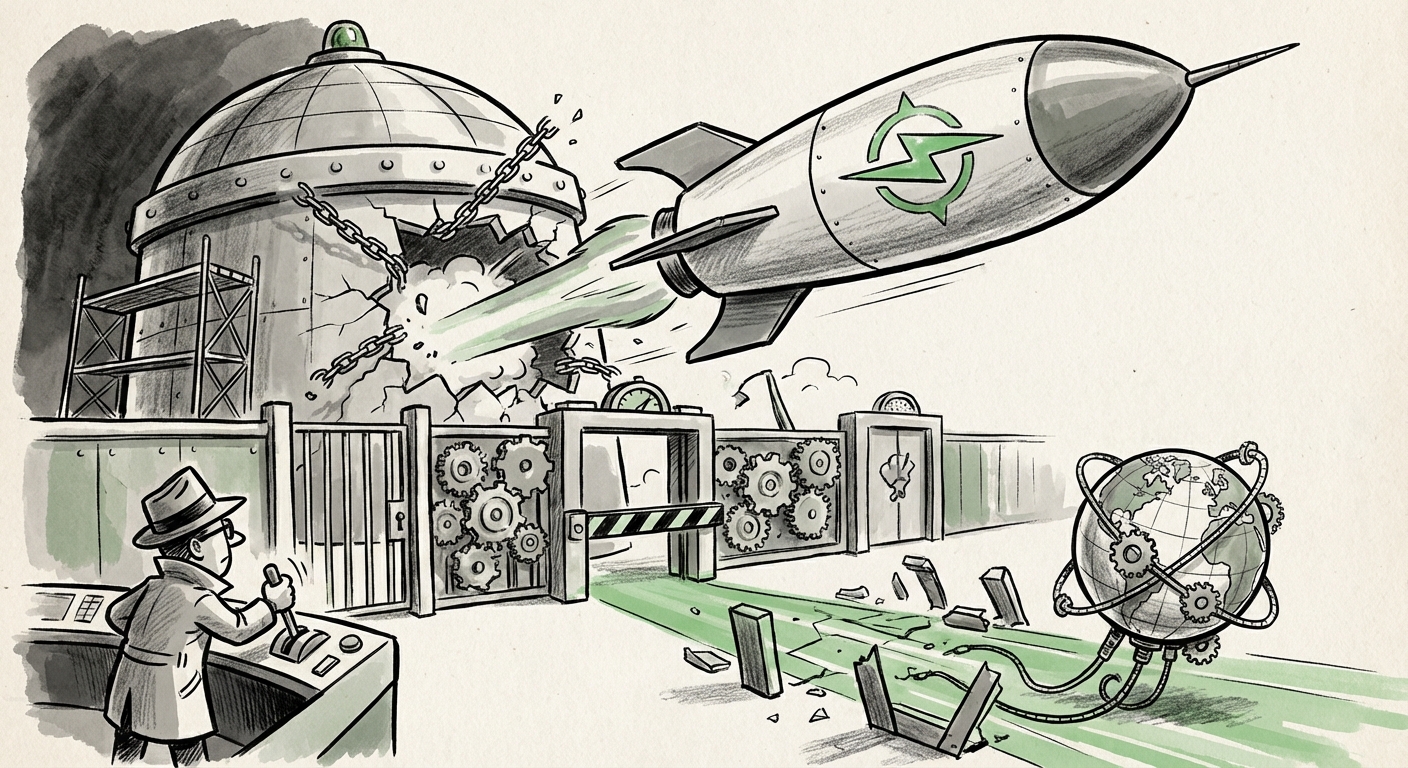
AI Agents in the Wet Lab: How Autonomous Labs Will Change Science Forever
Imagine a laboratory where nobody has to pipette anything. A place where an AI decides what experiment to run next, robots carry it out, sensors read the results, and the AI learns from what happened, then designs the next experiment on its own. That is the promise of the autonomous wet lab, and it is quickly becoming one of the most important frontiers in artificial intelligence.
The phrase at the heart of this shift is grounding AI agents in biological reality. It sounds technical, but the idea is simple. Today's AI is brilliant at reading and writing. It is far less brilliant at doing things in the messy, unpredictable physical world, especially the world inside a biology lab, where liquids spill, cells die, temperatures drift, and results are never quite as clean as a spreadsheet.
Grounding an AI agent in biological reality means giving it a body, eyes, and hands in the real world. It means connecting digital intelligence to actual test tubes, pipettes, incubators, and microscopes. That connection is the missing link between thinking AI and doing AI. And once it is fully built, it could reshape medicine, materials, agriculture, and the entire economics of scientific discovery.
What "Grounding AI Agents in Biological Reality" Actually Means
Most AI agents today live in a purely digital sandbox. They call tools, browse the web, write code, and send messages. The stakes are low. If an agent makes a mistake, you just run the task again.
A wet lab is different. It is wet, literally. Biology happens in liquids, in living cells, in environments that resist tidy digital control. An agent that operates here has to deal with contamination, evaporation, timing windows measured in minutes, and experiments that simply fail for reasons nobody can explain.
Grounding means building the agent so it understands those constraints from the inside. Instead of predicting text, it predicts what will happen when a sample is heated, mixed, or left overnight. Instead of writing an essay about a hypothesis, it tests the hypothesis and updates its beliefs based on what the physical world says back.
This is a fundamentally different kind of AI problem. Language models are trained on human writing. Wet lab agents have to be trained on, or at least tightly coupled to, the physical outcomes of real experiments. That makes the data slower, more expensive, and much harder to collect. It also makes it far more valuable.
The Building Blocks of an Autonomous Wet Lab
An autonomous wet lab is not one technology. It is a stack of several technologies that only recently became good enough to work together.
1. Perception, Giving the Agent Senses
The first building block is perception. An agent cannot act wisely if it cannot see what is happening. Modern labs are packed with cameras, spectrometers, plate readers, and imaging systems. Computer vision can now recognize colonies on a petri dish, spot color changes in a chemical reaction, or flag a pipetting error before it ruins a run.
Perception is what turns a blind script into an aware observer. The agent does not just follow a recipe, it watches the recipe unfold and reacts when reality drifts away from the plan.
2. Reasoning and Planning, The Brain
The second building block is the planning layer. This is where large language models and other AI reasoning systems come in. The agent needs to read scientific literature, propose hypotheses, design experiments, and decide what to test next.
The key skill here is experiment selection. A good scientist does not run random tests. They choose the experiment that will teach them the most, given what they already know. AI agents are increasingly capable of this kind of strategic thinking, picking the next question that shrinks uncertainty the fastest.
3. Robotic Execution, The Hands
The third block is physical automation. Robotic arms, liquid handlers, and automated sample movers do the actual work. These systems have existed for decades in industrial labs, but they were usually rigid. They ran the same protocol a thousand times.
What is new is flexibility. Modern automation can be reprogrammed quickly, and an AI agent can generate those programs on the fly. Combined with a planning brain, this means the lab can run a different experiment every hour, chosen dynamically, instead of repeating a fixed script.
4. The Closed Loop, Where It All Comes Together
The final building block is the feedback loop. Results flow back into the system automatically. The agent compares what it expected with what actually happened, updates its model of the biology, and designs the next round.
This is often called a self-driving lab or a closed-loop discovery system. It is the difference between a tool and a colleague. A tool waits for instructions. A closed-loop agent keeps working, overnight, on weekends, across thousands of experiments, until it finds something worth knowing.
Why Biology Is the Hardest Test for AI Agents
If autonomous labs are so valuable, why are they not already everywhere? Because biology is uniquely hostile to automation.
First, biology is noisy. Two identical experiments can give different results. Living systems vary. An AI agent trained on clean digital data can be badly confused by this. It has to learn to reason under uncertainty, to tell the difference between a real signal and random variation.
Second, biology is slow. Some experiments take days or weeks. That makes the feedback loop expensive. The agent cannot learn as quickly as a chatbot that gets a response in a second.
Third, biology is physical and fragile. Cells need care. Reagents expire. Robots make mechanical mistakes. A single jammed tip can corrupt an entire dataset unless the system notices and corrects it.
These difficulties are exactly why grounding is the right word. The goal is not to make biology more digital. The goal is to make AI more biological, more patient, more humble about uncertainty, and more respectful of messy reality.
What This Means for the Future of AI
The autonomous wet lab is a preview of where AI is heading next. For years, the biggest gains came from models that got better at text, images, and code. The next wave will come from models that get better at acting in the world.
That shift has three big consequences.
One: data becomes the bottleneck, not compute. In language, you can find training data almost anywhere. In science, you have to generate it, one experiment at a time. Whoever can run the most high-quality experiments the fastest will hold a real advantage. Autonomous labs are, in effect, data factories for the physical world.
Two: AI agents get graded on outcomes, not eloquence. A wet lab agent either finds a working compound or it does not. There is no partial credit for a well-written report. This relentless focus on real results will push AI development toward systems that are verifiable, reproducible, and honest about failure.
Three: the human role shifts upward. Scientists will spend less time pipetting and more time choosing good problems, interpreting surprising results, and deciding what should never be automated. Judgment becomes the scarce skill.
Practical Implications for Business and Society
Pharma and Biotech
Drug discovery is slow, expensive, and full of dead ends. Closed-loop labs can explore far more of the search space than any human team could. That will not make drug development easy, but it can shorten the early, exploratory phase, often the most wasteful part of the pipeline.
Materials, Agriculture, and Chemicals
The same approach applies far beyond medicine. New battery materials, better fertilizers, tougher crops, greener industrial chemicals, all of these are discovery problems. Any industry that runs experiments can benefit from a lab that runs itself.
The "Lab as a Service" Model
Not every company can afford a robotic lab. That creates a natural market for shared, cloud-accessible autonomous labs. Customers submit a research question; the remote lab designs, runs, and reports the experiments. Science becomes something you can rent by the hour, the way you rent computing today.
Safety, Governance, and Trust
Autonomy raises hard questions. Who is responsible if an agent designs a dangerous experiment? How do you audit a decision made by a system that ran a thousand tests overnight? Reproducibility becomes a governance issue, not just a scientific one. The labs that win trust will be the ones that log everything, explain their reasoning, and keep humans in the loop for high-stakes choices.
Actionable Insights
- Start with the data layer. Before buying robots, make sure results, protocols, and metadata are captured in structured, machine-readable form. An agent cannot learn from a paper notebook.
- Automate the loop, not just the task. A robot that runs one assay faster is useful. A system that decides which assay to run next is transformative.
- Design for failure. Assume experiments will break. Build detection, retries, and uncertainty tracking into the system from day one.
- Keep humans on the judgment layer. Let agents handle repetition and search. Let people handle ethics, strategy, and the interpretation of genuinely surprising results.
- Watch the skills shift. The most valuable lab workers of the next decade will blend biology, data science, and automation engineering.
The Bottom Line
Grounding AI agents in biological reality is not just a technical milestone. It is a change in what AI is for. For a decade, AI has mostly helped us think faster. Now it is starting to help us discover faster, testing ideas against the physical world instead of only against text.
The autonomous wet lab is the clearest example yet. It combines perception, reasoning, robotics, and feedback into a single system that can run science around the clock. It will not replace scientists. It will give them something they have never had: a tireless partner that never gets bored, never forgets a result, and never stops asking the next question.
The labs that embrace this shift early will not just work faster. They will ask better questions, and in science, that is where everything begins.