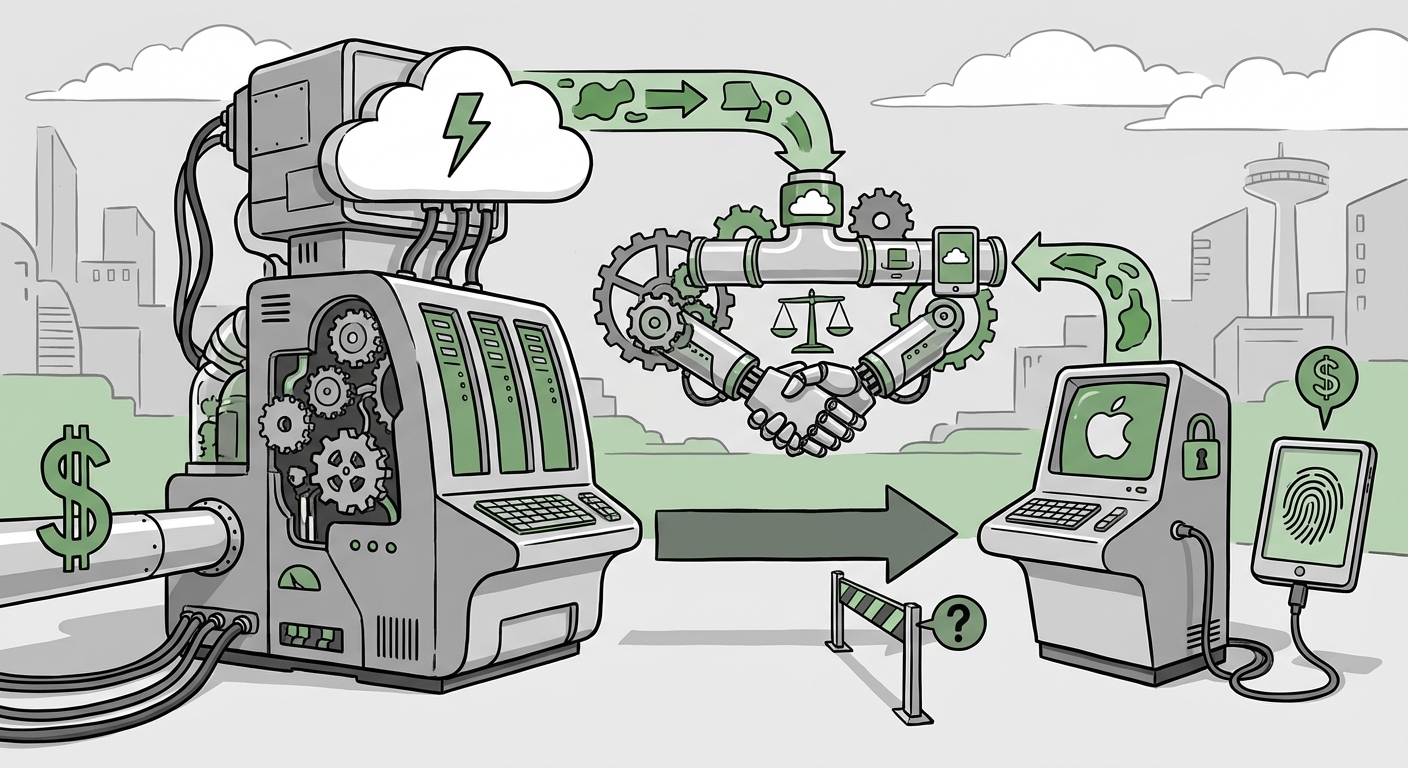
iOS Changes in Brazil: Why a Phone Rule Change Is Really an AI Story
On June 18, 2026, Apple began rolling out changes to iOS in Brazil. On the surface, this looks like a regional policy update, the kind of news that gets filed under "legal" and forgotten by everyone outside the app business. That would be a mistake. The rules that govern what can run on an iPhone decide which artificial intelligence products reach billions of people, who gets to build them, and who collects the data that makes them smarter.
In other words: the fight over the phone's front door is now the fight over AI's front door. And Brazil, one of the largest mobile markets on the planet, just became a live test of what happens when that door is opened wider.
What Is Actually Changing, and Why It Matters
The announcement, titled simply "Changes to iOS in Brazil," marks a shift in how iOS operates in that country. Apple has been under sustained pressure from regulators and lawmakers around the world who argue that tight control over app distribution, payments, and default services blocks competition. Brazil has joined the list of markets where that pressure is producing real changes to how the iPhone works.
For most people, these shifts sound technical. For anyone building or buying AI tools, they are structural. Here is the core idea: when a platform controls the only store, the only payment rails, and the default apps on the home screen, it controls the economics of every product built on top of it. Loosen one of those controls and entire categories of software, especially AI assistants, AI search, and AI-powered creative tools, can suddenly compete on features rather than on permission.
Why App Store Rules Are Really AI Rules
Modern AI products are not standalone apps. They are deeply wired into the phone. An AI assistant wants to read your calendar, draft an email, listen to a voice command, look at your photos, and call other apps to get things done. Every one of those actions touches a platform rule.
That is why any meaningful change to iOS in a major market has an outsized effect on AI. Three pressure points matter most:
- Default apps. Whichever assistant a phone ships with gets a massive advantage, muscle memory is a moat. Rules that make it easier for users to switch defaults, or to choose a different assistant at setup, hand real distribution power to challengers.
- Distribution. If apps can be installed from places other than a single official store, AI startups no longer need to win one gatekeeper's approval to reach customers.
- Payments. AI products are expensive to run. Every percentage point lost to a platform tax comes directly out of the compute budget. New payment routes change what business models are viable.
None of these are abstract policy debates. They decide whether an AI company can afford to give away a free tier, whether a local Brazilian startup can launch without a foreign partner, and whether a user's assistant can act on their behalf across apps.
The Default Assistant Becomes the Battleground
The most consequential part of any iOS opening is not the store, it is the home screen. Voice assistants were once a novelty. With modern large language models, they are becoming the primary way people interact with their devices. If that interface is locked to one provider, the rest of the AI market competes for scraps.
What happens in Brazil will be watched closely as a preview. If users there can more freely choose which assistant hears their commands, the lesson will travel fast. Expect three effects:
1. Assistants start competing on trust and privacy, not just smarts
When users can switch, vendors must earn the switch. That pushes AI providers toward clearer data promises, on-device processing, and transparency about what leaves the phone. Privacy stops being a marketing slogan and becomes a product feature with a price tag attached.
2. Local players get a real shot
Brazil is a huge, linguistically distinct market. A more open iOS lowers the cost of reaching users directly, which makes it more commercially sensible to build AI that handles Portuguese, local banking, local retail, and local slang well. Language coverage in AI has always followed commercial incentive. Open distribution creates that incentive.
3. Integration quality becomes the differentiator
Once access is fairer, the winner is whoever actually gets things done, booking, paying, messaging, scheduling. The AI race shifts from "whose model scores higher on a benchmark" to "whose assistant finishes the task."
The Hard Part: Security and the Trust Tax
Every opening carries risk, and it is worth being honest about it. Sideloading and alternative payment routes widen the attack surface. AI features make this sharper, because assistants hold permissions that traditional apps never had, access to messages, microphone, location, and financial actions.
A phone that lets an AI agent act on your behalf is a phone that can be tricked into acting against you. Prompt injection, where hidden text in a web page or email hijacks an assistant's instructions, is a real and growing problem. Platforms will respond with stricter permission prompts, notarization, and sandboxing, which means developers should expect a new compliance layer focused specifically on AI behavior.
The likely outcome in Brazil, and everywhere this path is followed, is a middle ground: more openness at the distribution layer, tighter control at the capability layer. That is a reasonable trade, but it means AI builders must plan for security review as a core engineering task, not an afterthought.
What This Means for Businesses
If you run a company that touches the Brazilian market, or any market likely to follow, here is the practical translation.
Your app strategy needs a distribution plan B
Relying on a single store as your only route to customers is now a concentration risk in more places. Smart teams are building direct channels: web apps, progressive web apps, email capture, and community. Own the relationship, not just the download.
Revisit your unit economics
AI margins are thin because inference is expensive. Any reduction in platform fees is not a windfall, it is runway. Model out what your product looks like if payment terms change in your market, in both directions, and price accordingly.
Assume your assistant will be pluggable
Design your product so it can be called by someone else's AI agent, not just opened by a human. That means clean APIs, machine-readable documentation, and clear permissions. In an open-assistant world, being the tool an agent picks is as valuable as being the app a person taps.
Localize for real
Open markets reward depth over breadth. An AI product that genuinely handles Brazilian Portuguese, local payment habits, and regional customer expectations will beat a global generic tool that merely translates its interface.
What This Means for Users and Society
For consumers, the upside is choice and price pressure. More competition usually means better free tiers, more variety, and assistants that actually understand local context. The downside is complexity, more decisions about defaults, permissions, and which AI you trust with what.
There is a broader point about AI governance here. Countries are discovering that they can shape AI's role in daily life not only through AI-specific laws but through competition rules aimed at the platforms AI runs on. That is a faster lever, and it is being pulled in more places. Brazil's changes are a data point in a global pattern: the phone is the policy instrument.
This also matters for smaller developers and for the diversity of the AI ecosystem. When distribution is controlled by one gatekeeper, the tools that reach people tend to reflect one company's priorities. Loosening that gate is one of the few interventions that can meaningfully widen who gets to build the AI layer of the next decade.
An Actionable Playbook
If you want to be ready rather than reactionary, start here:
- Audit your dependencies. List every assumption your product makes about platform rules, distribution, payments, defaults, permissions. Score each for risk.
- Build the web channel now. It is the only distribution you fully control, and it doubles as your AI agent endpoint.
- Treat privacy as UX. Clear, plain-language explanations of what your AI sees and does will win switches in an open market.
- Invest in security for agentic features. Test for prompt injection. Limit blast radius. Log actions. Assume attackers will try to talk your assistant into things.
- Watch Brazil as a leading indicator. Rules that appear there tend to spread. Budget for regulatory change as a recurring line item, not a one-time project.
The Bigger Picture
The headline reads like a legal footnote. The substance is bigger. When a market the size of Brazil gets different iOS rules, it does not just change how apps are installed, it changes who can sell intelligence to hundreds of millions of people, on what terms, and with what safeguards.
AI's future will not be decided only in research labs. It will be decided in app stores, payment systems, and default settings, the unglamorous plumbing of the phone in your pocket. The changes in Brazil are a reminder that the plumbing is being re-routed right now, and that the companies paying attention today will be the ones whose AI is actually on the home screen tomorrow.