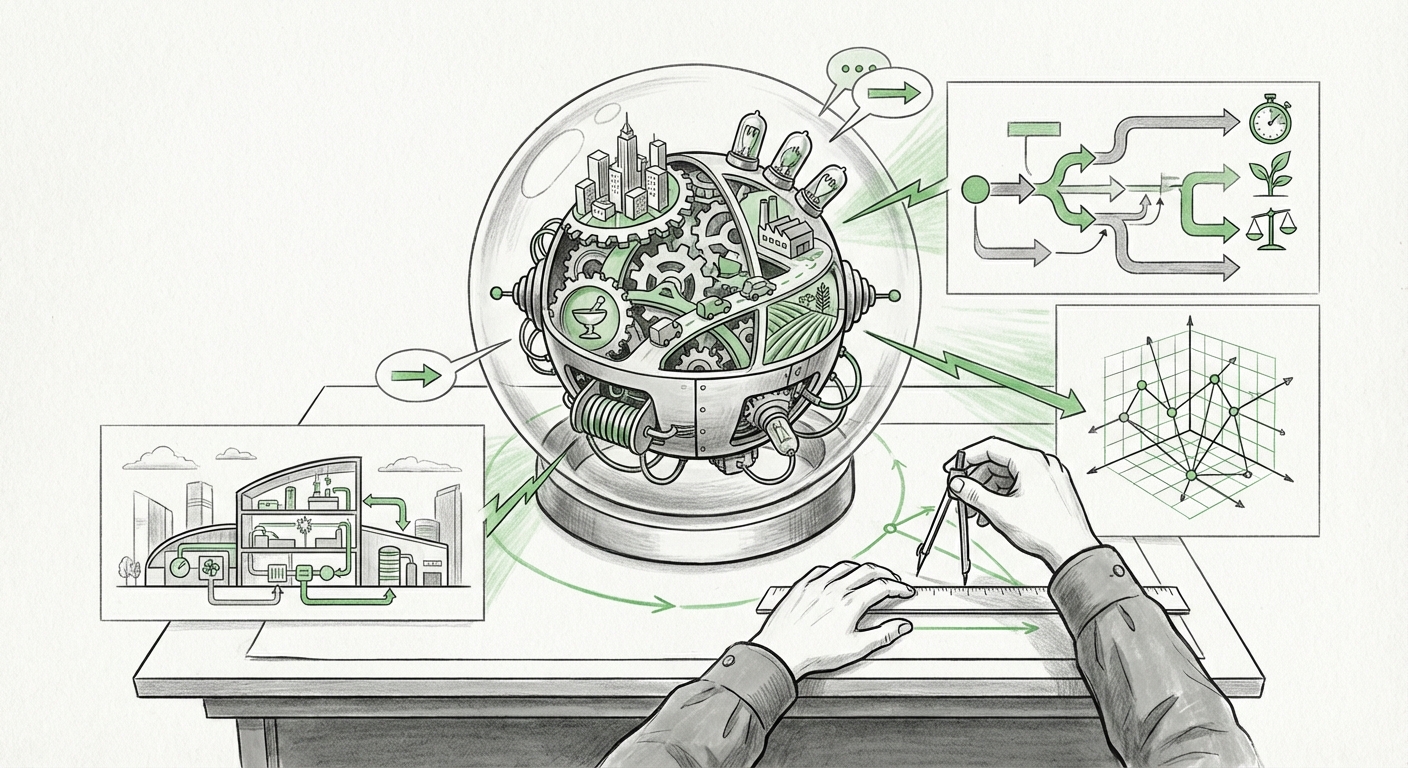
Google Open-Sources Harness2: What a Recursive Agent Framework Means for the Future of AI
Something important just shifted in the world of AI agents. Google has open-sourced Harness2, a framework for building AI agents that can improve their own working process. The name sounds technical, and the details are technical. But the idea behind it is easy to grasp: instead of hand-building every step an AI agent takes, Harness2 gives the agent a structure it can use to examine and rebuild those steps on its own.
That single move, putting a recursive loop around agent behavior and then releasing the code to everyone, tells us a lot about where AI is heading. It is a signal that the industry's center of gravity is moving away from "which model is smartest" and toward "which system can organize, check, and improve its own work." For businesses, that is a much bigger deal than it sounds.
First, What Is an Agent Harness?
An AI model on its own is like a very well-read person locked in a room with no tools, no memory, and no ability to check their own work. You ask a question, you get an answer. That's it.
An agent harness is everything built around the model to turn that into real work. Think of it as the scaffolding: the part that decides which tools the agent can use, how it breaks a big task into smaller steps, what it remembers from earlier attempts, when it should stop and ask for help, and how it checks whether the answer it just produced is actually any good.
The model is the brain. The harness is the desk, the filing cabinet, the checklist, and the manager standing behind the chair. Anyone who has built agents knows the hard part is almost never the brain. It's the desk. Most agent failures are not "the model was too dumb." They are "the loop spun forever," "it forgot what it learned three steps ago," or "nobody caught the mistake before it shipped."
By packaging that scaffolding into an open framework, Harness2 lowers the cost of doing agent work properly. That alone would be a useful release. But the "recursive" label is what makes it worth paying attention to.
The Recursive Part: Agents That Adjust Their Own Approach
"Recursive" in this context points to a feedback loop that goes one level deeper than usual. A normal agent loop looks like this: try a step, see the result, try the next step. A recursive harness asks a harder question: was the way I approached this task a good way to approach it?
That means the system can look at its own process, the plan it chose, the tools it reached for, the order it did things in, and revise that process for the next attempt. The agent is no longer just solving the problem. It is also editing its own recipe for solving problems.
This is where the real leverage sits. Most current agent systems are frozen at deployment: you design the workflow once, and it does the same thing forever, even when it keeps failing the same way. A recursive structure gives the system a way to notice a pattern of failure and change course without a human rewriting the code.
It is worth being clear about what this is not. It is not a model that rewrites its own underlying weights, and it is not a claim that AI is now improving itself without limits. What is being shared is a framework, a structure for the outer loop. The interesting part is architectural, not magical. The system gets better at working, not necessarily at being.
Why Open-Sourcing Is the Real Story Here
Google could have kept this internal. Plenty of companies would. The decision to open the framework up matters for three concrete reasons.
1. It turns agent design into shared infrastructure
Right now, every company building agents is quietly reinventing the same wheel: retry logic, memory handling, tool permissions, evaluation hooks. It is expensive and mostly undifferentiated. When a major lab publishes a reusable structure, the baseline rises for everyone. Small teams get a starting point that would have taken months to build.
2. It makes "recursive improvement" auditable by outsiders
Self-adjusting systems are hard to trust when they are black boxes. When the loop is open source, researchers, regulators, and customers can actually inspect how decisions get revised, where the guardrails sit, and what gets logged. Openness is not a guarantee of safety, but it is a precondition for accountability.
3. It signals where Google expects competition to move
When a leading lab gives away the scaffolding, it usually means the scaffolding is no longer the moat. The value moves up to the models, the data, the distribution, and the domain-specific work. That is a strong hint about how the next phase of the agent market will be won, and it is not by having the prettiest loop manager.
What This Means for the Future of AI
Shift one: from prompts to processes. The craft of getting good results out of AI is moving from writing clever instructions to designing reliable systems around the model. Frameworks like Harness2 accelerate that. The teams that win will be the ones that treat AI work as engineering, with checkpoints, tests, and error handling, not as a series of clever one-off prompts.
Shift two: agents that fail better. The most underrated capability in AI is graceful failure. A system that recognizes it is stuck, backs up, and tries a genuinely different approach is worth far more than one that is slightly smarter on a benchmark but loops forever in production. Recursive harnesses are, at heart, a bet that recovery is the bottleneck, not raw intelligence.
Shift three: evaluation becomes the product. If an agent can revise its own approach, the critical question becomes "how do we know the revision was an improvement?" That puts measurement, tests, scoring, human review loops, at the center of the stack. Expect the tooling around agent evaluation to grow as fast as the agents themselves.
Shift four: a lower floor, not a higher ceiling. Open frameworks don't make the best systems better. They make the average system much better. That is usually the change that actually reshapes an economy, because it puts capability in the hands of the thousands of companies that will never build their own harness from scratch.
Practical Implications for Businesses
The temptation with any new framework is to treat it as a product to adopt. Resist that. Harness2 is infrastructure, and infrastructure decisions are strategic. Here is how to think about it.
Start with the workflows that fail repeatedly
Recursive self-correction is most valuable where the same mistake keeps happening. That means tasks like document processing with messy inputs, multi-step research, data reconciliation, and support triage, jobs where the first attempt often misses and a second pass with a revised plan fixes it. High-volume, repetitive, error-prone work is the sweet spot.
Keep a human in the loop where the stakes are high
A system that revises its own approach can also confidently revise itself in the wrong direction. For anything touching money, safety, legal exposure, or customer trust, the loop needs an approval gate and a clean audit trail. The framework may give you the mechanism; the policy is still your job.
Budget for observability, not just capability
If you deploy self-adjusting agents without logging what changed and why, you will eventually have an incident you cannot explain. Right now, logging and trace tooling should get as much engineering attention as the agent logic itself. This is the least glamorous and most valuable investment you can make.
Reassess your build-versus-buy math
If the scaffolding is now free and open, the honest question is whether your internal agent framework is still worth maintaining. For most organizations, the answer is to adopt the shared layer and spend your engineering effort on the domain-specific parts that actually differentiate you.
Risks Worth Naming
Open-sourcing a recursive agent framework also lowers the barrier for people who want to use it carelessly. Self-modifying loops can drift: small changes compound, and a system can end up optimizing for a proxy that nobody intended. There is also the accountability gap, when an agent silently changes how it works, who signed off on the new behavior?
The reasonable posture is neither fear nor cheerleading. It is controlled adoption: use the framework, cap how far the loop can drift, log everything, and keep a human owner for every agent that touches the outside world.
Actionable Next Steps
- Pick one workflow and pilot it. Choose a repetitive task with a visible failure rate. Measure the baseline before you change anything.
- Instrument first. Before scaling, make sure you can see every plan, revision, and tool call the agent makes.
- Set drift limits. Define what the agent is allowed to change about its own approach, and what requires human sign-off.
- Build the eval set. You cannot judge a self-improving loop without a fixed set of test cases to score it against.
- Revisit your roadmap. If scaffolding is commoditizing, double down on proprietary data, domain expertise, and integration depth, the parts nobody can open-source for you.
The Bottom Line
Harness2 is not a headline-grabbing model release. It is something more quietly consequential: a shared, open structure for making AI agents that can check and correct their own approach. That combination, recursive loops plus open code, pushes the industry toward a future where reliability is engineered rather than hoped for, and where the ability to build dependable agents is no longer reserved for a handful of well-funded teams.
The companies that move early and carefully will not just get more done with AI. They will get work they can actually trust. And in the agent era, trust is the real product.