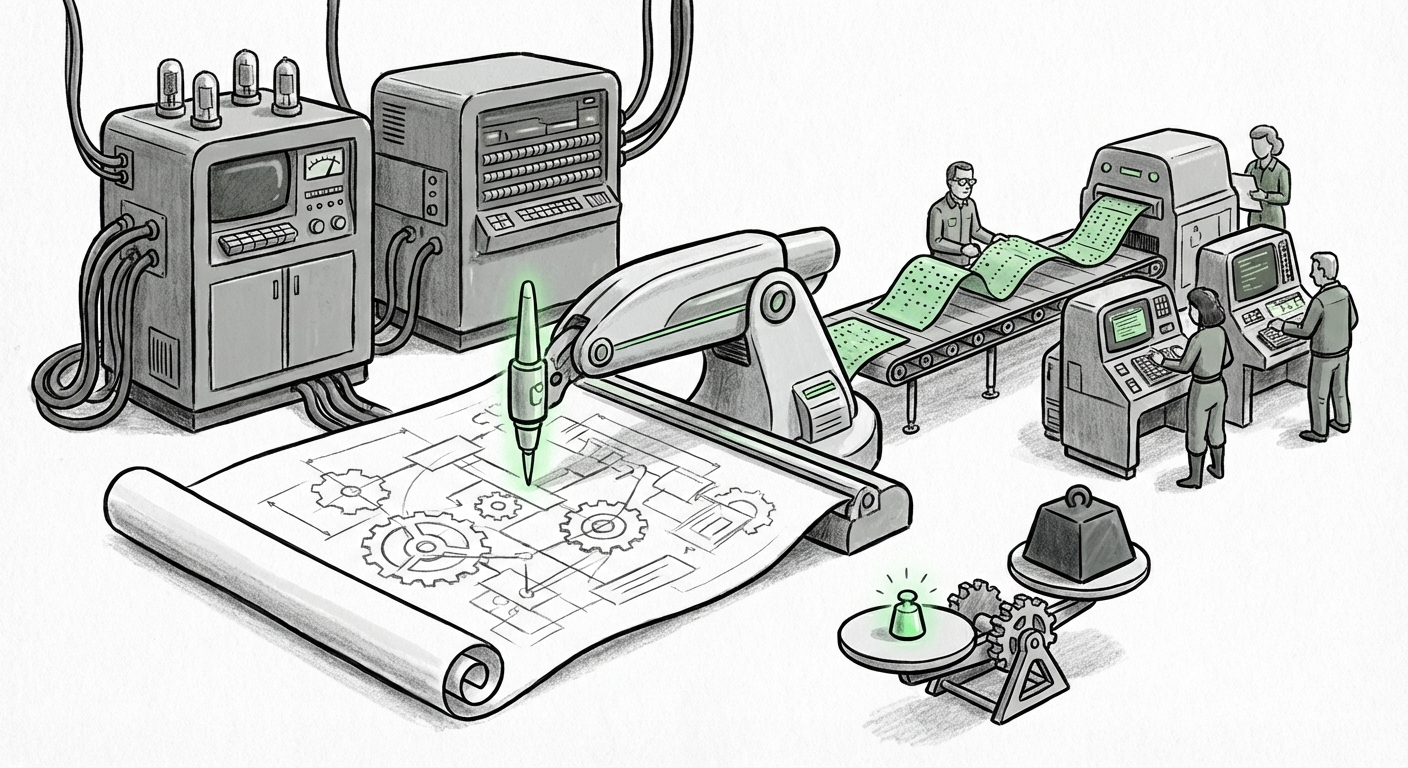
Holotron-12B and the Rise of High-Throughput Computer Use Agents: What It Means for the Future of AI
Something important is happening in AI right now, and it is not about bigger chatbots. It is about software that can actually use a computer, clicking, typing, scrolling, filling in forms, moving between apps, the way a person does. The arrival of a model called Holotron-12B, described as a high-throughput computer use agent and published in March 2026, is a useful marker of where this category is heading.
The name itself tells a story worth unpacking. "12B" points to a model of roughly twelve billion parameters, a size that sits firmly in the small-to-mid range for modern AI. "High-throughput" points to speed and volume: not one careful task at a time, but many tasks running in parallel, cheaply and continuously. And "computer use agent" points to a model whose job is to operate the tools we already own.
Put those three ideas together and you get something more significant than a single model launch. You get a blueprint for AI as digital labor, not AI as a chat partner.
Why "Computer Use" Is the Next Big Front in AI
For the last few years, most AI progress has been about understanding and generating text, images, and code. That is powerful, but it runs into a wall fast. Most of the world's work does not happen in a text box. It happens inside business applications, the CRM, the billing system, the insurance portal, the legacy database with a 1990s interface.
Those systems have no clean connection for AI to plug into. There is no friendly door. There is only a screen designed for human eyes and hands.
A computer use agent solves that by doing what humans do. It looks at the screen (often as an image plus the underlying page structure), decides what to click or type, and takes the next step. This is sometimes called "robotic process automation with a brain." The old version of that idea needed a human to hand-write brittle scripts for every workflow. The new version learns from examples and generalizes.
That is a big deal, because it means the long tail of software becomes automatable without a rewrite. Companies do not have to replace their systems. They can put an agent in front of them.
Throughput Is the Quiet Revolution
The most under-discussed word in AI today may be "throughput." Most agent demos show one agent doing one interesting task while a human watches. That is a science fair project. Business value lives somewhere else entirely: doing ten thousand boring tasks reliably, overnight, while nobody watches.
High throughput means several things at once:
- Speed per action. Agents that pause for a second or two between clicks cannot keep up with real work queues. The "high-throughput" framing signals that latency per step is treated as a first-class design goal, not an afterthought.
- Parallel execution. Many sessions running side by side, each handling a different case or account.
- Cost per task. A smaller model, again, the 12B naming, is far cheaper to run than a giant flagship model. If a task is repetitive, small and fast beats large and clever almost every time.
This is the economics that will decide which agent products survive. Enterprises do not buy intelligence in the abstract. They buy a cost per invoice processed, per ticket resolved, per record updated. When that number drops below the cost of a human doing the same work, with acceptable accuracy, adoption stops being optional.
The small-model bet
There is a real strategic argument buried in the Holotron-12B name. Many teams assumed the path to capable agents ran through the largest frontier models available. The counter-argument is that a mid-sized model, tuned specifically for the narrow job of screen-based action, can outperform a general giant on that job while being dramatically cheaper and faster.
That is a maturing thesis across the AI industry: specialization plus efficiency beats scale alone for well-defined, high-volume work. Chat models get better as they get bigger. Operating a checkout form does not necessarily get better that way, it gets better with feedback, tight evaluation loops, and a model trained on the right action traces.
What This Means for the Future of AI
1. AI shifts from answering to doing
The value of AI in the near term will be measured less by what it can explain and more by what it can finish. That moves the hard problems from "can the model write a good paragraph?" to engineering questions: How do we know the agent did the right thing? How do we undo it when it does not? How do we integrate it into approval chains that already exist?
2. The interface becomes a fallback, not a destination
Today's agents largely click through screens built for humans. Over time, this is likely to look like a transition phase. The most valuable workflows will get proper machine interfaces, and screen-driving will be reserved for the messy, older, or one-off systems that will never be rebuilt. The agent's real role is to cover the gap, and it is a huge gap.
3. Reliability becomes the product
An agent that succeeds 95 percent of the time sounds great until you remember that 1 in 20 failure rate means hundreds of failed tasks a day at scale. The companies that win here will be the ones that treat verification as seriously as intelligence: checkpoints, confirmation steps, dry runs, and clean handoffs to a human when confidence drops.
4. The human role moves up a level
Fewer people doing the clicking; more people designing the rules, reviewing exceptions, and owning the outcomes. This is the same pattern we saw in manufacturing and data entry. It is disruptive in the short run and productive in the long run, but only if organizations invest in training and clear accountability.
Practical Implications for Businesses
If high-throughput computer use agents become a standard tool over the next few years, here is what that means in practice.
- Audit your screen work. Find the tasks people do repeatedly in systems that will never be modernized. Those are your first candidates. High-volume, low-judgment, rules-based work is the sweet spot.
- Measure cost per task, not model quality. Build a simple spreadsheet: how many tasks per day, what does each cost today, what would an agent cost at expected accuracy. That number decides your roadmap.
- Design for exceptions first. Plan how a broken workflow reaches a human, how fast, and with what context. The exception path, not the happy path, is what will determine whether users trust the system.
- Start with read-only tasks. Having an agent gather data, summarize, and prepare work for approval is far safer than letting it move money on day one. Earn trust in stages.
- Keep an audit trail. Every action an agent takes should be logged with the screen it saw, the decision it made, and the result. When something goes wrong, this trail is what lets you fix it and prove what happened.
- Do not skip the access review. An agent that can log in is an agent with credentials. Scope permissions tightly and rotate them like you would for any user.
Risks Worth Taking Seriously
Powerful agents that drive computers are also agents that can be manipulated. A malicious webpage or a hidden instruction on a screen can, in principle, steer an agent into doing something its owner never asked for. This class of attack is not theoretical in agent research, and it will get more attention as agents get more autonomy.
There is also the plain operational risk of scale. One broken agent is an inconvenience. Ten thousand broken agents on the same weekend is an incident. High throughput amplifies every mistake as well as every success, which means deployment plans need to think about blast radius, rate limits, and kill switches from day one.
And there is the accountability question. If an agent submits a wrong filing or sends a wrong notice, who is responsible? The vendor, the operator, or the person who approved the workflow? Companies adopting this technology will need clear answers before, not after, something goes wrong.
What to Watch Next
The signal to track is not another benchmark score. It is evidence of agents working at volume, on real tasks, with published accuracy and cost figures. Watch for:
- Tasks per hour and cost per completed task, reported honestly.
- How models handle the failure cases, retries, escalations, and recovery.
- Whether mid-sized, task-tuned models keep closing the gap on general flagship models for narrow work.
- Whether enterprises start treating agent output as something that needs approval workflows rather than blind trust.
The Bottom Line
Holotron-12B is a small name for a large shift. The interesting thing about it is not that another model appeared in March 2026. It is the combination it represents: mid-sized, fast, built for volume, and pointed at the screen instead of the chat box.
That combination is how AI stops being a tool you visit and becomes a worker that runs in the background. The organizations that do well will not be the ones with the most impressive demo. They will be the ones who measured their own repetitive screen work honestly, tested carefully, built real guardrails, and treated cost per task, not intelligence per parameter, as the number that matters.
The agents are coming for the boring parts first. That is exactly where the value has been hiding.