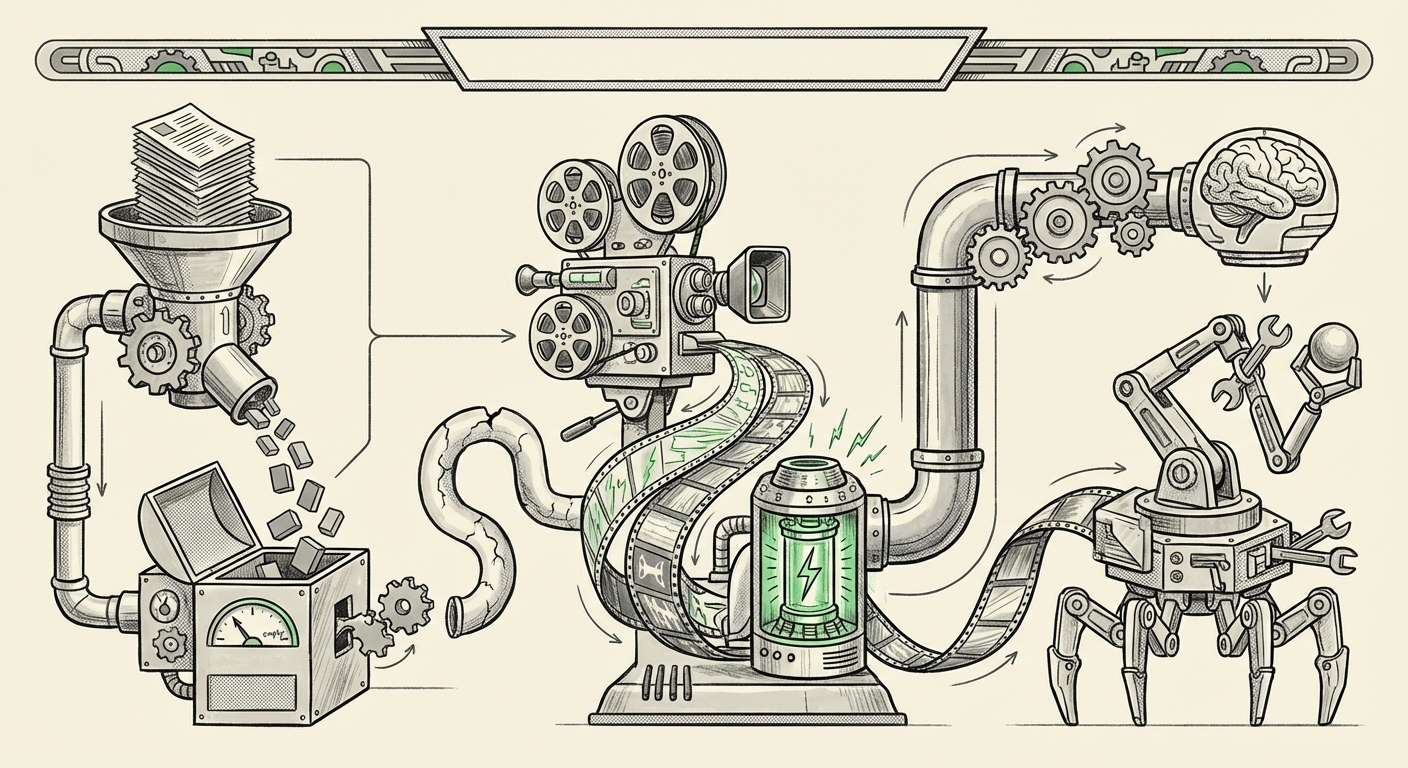
Model Distillation Attacks: Inside the Coordinated Copying Campaign That Got Shut Down
A quiet fight has been going on in the AI industry for the last few years, and it finally spilled into the open in late September 2026. A coordinated model-distillation campaign was detected and disrupted. That single sentence hides a lot. It means someone was using a front-end AI product to quietly train a rival model, not by stealing code, but by harvesting millions of answers.
This is one of the most important and least understood risks in AI today. It does not involve hacking servers or breaking encryption. It uses the front door, a normal user account, and a lot of patience. Understanding how these campaigns work, and how they get stopped, tells us a lot about where the AI business is heading.
What Model Distillation Actually Is
Distillation is a standard technique in machine learning. You take a big, expensive "teacher" model and use its outputs to train a smaller, cheaper "student" model. This is legal, common, and often encouraged. Many companies publish guidance on how to do it with their own models.
The problem starts when distillation happens without permission. An AI model is built from patterns learned from huge amounts of data. Its answers are valuable. If a competitor can send millions of carefully chosen prompts and record the answers, they can train a copy that gets close to the original's behavior, at a fraction of the cost.
Think of it like this: building a world-class model can take years of research, enormous computing power, and hundreds of millions in spending. Copying one through its outputs might take a few months, some clever scripting, and a lot of API calls. That gap is the whole problem.
Why Outputs Are the New Source Code
Traditionally, a company's secret sauce was its source code or its data. In AI, the sauce is partly in the weights, the billions of numbers that shape how a model responds, and partly in the behavior the weights produce. You cannot easily read the weights. But you can read the behavior, one answer at a time.
Every response is a tiny lesson. "Here is how this model reasons about a legal clause." "Here is how it formats a JSON output." "Here is how it handles a tricky math word problem." Collect enough of those lessons and you have a training set that captures something real about the teacher.
Anatomy of a Coordinated Campaign
The word coordinated matters. A single curious user asking a lot of questions is not a campaign. A campaign is organized. It usually shows a few recognizable patterns:
- Many accounts, one goal. Attackers spread traffic across hundreds or thousands of accounts, API keys, and payment methods so no single one looks unusual.
- Systematic prompt coverage. Instead of random questions, the prompts sweep across topics in an organized grid, reasoning, coding, translation, summarization, safety edge cases, so the harvested data covers the model's full range.
- High volume, low variety in format. Long runs of near-identical prompt templates are a classic tell.
- Output farming. The accounts often ignore the answers entirely. They just log them. No human reads a million responses.
- Infrastructure hygiene. Rotating IP addresses, mixed billing details, and traffic timed to look organic.
- Downstream training signals. Eventually the harvested data shows up in a new model that behaves a little too much like the original.
None of these signals is conclusive on its own. A legitimate researcher might generate huge volumes of prompts. A company building an evaluation suite might look exactly like a farming operation. That is what makes detection hard, and why disruption usually depends on combining weak signals, not catching one smoking gun.
How a Campaign Gets Disrupted
Stopping this kind of activity is not a single action. It is a stack of defenses that work best together. Based on how these programs are typically built, disruption tends to come from several layers at once.
1. Traffic and Account Analysis
The first layer is behavioral. Security teams look at graph-level patterns: which accounts share payment fingerprints, which ones appear and disappear together, which ones spike in the same hour. When a "random" set of customers behaves like a single coordinated buyer, that pattern is often enough to act on, throttling, suspending, or requiring stronger verification.
2. Output Fingerprinting
Model providers can embed subtle statistical signatures in responses. These are not visible watermarks in the text that a user would notice. They are patterns in how outputs are generated. If a new model shows those patterns, it is strong evidence that it was trained on a specific teacher's outputs.
This matters because it turns distillation from an invisible act into a traceable one. You cannot easily scrub a fingerprint from a training set you did not know existed.
3. Canary Prompts and Trap Inputs
Providers can plant special prompts whose answers are unique and memorable. If those answers ever appear in a competitor's training data or model outputs, the trail is direct. It is the AI equivalent of marking a document with a unique typo to catch a leaker.
4. Rate Limits and Query Diversity Checks
Simple friction works. Limits on how many tokens a single account can pull per day, combined with checks on how repetitive the request stream is, raise the cost of farming. Attackers then need more accounts, more payment methods, and more time, all of which create more chances to be caught.
5. Licensing and Terms Enforcement
Contracts matter here. Most commercial AI terms explicitly forbid using outputs to train competing models. Enforcement ranges from cutting off access to legal action. The disruption of a coordinated campaign is rarely just a technical event; it is usually a policy event too.
What This Means for the Future of AI
The disruption of a distillation campaign is a signal, not an ending. It tells us several things about where the industry is going.
The Moat Is Moving
For years, the assumption was that the best model wins. That is changing. If behavior can be copied at a fraction of the cost, then the durable advantages shift to things that are harder to copy: distribution, trust, integration into workflows, proprietary data, and cost of operation. A model that is 5% better is not much of a moat if a copycat can match 90% of its quality for a tenth of the price.
The companies that come out ahead will be the ones that treat their model as a product with a supply chain, not just a research artifact.
Detection Becomes a Product Feature
Expect model providers to publish more about provenance and fingerprinting. Enterprise buyers will start asking hard questions in procurement: How do you prove where this model's training data came from? Can you show it was not distilled from a competitor? Provenance is becoming a compliance topic, similar to how supply chain transparency became standard in manufacturing.
Open and Closed Models Face Different Risks
Open-weight models have a different exposure profile. When weights are downloadable, the question of distillation changes, there are no API logs to analyze. But open models also make a strong argument: if you publish the weights, you cannot complain about copying quite as easily. The industry is still working out where the line sits between legitimate derivation and free-riding.
A New Kind of Arms Race
Every defense raises the cost of attack, and every successful attack reveals a gap. Expect this to be an ongoing cycle, much like spam filtering or fraud detection. There will be no final victory, only better tooling and faster response.
Practical Implications for Businesses
If you build on top of AI models, this story is directly relevant to you.
- Know your exposure. If your product wraps a third-party model, your vendor's anti-distillation posture affects your risk and your costs.
- Audit your own traffic. If you generate synthetic training data using a vendor's API, make sure your usage is clearly permitted. Many teams have crossed lines without realizing it.
- Document your data lineage. Being able to show where training data came from is becoming a business requirement, not a nice-to-have.
- Value integration over parity. If your only differentiator is "we use a good model," that is fragile. Build workflows, data, and trust that a copied model cannot replicate.
- Treat model access like a security perimeter. Log prompts, monitor anomalies, and set spend and volume caps by default, not after an incident.
The Bigger Picture
The deeper issue here is economic. AI models are expensive to create and cheap to imitate. That mismatch is exactly the condition that produces black markets, gray markets, and enforcement fights. We saw it with music, with software, and with pharmaceuticals. AI is not special in that regard, it is just faster.
The important question is not whether copying will happen. It will. The question is whether the industry builds clear, fair rules for allowed derivation. Distillation is not inherently bad. It is how smaller, cheaper, faster models reach more people. A world where only a handful of firms can build capable models is worse than one where many can, as long as they build on fair terms.
Disrupting a coordinated campaign is a good outcome for the defenders. In the long run, the more valuable outcome will be clearer norms about who gets to learn from whom, and at what price.
Actionable Takeaways
- Understand that model outputs are a training resource and a trade secret at the same time.
- Layer your defenses: behavior analysis, output fingerprints, canary prompts, rate limits, and contract enforcement.
- Assume attackers will spread across accounts, detect coordination, not just volume.
- Buyers should ask vendors about provenance and anti-distillation policies before signing.
- Build moats in distribution, workflow, and trust, not just model quality.