Robotics AI Is Moving On-Device: Why VLA Fine-Tuning and Embedded Optimization Change Everything
For the last few years, the smartest robot brains have lived far away from the robots. A camera would see something, the video would be shipped to a data center, a model would think about it, and a command would come back. In a lab, that works fine. In a real warehouse aisle with bad Wi-Fi, a slow connection, or a strict safety rule, it falls apart fast.
That is why the shift toward bringing robotics AI onto embedded platforms is one of the most important stories in AI right now. It is not just an engineering tweak. It changes what robots can do, where they can work, who can afford them, and what kind of data becomes valuable.
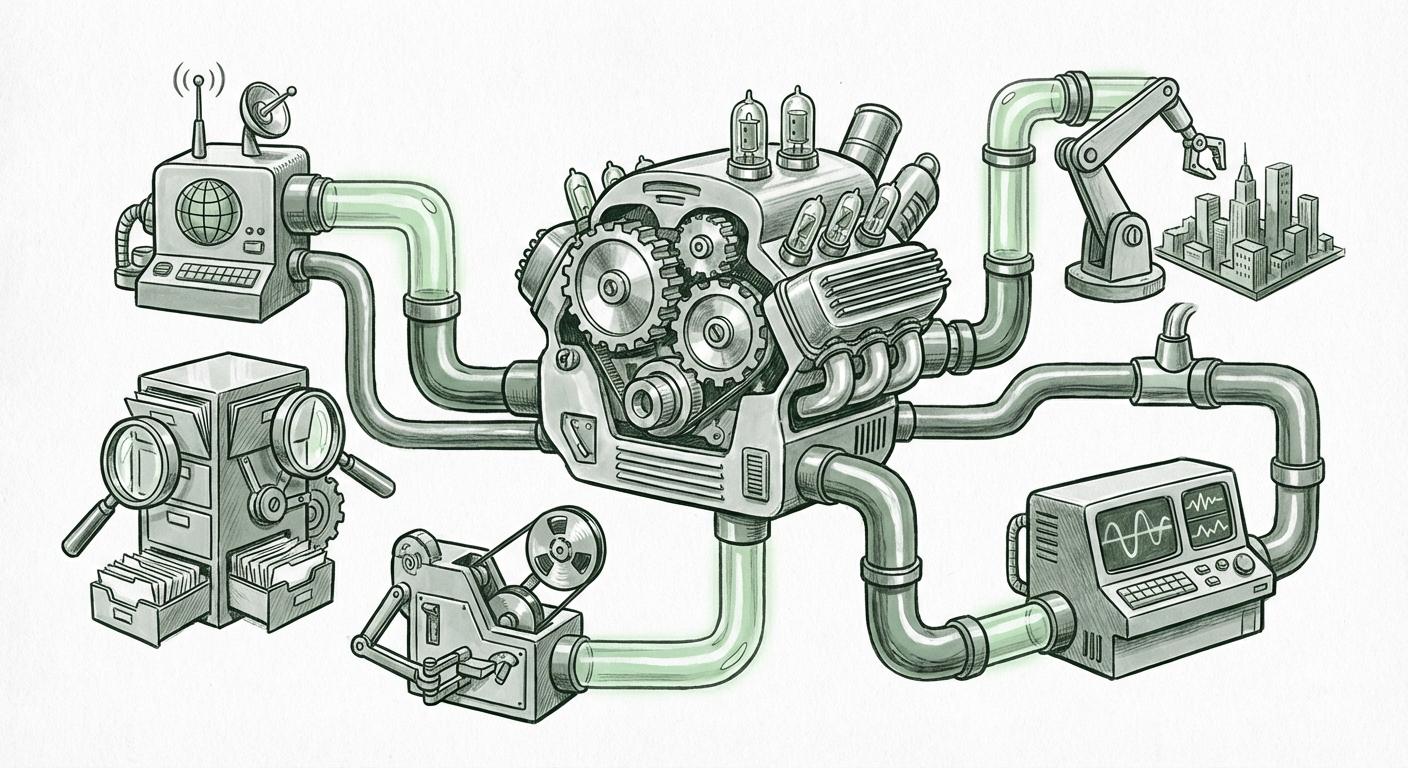
The shift has three moving parts: recording better robot datasets, fine-tuning vision-language-action models for a specific job, and squeezing those models down so they run on the hardware actually bolted to the machine. Each part is hard. Together, they describe the next phase of physical AI.
What a VLA Model Actually Does
VLA stands for vision-language-action. These models take in three things: what the camera sees, what the human asked for in plain language, and what the robot's joints and sensors are doing. They output motor commands.
The big idea is that you stop hand-coding every motion. Instead of writing hundreds of rules for "grab the box, but only if it's upright, and only if the gripper is open," you show the robot examples. It learns the pattern.
General VLA models are trained on huge amounts of video and robot data. They are impressive. They are also too heavy and too slow for the small computers inside most machines. That gap is exactly where the real work is happening.
Trend One: Dataset Recording Becomes the Real Moat
The first truth of robotics AI is uncomfortable for software people: the model is not the hard part anymore. The data is.
Robots learn from demonstrations. A person wears a controller rig or moves the arm by hand, and the system records everything: camera frames, joint positions, gripper state, force readings, timestamps. Do that a thousand times, and you have a training set.
But messy data produces clumsy robots. A useful robotics dataset needs:
- Time alignment. Every sensor reading has to line up. If the camera frame is even slightly out of step with the arm position, the model learns the wrong lesson.
- Calibration records. Camera height, lens angle, and mounting position must be logged, or the data cannot be reused on a different machine.
- Task metadata. What was the operator trying to do? Did it succeed? Why did it fail? Labels like these turn raw video into teaching material.
- Failure examples. Robots learn a lot from the moments things went wrong. Teams that only keep the successes end up with models that freeze when reality gets strange.
The practical takeaway is that a dataset is a product, not a byproduct. Companies that build clean, repeatable recording pipelines now will have an advantage that is very hard for a competitor to copy later. You cannot download someone else's warehouse.
Trend Two: Fine-Tuning Is the Last Mile
A general VLA model has seen a bit of everything. That is its strength and its weakness. It has never seen your lighting, your gripper, your shelf heights, or the way boxes slide on your floor.
Fine-tuning fixes that. You take a foundation model and continue training it on a smaller, focused dataset from one machine or one task. The result is a specialist. It stops guessing and starts performing.
What makes this practical now is that fine-tuning no longer requires enormous compute. Teams can adapt a model to a new task with a modest set of demonstrations, which is why the recording pipeline above matters so much. Data in, capability out.
This also changes the deployment model. Instead of shipping one giant robot brain to every customer, a vendor can ship a base model and tune it per site. A picking robot in a cold storage facility and a picking robot in a warm warehouse can share a foundation but diverge in the details.
Trend Three: On-Device Optimization Is the Enabler
Here is the constraint that shapes everything: a robot's control loop has to be fast. If a robot takes too long to react, it drops things, bumps into people, or misses. Sending data to the cloud and waiting for an answer adds delay that no amount of model quality can fix.
So the model has to live on the machine. That means fitting a large neural network into a small computer with limited memory, limited power, and a heat budget. Teams do this with a set of well-understood techniques:
- Quantization. Storing model weights in lower precision so they take less memory and run faster, with careful checks that accuracy holds up.
- Pruning and distillation. Removing parts of the network that contribute little, or training a smaller model to imitate a bigger one.
- Compiled, hardware-specific code. Making sure the model runs on the chip that is actually on the robot, whether that is an edge accelerator or a small graphics processor, instead of a general-purpose CPU.
- Memory and scheduling discipline. Managing how the model and the robot's other software share limited memory so nothing stalls at the worst moment.
The important mindset shift is this: on-device AI is a systems problem, not just a model problem. Accuracy on a benchmark is not the goal. The goal is consistent latency, predictable behavior, and low power draw, hour after hour, in a machine that people stand next to.
Safety Belongs in the Design, Not the Patch Notes
When the model runs on the robot, there is no cloud fallback. So good teams build a hard safety layer underneath the AI: speed limits, force limits, and a simple, deterministic controller that takes over if the model outputs something odd. The AI handles judgment. The safety layer handles physics.
What This Means for the Future of AI
The clearest signal here is a change in direction. For a decade, progress meant bigger. The next phase is about fitted, models shaped to a specific body, a specific job, and a specific chip.
Three consequences follow.
First, AI spreads to places with no good internet. Farms, construction sites, mines, ships, and factory floors are not going to have perfect connectivity. On-device models let smart machines work there. That is a much larger market than the neatly wired world.
Second, data becomes a private advantage. When the model runs locally, the footage of your operation does not have to leave the building. That is good for privacy and good for competitive advantage. Your fine-tuned model is a reflection of your operation, and nobody else has your operation.
Third, the cost curve changes shape. Cloud inference carries a bill that grows with every hour the robot runs. On-device inference has an upfront hardware cost and then mostly stops. For a machine running thousands of hours a year, that math is very different.
What It Means for Businesses
For companies deploying robots, the strategic question is no longer "which model is smartest?" It is "who can turn my operation into a dataset and keep improving the model?"
- Logistics and warehousing get robots that keep picking when the network drops, and that improve as they see more of your specific inventory.
- Manufacturing gets inspection and assembly systems that respond in real time and keep sensitive production data on site.
- Agriculture and field work get machines that can operate in places where a cellular signal is a luxury.
- Inspection and maintenance get robots that can make judgments in tight spaces without a round trip to a server.
The bigger organizational point is that robotics AI is becoming an operations project, not an IT project. The people who know how the work actually gets done are the ones who can record the demonstrations, spot the failure modes, and judge whether the robot is ready.
An Actionable Playbook
If you are building or buying robotics AI right now, these steps matter more than any model leaderboard:
- Start recording today. Even before you know which model you will use, capture demonstrations with clean, consistent, well-labeled sensor data.
- Standardize your data format. Agree on a schema for sensors, timing, and task labels early. Retrofitting it later is painful.
- Pick your compute before you pick your model. The hardware on the robot sets a hard ceiling on what models can run there.
- Measure latency, not just accuracy. Track how fast and how consistently the model responds in the real environment.
- Plan the retraining loop. Decide in advance how new data flows back from deployed machines into the next model version.
- Keep failures. The edge cases you want to forget are the ones your model most needs to see.
- Build the safety layer first. Hard limits on speed and force, plus a simple fallback controller, should exist before the AI takes control.
The Honest Limits
None of this is easy or instant. Collecting demonstrations is slow and expensive work. Robots break, operators get tired, and sessions get thrown out. Models trained in one setting often struggle in another. And judging whether a robot is genuinely reliable is much harder than judging whether a chatbot sounds smart, because the failure shows up as a dropped box or a damaged part.
Security also deserves early attention. A model baked into a machine is a piece of software on a device you may not control closely. Treat it like one.
The Bottom Line
The move toward embedded robotics AI is the moment physical AI stops being a demo and starts being infrastructure. Better datasets make robots teachable. Fine-tuning makes them useful. On-device optimization makes them practical, affordable, and deployable in the real world, where the Wi-Fi is bad and the clock is always running.
The companies that win this phase will not be the ones with the largest model. They will be the ones with the best recording habits, the sharpest fine-tuning loop, and the discipline to make a small model behave reliably on a small computer. That is a very different kind of AI race, and it has already started.