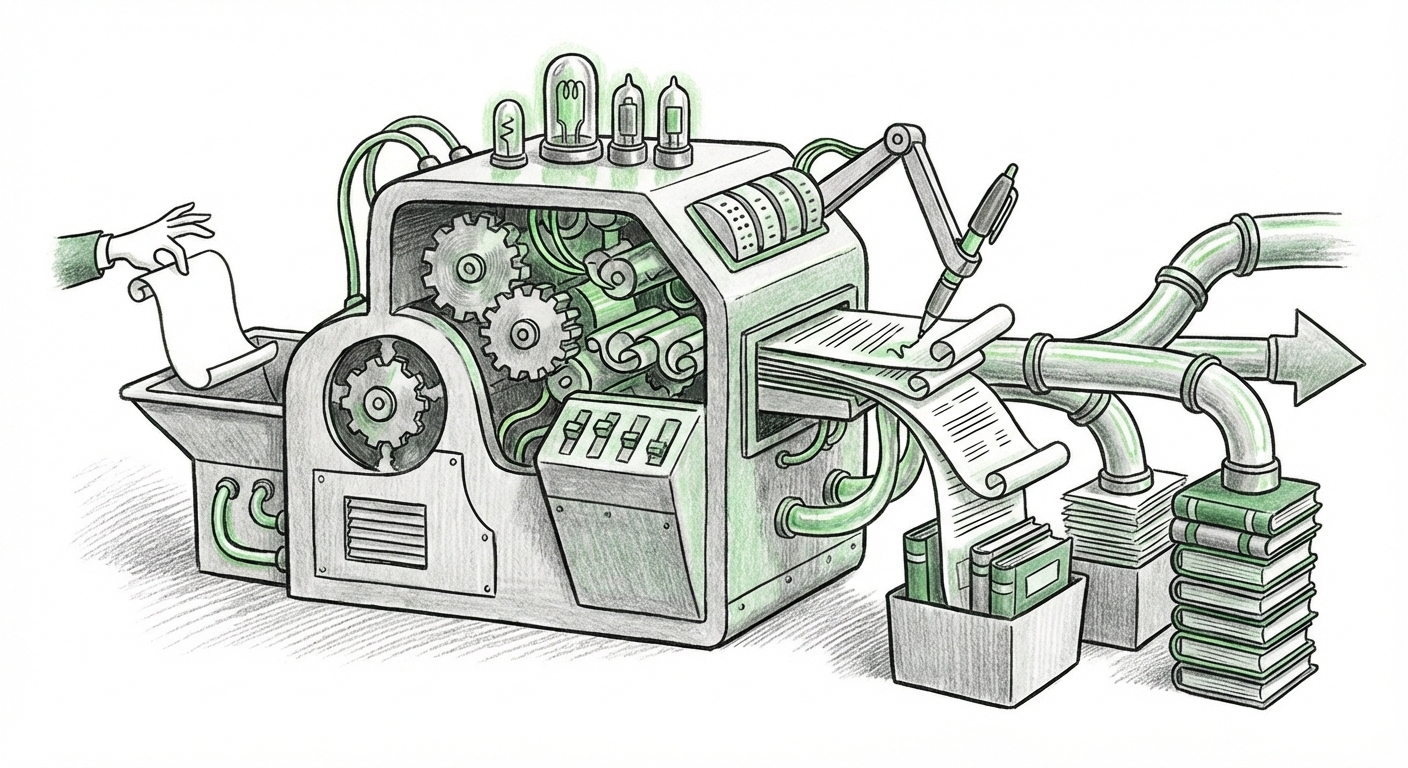
Your AI's Plan Is the Problem: Why Smart Agents Still Plan Badly
Artificial intelligence has crossed a quiet line. For years, the value of an AI system came from what it said: a summary, an answer, a draft, a bit of code. Today, more and more AI systems are asked to do things, book the meeting, refactor the code, research the supplier, run the workflow, chase the invoice.
That shift sounds like progress, and in many ways it is. But it also moves the hardest part of the job into a place most of us never look: the plan.
When an AI agent takes on a task, the first thing it produces is a plan. A list of steps. A sequence of actions with tools, checkpoints and a finish line. Everything the agent does afterward follows from that plan. If the plan is good, the work has a chance. If the plan is bad, nothing downstream can save it.
And here is the uncomfortable part: the plan is usually the weakest thing in the entire system, and the least examined.
The Plan Has Become the New Interface
Think about how you use AI today. If you ask a chatbot a question, you can judge the answer immediately. It's right or it's wrong, useful or useless. You see the product and you grade it.
Agents don't work like that. Ask an agent to "prepare a competitive analysis for next week's board meeting," and it will quietly decide a dozen things on your behalf: where to search, what counts as a competitor, how deep to go, which sources to trust, how to structure the output, when it's done. All of that happens before you see anything. What you eventually receive is the result of those decisions, not the decisions themselves.
This is the core problem. The plan is now the real interface between what you wanted and what you got. But most tools show you the plan only as a passing flicker of text, if they show it at all.
Why Good-Sounding Plans Are Often Wrong
The strange thing about AI planning failures is how reasonable they look. A bad plan is rarely obviously bad. It's fluent. It's organized. It uses confident verbs. It reads like something a competent person might have written.
That fluency is exactly what makes it dangerous. Humans are wired to trust text that flows well. We mistake clarity for correctness. And large language models are exceptionally good at sounding clear, because clear-sounding text is what they were built to produce.
Underneath that clarity, several failure patterns show up again and again.
1. Steps hide assumptions
A plan step like "verify the vendor's compliance certificate" sounds responsible. But it quietly assumes the certificate exists, that the agent can access it, that it knows which standard matters, and that it can tell a valid certificate from an expired one. Four assumptions, one short phrase. If any of them is wrong, the step fails, or worse, silently "succeeds" with a wrong result.
2. Plans are built for the model, not for the world
Agents plan in language. The real world runs on constraints: permissions, budgets, time zones, deadlines, regulations, other people's calendars. A plan can be logically perfect and still be impossible to execute. It might call a tool the agent doesn't actually have, spend money it isn't authorized to spend, or assume an approval arrives in minutes when it takes days.
3. Small errors compound fast
A single answer is one roll of the dice. A ten-step plan is ten rolls, where each step depends on the one before. Even a small error rate per step adds up quickly across a long task. This is why agents that look impressive on short demos fall apart on real work: the horizon is longer, and every extra step is another chance to drift.
4. Plans don't know when to stop
Knowing when you're finished is a planning skill. Many agents either quit too early, declaring success on a half-finished job, or keep going, adding steps, researching forever, chasing a goal that was met twenty minutes ago. Without clear stopping rules, autonomy turns into drift.
5. Nobody graded the plan
This is the deepest issue. Most evaluation of AI systems looks at the final output. Did the agent produce a correct answer? Was the code accepted? Did the report look right? Almost nobody scores the plan in isolation, whether the steps were necessary, in the right order, using the right tools, with the right assumptions surfaced.
So the planner gets no signal about the quality of its reasoning. It only gets feedback on the ending. That's like training a chef by only tasting the plate and never watching the kitchen.
What This Means for Business
For companies rushing to deploy agents, the planning gap creates three practical risks.
The illusion of delegation
Delegation only works when you can check the work. If an employee hands you a result with no visible process, you've outsourced trust, not work. With AI agents, the same rule applies, and the stakes are higher because agents can act at machine speed and scale.
Hidden cost and hidden risk
Bad plans don't always announce themselves with an error message. They announce themselves with a wasted quarter, an over-provisioned cloud bill, a supplier contacted twice with different terms, or a compliance step that was assumed rather than done. The failure shows up late and far from the cause.
Audit trouble
Regulated industries increasingly need to explain how a decision was reached. "The model chose that" is not an explanation. If the plan was never captured or reviewed, there is no trail to audit, just an outcome with no story behind it.
What to Do About It: Practical Guardrails
The fix isn't to stop using agents. It's to treat planning as a first-class product, not an invisible side effect.
- Make the plan a visible artifact. Require the agent to produce its plan as a reviewable document before it acts. Give someone, or something, a chance to say no.
- Review plans, not just results. Add a checkpoint after planning and before execution. For high-stakes work, that checkpoint should be human.
- Score plan quality separately. Track whether steps were necessary, whether the order made sense, whether the right tools were used, and whether assumptions were stated. This gives you something to improve.
- Force assumptions into the open. Ask the agent to list what must be true for the plan to work. Reviewing five stated assumptions is far cheaper than debugging a ruined workflow.
- Constrain the tool space. Give agents only the tools and permissions they genuinely need. A smaller action space means fewer creative mistakes.
- Set explicit stop conditions. Define what "done" looks like up front, plus a budget and a step limit. If the agent hits the limit without finishing, it should stop and report, not improvise.
- Simulate before you ship. Run plans against test environments where failures are cheap. Most planning bugs are predictable in advance, they just need somewhere safe to show up.
- Keep a log. Record plans, tool calls and outcomes. The log is your audit trail, your debugging tool, and your training data all at once.
The Bigger Picture: Planning as a Discipline
Over the next few years, the competitive difference between AI systems probably won't come from raw knowledge. Most capable models know roughly the same things. The difference will come from how well they plan, how honestly they expose their plans, and how gracefully they fail when reality doesn't match the script.
That suggests a shift in how we build and buy AI. Expect to see plan review tools built into agent platforms. Expect organizations to create roles for people whose job is to inspect machine plans the way editors inspect drafts. Expect procurement conversations to include questions like "show me a failed plan and how your system caught it", questions that barely exist today.
For society, the stakes go beyond efficiency. As agents take on more decisions, hiring screens, loan triage, medical scheduling, benefits processing, the quality of their plans becomes a question of fairness and accountability. A biased plan is harder to spot than a biased answer, because the bias lives in the sequence of steps rather than in a single sentence. Making plans visible is a prerequisite for making them fair.
The Takeaway
We spent years teaching machines to answer. We are now teaching them to act. The gap between those two skills is the plan, and it is where most of the real difficulty hides.
The next wave of AI value won't be unlocked by bigger models alone. It will come from systems that plan carefully, show their work, notice when reality has changed, and know when to stop and ask. That's less exciting than a demo. It's also what separates a tool you can trust from one you merely admire.
If your AI's plan is the problem, then the plan is also the fix, but only if you can see it.