Wikipedia Is Training the AI That Could Replace It, What That Means for the Future of AI
Wikipedia is one of those things almost everyone uses and almost nobody thinks about. You search for a fact, you land on a clean page, you read, you leave. It feels permanent, like a public utility. But look at how it came to exist, a free encyclopedia written by volunteers, funded by donations, governed by argument and consensus, and you realize it is a strange, unlikely project that should not have worked.
It did work. Now it sits at the center of two stories at once. It is one of the most important sources of training data for modern artificial intelligence. And it is one of the things AI is quietly competing with for human attention. That double role is the most underrated tension in the AI economy right now, and it has real consequences for anyone building or buying AI systems.
Why Wikipedia's History Matters More Than Ever
The story of Wikipedia is a story about a model almost nobody believed in. Instead of hiring experts, it let anyone edit. Instead of selling ads, it asked for small donations. Instead of locking pages, it argued toward a neutral point of view. It survived vandalism, edit wars, hoaxes, and years of predictions that it would collapse under the weight of its own openness.
What made it durable was not technology. It was process: rules for citing sources, visible edit histories, and a community willing to enforce them. That process is exactly what makes the encyclopedia valuable to machine learning teams today. It is not just text. It is organized, referenced, reproducible text.
That is also why its future being described as fragile should get your attention. Fragility in a system this central does not stay contained. It spreads outward into everything built on top of it.
The Hidden Engine: Wikipedia as AI's Raw Material
Large language models learn by reading enormous amounts of text. Not all text is equally useful. Web pages are messy, marketing copy, spam, broken formatting, contradictory claims. Wikipedia is different. Its articles follow a consistent structure. Facts are supposed to be traceable to a citation. Topics are broad enough to cover science, history, geography, and pop culture in the same voice.
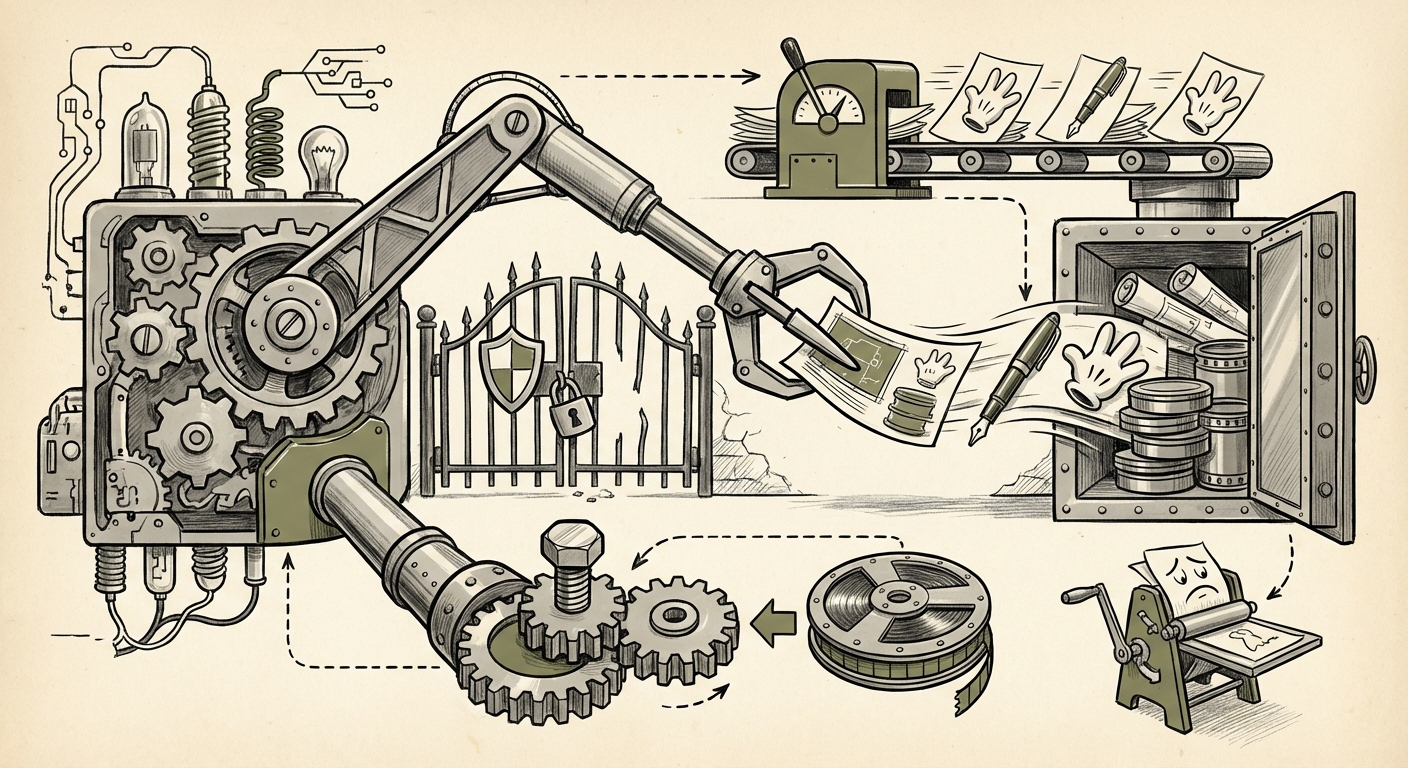
That combination makes it a favorite raw ingredient for training and for evaluating models. It is also a favorite grounding source for retrieval systems, the pattern where an AI assistant looks up facts before answering instead of relying only on memory. When a chatbot gives you a neat, sourced-sounding answer about a chemical reaction or a historical treaty, there is a decent chance the underlying knowledge came from a volunteer-edited page.
This creates an uncomfortable relationship. The most reliable public store of human knowledge is written by people who are not paid, hosted by an organization that does not sell ads, and licensed in a way that lets others reuse it. AI companies are among the biggest beneficiaries of that arrangement. Very few of them contribute back in any proportional way.
Three Pressures on the Commons
The fragility comes from a handful of forces stacking on top of each other.
First, traffic. AI answer tools increasingly summarize facts directly in the chat window. Users get the answer without clicking through to the source. That is convenient, but it means fewer visits to the pages that supplied the knowledge. Fewer readers mean fewer small donors, and donations are the lifeblood of a project with no ad revenue.
Second, the volunteer pipeline. Editing is a skill. Newcomers face a steep learning curve, dense rule sets, and sometimes hostile veterans. The pool of active editors is the single most important asset the project has, and it is the hardest thing to grow. If the community shrinks, coverage of niche and fast-changing topics is the first to suffer.
Third, the content-quality question. As AI text floods the open web, the job of checking sources gets harder for human editors. A citation that looks legitimate may point to machine-generated content. Verifiability is the whole foundation, and it depends on a web where human-written, trustworthy sources still exist in quantity.
What Happens to AI If the Well Runs Dry
Here is the part that should worry AI builders most. High-quality human-curated data is not infinite, and it is not easily replaced. Synthetic data, text generated by models, can help in some areas, but it cannot supply the thing that makes Wikipedia valuable: independent human judgment about what is true and worth saying.
If the public commons weakens, training data becomes an asset you buy rather than something you inherit. That shifts power toward whoever can afford exclusive licensing deals. Smaller labs, academic researchers, and startups in developing markets lose access. The result is a more concentrated AI industry, not because of better models, but because of better contracts.
There is a second risk: a feedback loop. If models are trained increasingly on other models' output, and the human-verified sources underneath thin out, quality degrades. Answers get smoother and less grounded. Errors become harder to trace because the trail of citations leads back to a machine.
Practical Implications for Businesses
Most companies are not training frontier models. They are building assistants, search tools, and automated workflows on top of them. The fragility of public knowledge sources affects them anyway.
Retrieval is not free forever. If your product depends on pulling facts from open knowledge bases, plan for a future where some of that access is licensed, metered, or restricted. Build your architecture so the knowledge source is a swappable layer, not a hard-coded assumption.
Provenance becomes a feature. Regulators and customers both want to know where an answer came from. Systems that can point to a citation, and show that the citation was human-reviewed, will win trust and clear compliance reviews faster than systems that cannot.
Your company's AI reputation is being written by strangers. When someone asks an assistant about your brand, product, or CEO, the answer is often assembled from publicly editable sources. That makes monitoring and contributing to public knowledge bases a real communications function, not a nice-to-have.
Original, citable content gains value. As generic text becomes cheap, the scarce thing is verified information produced by identifiable people with something to lose. Content strategies built on being quotable and checkable will outperform volume plays.
Actionable Insights
- Map your data dependencies. List every public knowledge source your AI systems touch. Note which are volunteer-run, donation-funded, or license-restricted. Those are your single points of failure.
- Budget for data licensing now. Treat access to quality corpora as a line item, not an assumption. Early contracts will be cheaper than emergency ones.
- Fund the commons you profit from. Donations, staff contributions, and formal partnerships are cheap insurance against the source degrading.
- Build citation-first UX. Show users where an answer came from and how confident the system is. It reduces liability and increases adoption.
- Measure zero-click exposure. Track how often AI assistants answer questions about your business without a visit to your site. That number is your new share-of-voice metric.
- Keep humans in the verification loop. Automated fact-checking helps, but the last step for high-stakes claims should involve a person who can be held accountable.
- Watch for benchmark contamination. Public evaluation sets drawn from the open web may already be in your training data. Build private test sets.
The Road Ahead
The most likely future is not collapse. It is negotiation. Expect more formal licensing between AI developers and knowledge holders, more pressure on the biggest beneficiaries of free data to pay into the system that produces it, and more experimentation with new funding models for volunteer-built public goods.
The deeper lesson from Wikipedia's history is that its odd model worked because enough people decided the project was worth defending. AI now depends on that same decision. The commons is not a natural resource that refills on its own. It is maintained by humans, at a cost, and it is only free because someone else already paid.
For AI builders, the strategic move is straightforward: treat human-curated knowledge as critical infrastructure, not background noise. The companies that do will have more reliable models, cleaner compliance stories, and a durable advantage. The ones that treat it as infinite may find out otherwise, quietly, and all at once.