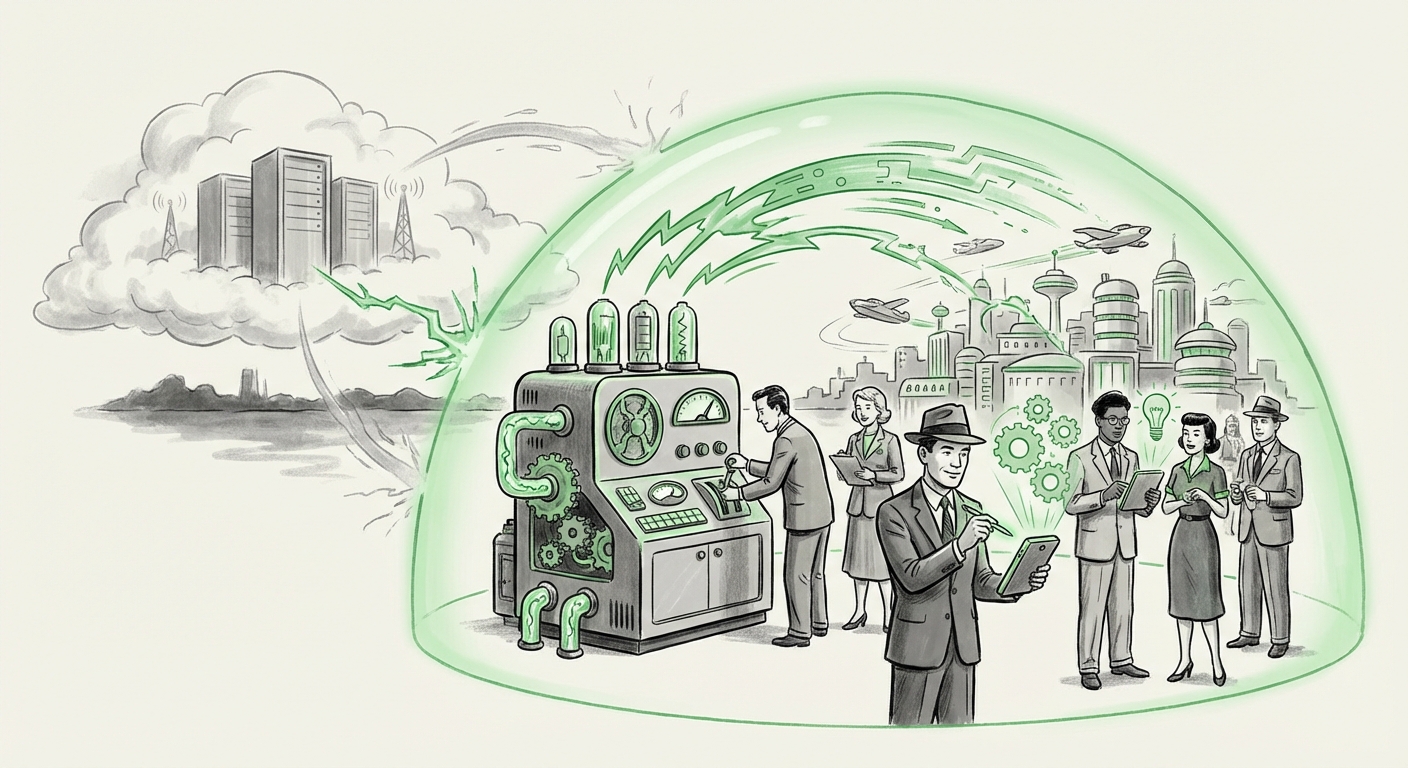
ACM SIGAI Opens Nominations for the 2027 Autonomous Agents Award: What It Means for the Future of AI
Nominations for the 2027 ACM SIGAI Autonomous Agents Award are now open. The Association for Computing Machinery's Special Interest Group on Artificial Intelligence (ACM SIGAI) opened the call on October 20, 2026, inviting the research community to put forward the people and projects that have shaped the field of autonomous agents.
On the surface, this is a calendar item, an award cycle rolling around again. But look closer and it tells you something important about where artificial intelligence is heading. Awards are how a field tells the world what it values. For years, the loudest prizes in AI went to bigger models, faster training runs, and higher benchmark scores. A dedicated, recurring award for autonomous agents signals a different centre of gravity: not just what a model can say, but what a system can do, on its own, over time, toward a goal.
That shift is already reshaping how businesses buy, build, and govern AI. Here is what the nomination window means, why it matters, and what leaders should do about it now.
Why "Autonomous Agents" Is the Phrase to Watch
Most people met AI as a chat window. You type, it answers, you close the tab. That model is easy to understand and easy to contain, nothing happens unless a human asks.
An autonomous agent is different. It is software that takes a goal, plans a path toward it, uses tools, takes actions, checks its own work, and keeps going until the job is done or it needs help. Instead of answering one question, it runs a process. Instead of producing text, it can create files, book things, query systems, send messages, and trigger workflows.
The gap between those two modes is the biggest practical change in enterprise AI right now. A chatbot improves productivity by minutes. A reliable agent can absorb an entire task. That is why the research community treats agents as a discipline in its own right, and why a standing award in the area matters. It marks agents as a field with its own standards, its own methods, and its own definition of excellence, rather than a feature bolted onto a language model.
What an Award Actually Does for a Field
Awards are not just trophies. They are steering signals. When a professional body recognises work in a specific area, four things tend to follow:
- Direction for researchers. Prizes point graduate students and early-career scientists toward problems the community considers hard and worth solving, planning under uncertainty, multi-agent coordination, long-horizon reliability, safety and oversight.
- Shared vocabulary. Recognition of specific lines of work helps a scattered community agree on how to describe problems, which speeds up comparison and progress.
- Credibility with funders. A recognised award makes it easier for research teams to explain to companies and grant bodies why a niche-sounding topic deserves investment.
- A bridge to industry. Public recognition of agent research gives product teams a way to find the specialists they need, and gives specialists a reason to talk to product teams.
In a field that moves as fast as AI, where attention swings wildly between hype cycles, that kind of steady, formal recognition is valuable. It rewards the unglamorous work, evaluation methods, safety frameworks, reproducible benchmarks, that determines whether agents ever become trustworthy enough for high-stakes use.
The Real Bottleneck: Trust, Not Capability
Anyone who has deployed an agent in production knows where the pain is. The model is rarely the limiting factor. The limiting factor is reliability over long chains of steps.
If an agent completes a task correctly 95% of the time per step, and a task takes ten steps, the chance of a clean end-to-end result drops sharply. Errors compound. So do costs. This is the core engineering problem the agent research community is wrestling with, and it is why the field's best work focuses on things like:
- Planning and decomposition, breaking a vague goal into steps that can be checked.
- Tool use and grounding, making sure an agent acts on real data, not confident guesses.
- Memory and state, keeping track of what has already happened across a long task.
- Self-checking and recovery, noticing a mistake and correcting it rather than ploughing on.
- Human oversight, knowing when to stop and ask.
Each of those is a research problem in its own right. Together, they are the difference between a demo and a dependable colleague. Recognising excellence in these areas is not academic housekeeping, it is how the industry gets from impressive prototypes to systems you can actually put in front of a customer.
What This Means for Businesses
For leadership teams, the takeaway is not "wait for an award winner to arrive." It is that the agent layer of AI is maturing into a recognised discipline, and that changes how you should plan.
1. Start thinking in workflows, not prompts
The value of agents shows up when you hand over a whole process: triaging support tickets, reconciling invoices, drafting and routing compliance reports, researching and summarising a market. Map your processes and ask which ones have clear success criteria, high volume, and low cost of error. Those are your first agent candidates. Save the messy, high-stakes work for later.
2. Budget for oversight, not just licences
Every serious agent deployment needs a human in the loop somewhere, an approval step, a review queue, an audit log. Teams that plan for this from day one ship faster, because they can widen the agent's permissions gradually as trust builds. Teams that skip it end up retrofitting controls after an incident.
3. Measure outcomes, not activity
It is tempting to count agent actions as if they were productivity. They are not. Track completion rate, rework rate, escalation rate, and time saved per task. A modest agent that finishes 80% of a well-defined task cleanly beats an ambitious one that produces work nobody trusts.
4. Treat evaluation as a product feature
The research emphasis on benchmarks and reproducibility has a direct commercial translation: you need your own test set of realistic tasks, with known good answers, that you re-run every time you change a model, a prompt, or a tool. Without it, you are flying blind.
What It Means for Society
Autonomous agents raise questions that a chat assistant never did. When software can act, someone has to answer for the action.
Expect three debates to sharpen as agent research matures. Accountability: if an agent books the wrong thing or sends the wrong email, who is responsible, the vendor, the deployer, or the operator who approved the workflow? Transparency: can a person reconstruct why an agent did what it did? Access: will agentic capability concentrate inside a handful of large firms, or spread?
Formal recognition of agent research helps here too. A field that prizes robustness, interpretability, and safety alongside raw capability produces graduates who carry those values into industry. Awards are a quiet, slow lever, but they shape what the next generation of builders considers good work.
A Signal About Talent
For individuals, the nomination cycle is a useful reminder that "agent engineer" is becoming a real specialism. The skills that matter are a blend of classical AI, planning, search, multi-agent systems, reinforcement learning, and modern practice: tool integration, evaluation design, and safety engineering.
People who can design a reliable agent workflow, and prove it is reliable, are scarce. The recognition of this research area by a major professional body is one more data point suggesting that scarcity will last. If you are building a team, invest in evaluation and safety skills early. If you are building a career, those are the differentiators that survive the next model release.
Actionable Checklist for the Next 12 Months
- Audit for agent-shaped work. Identify three processes with clear success criteria and high volume.
- Pick one and pilot it narrowly. Human approval on every action at first, then widen scope as trust is earned.
- Build a task test set. Twenty to fifty realistic examples with known good outcomes, re-run on every change.
- Define escalation rules. Spell out exactly when the agent must stop and hand off.
- Log everything. Inputs, actions, tool calls, outputs. You cannot debug or defend what you cannot see.
- Follow the research. The problems the agent community treats as hard, long-horizon reliability, coordination, oversight, are the problems your deployment will hit in month three.
The Bigger Picture
The opening of nominations for the 2027 ACM SIGAI Autonomous Agents Award will not make headlines the way a new model launch does. But it marks something more durable: the moment a research area stops being a promising tangent and becomes an established discipline with standards, heroes, and a shared sense of what good looks like.
That is usually the point at which an idea stops being a demo and starts becoming infrastructure. For AI, that means the next phase of competition will not be about who has the smartest assistant in a chat box. It will be about who can build agents that people trust with real work, reliably, safely, and at scale. The research community has been pointing at that target for a while. This award cycle is one more sign that the rest of the world is catching up.