Why Your Expensive Wi-Fi 7 Router Feels Slower, And What It Means for the Future of AI
You unboxed the router. You paid a premium for it. You plugged it in, opened the settings app, and waited for the internet to feel different. It doesn't. In fact, some rooms feel worse than they did before. The video calls still stutter. The file upload still crawls. The smart camera in the hallway still drops out at random.
This is one of the most common complaints in home and small-office networking right now, and it is not a story about a broken product. It is a story about a widening gap between what a box on a shelf promises and what your actual network can deliver. And that gap matters far more than most people realize, because the next wave of AI is being built to run on the exact network connections that are quietly failing us today.
The Speed Gap: Where the Promise Goes to Die
When a new generation of Wi-Fi hardware arrives, the marketing centers on a single big number. That number describes the theoretical peak of the radio inside the box, under ideal conditions, talking to ideal equipment, with nothing else in the way. Almost nothing in a real home or office matches those conditions.
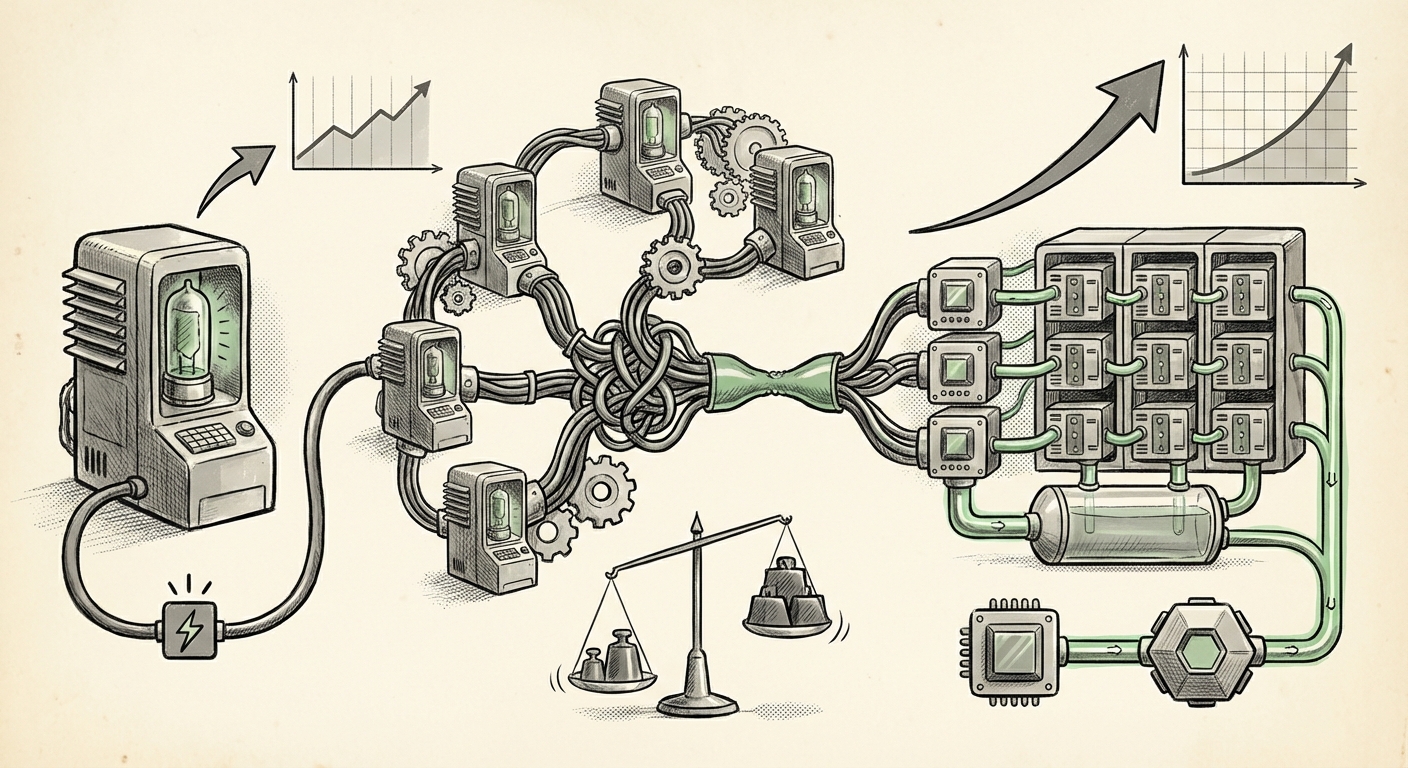
The result is a familiar pattern: the router is faster on paper, but the experience is not faster in practice. The bottleneck simply moved somewhere the buyer wasn't looking. Here is where the speed actually goes:
1. The devices on the other end are the real limit
A router can only speak as fast as the thing it is speaking to. Phones, laptops, TVs, printers, thermostats and cameras all have their own radios, and most of them are older, cheaper and slower than the router you just bought. One fast access point surrounded by slow clients produces a slow network. This is the single most common reason a premium router feels underwhelming: the upgrade happened on one side of the conversation only.
2. The internet pipe didn't change
Your Wi-Fi is the hallway inside your building. Your internet plan is the road outside it. Widening the hallway does nothing for the road. If your connection from the provider is the constraint, and for most households it is, no router on earth will make downloads faster. People routinely upgrade the wrong piece of the chain.
3. The new spectrum is faster but shorter
Newer Wi-Fi generations lean on newly opened frequencies. Those frequencies carry more data, but they also travel less well. They are blocked more easily by walls, floors, furniture and even a person standing in the wrong spot. So a router that is dramatically faster in the same room can be less reliable two rooms away. If the router is tucked in a closet or against an exterior wall, the fancy new band may barely reach the sofa.
4. Default settings are rarely the fast ones
Out of the box, most routers ship with settings chosen for compatibility and stability, not performance. New features, like the ability for a device to use more than one connection path at once, are often switched off or partially supported, because they can cause problems with older gear. Buyers who never open the advanced panel are effectively running a previous-generation network in a newer shell.
5. Firmware and early-adopter turbulence
New wireless standards arrive with new firmware, and new firmware arrives with bugs. Early buyers become unpaid testers. Throughput quirks, devices that refuse to connect, random reboots after an update, these are normal growing pains in the first stretch of any hardware generation, and they read to the customer as "my expensive router is slower."
6. Congestion is invisible until it isn't
Neighboring networks, baby monitors, doorbells, microwave ovens and dense apartment buildings all compete for the same air. A router tuned for maximum speed with wide channels is more sensitive to that interference, not less. In crowded environments, the box with the biggest headline number can be the most fragile one in the room.
Why This Is an AI Story, Not Just a Router Story
Here is the part that most reviews miss. The router disappointment is a preview of a much bigger problem heading straight at the AI industry.
For the last few years, the AI conversation has been about compute: bigger models, faster chips, more data centers. That phase is maturing. The next phase is about where the intelligence runs, and a growing share of it is moving off the data center and into homes, offices, factories and pockets.
The industry calls this the edge. In practice it means AI features built directly into laptops, phones, cameras, appliances, cars and industrial sensors. Running a model locally is attractive for three reasons: it is private, it is fast, and it keeps working when the cloud doesn't. But every one of those benefits depends on a network that can keep up, either to sync data back to a central system, or to hand off a task when the local device hits its limit.
Now reconsider everything above. If a brand-new router can't reliably deliver a video call to the back bedroom, what happens when that back bedroom contains a camera running live AI analysis, a laptop running a local model, a headset streaming spatial data, and a robot vacuum mapping the floor? The network becomes the ceiling on what the AI is allowed to do.
We are watching the bottleneck migrate from compute to connectivity in real time. That migration is the single most underrated trend in technology right now.
The Coming Squeeze: AI Traffic Is Different Traffic
Most home and office networks were designed for a world of downloads. Streaming video, web pages, file sync, these are largely one-directional and forgiving. AI workloads are not like that. They tend to be:
- Continuous rather than bursty. A camera running inference uploads constantly, not in occasional spikes.
- Upstream-heavy. Most consumer networks are tuned for download speed and neglect upload, which is exactly the direction AI devices need most.
- Latency-sensitive. A voice assistant that answers in two seconds feels broken. A safety system that reacts in two seconds is useless.
- Persistent. Dozens of small devices chattering all day, rather than one big transfer at night.
- Unforgiving of dropouts. A stalled video stream recovers. A stalled inference pipeline can lose data or miss an event entirely.
Add these together and you get a network profile that today's consumer-grade setups handle poorly, no matter what the box says on the front.
What This Means for Businesses
The implications extend well beyond the living room. Companies are currently being sold "AI-ready" everything: AI-ready laptops, AI-ready offices, AI-ready factory floors. Very few of those purchases include an honest audit of whether the wireless network underneath can actually carry the load.
Three practical consequences stand out:
Procurement is being sequenced backwards
Organizations buy the shiny endpoint first and think about the network last. It should be the other way around. Before rolling out AI-capable devices at scale, run a real survey: how many clients per access point, what the actual coverage looks like in the corners where people work, what the upload performance is, and how much interference exists at peak hours. A pilot of twenty devices on a network built for five hundred tells you almost nothing.
Vendor claims need to be tested against your building
Peak theoretical throughput is a marketing figure, not a planning figure. Ask vendors for real-world performance under load and with mixed older devices. Then verify it in your own space. A device that excels in a lab can collapse in a warehouse full of metal racking.
The cost of "good enough" networking is about to rise
When the network only carried email and web browsing, mediocre Wi-Fi was an annoyance. When it carries AI-driven workflows, automated inspections, live translation, sensor analytics, remote assistance, mediocre Wi-Fi becomes an operational risk. The budget conversation needs to change before the incident, not after.
A Practical Checklist Before You Blame the Router
If you have already bought the hardware and the experience is disappointing, work through this before returning anything:
- Test the wired connection first. Plug a laptop directly into the router. If that is slow, the problem is your internet plan, not your Wi-Fi.
- Check what your devices actually support. Look up the wireless capability of your phone and laptop. If they are older, the router is waiting on them.
- Move the router. Central, elevated, out of closets, away from metal and microwaves. This one change fixes more complaints than any setting.
- Separate the bands. Put older and distant devices on the slower, longer-range band and keep the fast band for devices that are close and modern.
- Cut the channel width. In a crowded area, narrower channels are often more stable than wider ones. Stability beats peak speed for real work.
- Turn on the new features deliberately. Check whether multi-link operation and similar capabilities are actually enabled, and whether your devices support them.
- Update the firmware, then wait a week. Early firmware is buggy. Let the first round of patches land before judging the hardware.
- Count your clients. If you have dozens of smart devices, a single router may simply be overloaded. Adding a second access point often helps more than buying a more expensive single unit.
The Bigger Picture: Wi-Fi Is Becoming AI Infrastructure
The router on your shelf used to be plumbing. It is becoming something closer to a nervous system. As AI moves into cameras, speakers, wearables, vehicles and industrial equipment, the wireless network stops being a convenience and starts being the substrate that intelligence runs on.
That shift will force changes across the industry. Expect "AI-ready" networking to become a real category rather than a sticker, with emphasis on upload capacity, consistent low latency, device density and reliability rather than a single peak-speed figure. Expect smarter routers that use AI themselves, to detect interference, predict congestion and route traffic around problems automatically. And expect buyers to get much more skeptical of headline numbers, because they will have learned the lesson the hard way.
The uncomfortable truth is that the current generation of premium home networking gear is being sold on a promise the rest of the ecosystem cannot yet keep. The radios are ahead of the devices, the devices are ahead of the internet plans, and the internet plans are ahead of the applications. Every layer has to catch up together.
Conclusion
A fast router that feels slow is not a scam. It is a symptom. It tells us that the weakest link in a modern network is rarely the newest component, it is whatever we forgot to upgrade alongside it. The same lesson is about to be repeated at a much larger scale as AI spreads from the data center into every device we own.
If there is one takeaway worth carrying forward, it is this: the future of AI will not be limited by how smart our models are. It will be limited by how reliably they can talk to everything else. The people and companies who treat connectivity as a first-class part of their AI strategy, rather than an afterthought, will be the ones whose systems actually work when it matters. Everyone else will be standing in the hallway, wondering why the faster router didn't make their internet faster.