AI Agents Watching AI Agents: Why Grafana Labs Is Automating Observability for the Agent Era
Something strange and important is happening in the world of software monitoring. The tools that watch over computer systems are starting to watch over themselves, and they are using artificial intelligence to do it.
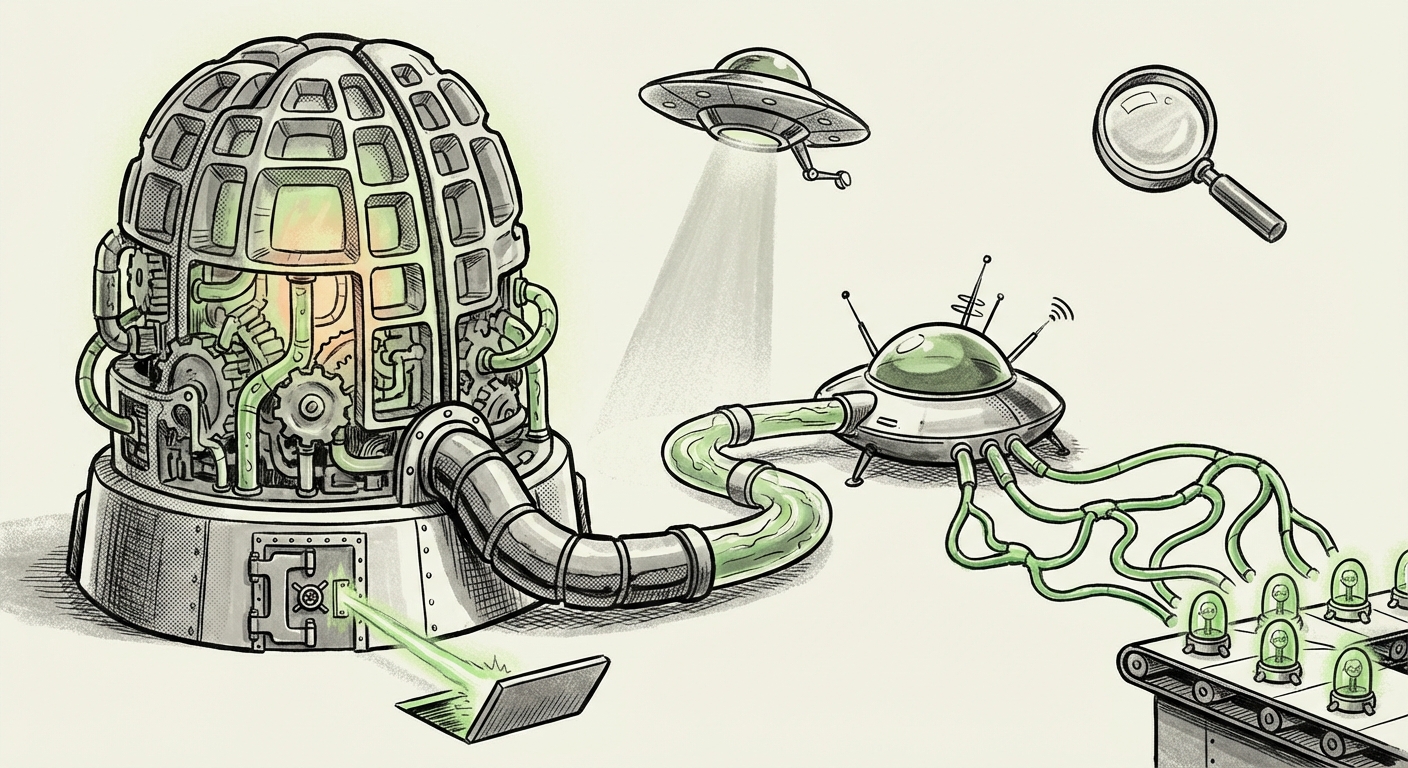
Grafana Labs is now leaning on AI agents to automate observability for AI agents. Read that sentence twice. It is not a typo. The company best known for helping teams see what their systems are doing is now pointing that same lens at the fast-growing population of autonomous AI agents, and it is putting AI agents to work on the job.
That decision is a small headline with a very large meaning. It tells us that AI agents have moved from demo to dependency. And once something becomes a dependency, someone has to watch it at 3 a.m. when it breaks.
The Monitoring Problem Nobody Budgeted For
For twenty years, observability has been a fairly settled discipline. You collect logs, metrics, and traces. You build dashboards. You set alerts. When something goes wrong, a human being looks at a graph and figures out what happened.
AI agents break most of those assumptions.
A traditional piece of software does the same thing every time. Given the same input, it produces the same output. An AI agent does not work that way. It reasons through a problem, picks tools, calls them, reads the results, and decides what to do next. Run the same request twice and you may get different paths, different timing, and different costs.
Now multiply that across a fleet of agents. One agent might be handling customer support tickets. Another might be summarizing documents. Another might be writing and running code. Each one makes dozens of small decisions that a human never sees.
When a normal service fails, you get an error code. When an agent "fails," you often get something worse: a confident, well-written answer that is completely wrong. There is no stack trace for a bad judgment call.
This is the gap that agent observability is meant to fill. And it is a gap that is widening every month as more companies push agents into real production work.
What AI Agent Observability Actually Means
Observability for agents is not just the old dashboards with a new label on them. It requires tracking a different set of things.
- Traces of reasoning, not just requests. Teams need to see the full chain of steps an agent took, which tools it called, in what order, and why.
- Cost per decision. Every model call costs money. An agent that loops six times instead of once can quietly triple a bill.
- Quality signals. Was the answer correct? Was it grounded in real data? Did it follow the rules it was given?
- Safety and policy events. Did the agent try to do something it was not allowed to do? Did a guardrail trigger?
- Human handoffs. When did the agent give up and pass the work to a person, and how long did that take?
None of this fits neatly into a traditional monitoring stack. It is a new layer, and it is growing fast.
Why Use AI Agents to Watch AI Agents?
Here is where the story gets interesting. The obvious way to monitor agents is with more dashboards and more human analysts. But that approach does not scale.
Agent traffic is high-volume and messy. A single workflow can generate hundreds of events in seconds. A team that builds one dashboard per agent will drown. A team that reads every alert will burn out.
So Grafana Labs is doing what many platform teams are starting to do: it is handing the first pass of the work to AI. Agents can scan huge piles of telemetry, spot patterns that look unusual, group related signals together, and write a plain-English summary of what appears to be happening.
The logic is simple. If a machine can produce a thousand events a minute, a machine should be the first to read them. Humans should be brought in for judgment, not for triage.
This flips the traditional on-call model. Instead of a person waking up to a wall of red graphs, a person wakes up to a short explanation: here is what changed, here is the likely cause, here is what we already checked, and here is what we recommend.
The "Who Watches the Watchers" Problem
There is an obvious objection, and it deserves a straight answer. If you use AI to monitor AI, what happens when the monitoring AI is wrong?
This is the self-referential loop at the heart of the whole trend. And it is not a hypothetical concern, it is the central design challenge.
The answer, in practice, comes down to a few guardrails:
- Keep the raw data. The AI agent's summary should always sit on top of the original logs and traces, so a human can check the work.
- Never let the watcher act alone. The monitoring agent should recommend and explain. It should not silently restart, roll back, or delete anything without a human decision.
- Score the watcher. If the triage agent says "this is a memory issue," track whether that turned out to be true. Monitoring tools need their own quality metrics.
- Watch the cost of watching. An AI agent that reads every event can become its own line item. Sampling and filtering matter.
In other words, the loop only works if it stays open at the top. Automation handles volume; people handle judgment.
Why This Matters for Businesses Right Now
This is not just a technical story. It touches three things every company cares about: money, trust, and speed.
Money
Agent costs are sneaky. A model call looks cheap on its own. But agents make many calls, and they retry, and they loop, and they call tools that call other tools. Without visibility, a small logic bug can turn into a large invoice before anyone notices. Agent observability turns that invisible spend into a number on a screen.
Trust
Companies cannot put agents in front of customers without being able to explain what those agents did. Regulators, auditors, and internal risk teams all want the same thing: a record. Observability is how you produce that record. It is the difference between "we think the agent behaved" and "we can show you exactly what it did."
Speed
Teams ship faster when they can see what is happening. The fear of invisible failures is one of the main reasons pilots stall. Good observability turns a scary black box into a manageable system, and that is what moves an agent from a proof of concept into a real product.
Practical Steps Teams Can Take Today
You do not need to wait for a finished product category to get started. A few moves pay off immediately.
- Instrument from day one. Log every agent step, inputs, tool calls, outputs, latency, and cost. Retrofitting this later is painful.
- Define "good" before you measure it. Pick a handful of quality checks that matter for your use case. You cannot alert on quality you never defined.
- Set cost budgets per workflow. Give each agent a spending ceiling and alert when it gets close. Treat tokens like cloud spend.
- Start with read-only AI triage. Let an agent summarize and suggest. Keep the actions with humans until you trust the summaries.
- Review the watcher monthly. Check how often the triage agent was right. Fix or retire it if it drifts.
What This Means for the Future of AI
The bigger signal here is about maturity. Every major technology goes through the same arc. First comes excitement. Then comes adoption. Then comes the unglamorous work of making it reliable, and that is where an industry actually grows up.
AI agents are entering that third phase. The question is shifting from "what can an agent do?" to "can we prove what it did, control what it costs, and fix it when it breaks?" Grafana Labs pointing AI agents at that question is a clear sign of where the market is heading.
Expect three things to follow.
First, observability becomes a first-class part of agent design, not an afterthought. Just as nobody ships a web service today without logging, nobody will ship an agent without tracing. It will be built in, not bolted on.
Second, the monitoring layer becomes a competitive battleground. Whoever can make agent behavior legible, clearly, cheaply, and at scale, will sit at the center of enterprise AI buying decisions. That is a very valuable place to be.
Third, the human role shifts upward. Fewer people will stare at graphs. More will set policy, judge edge cases, and decide what "correct" means. The job becomes less about watching and more about governing.
There is also a cautionary note. Automated observability can create a false sense of safety. A clean dashboard is not the same as a working system. Teams that treat AI triage as a replacement for understanding their agents will eventually be surprised. The tool should shorten the path to insight, not remove the human from it.
The Bottom Line
Grafana Labs using AI agents to automate observability for AI agents sounds like a riddle. It is really a milestone. It means agentic systems are now common enough, and important enough, that the industry needs a dedicated way to keep an eye on them, and that the volume of data involved is already too large for people alone.
For businesses, the takeaway is straightforward. If you are deploying agents, build the visibility layer at the same time. If you are not, start planning for it, because you will need it sooner than you think. The agents are here. Now someone has to watch them, and increasingly, that someone is another agent.