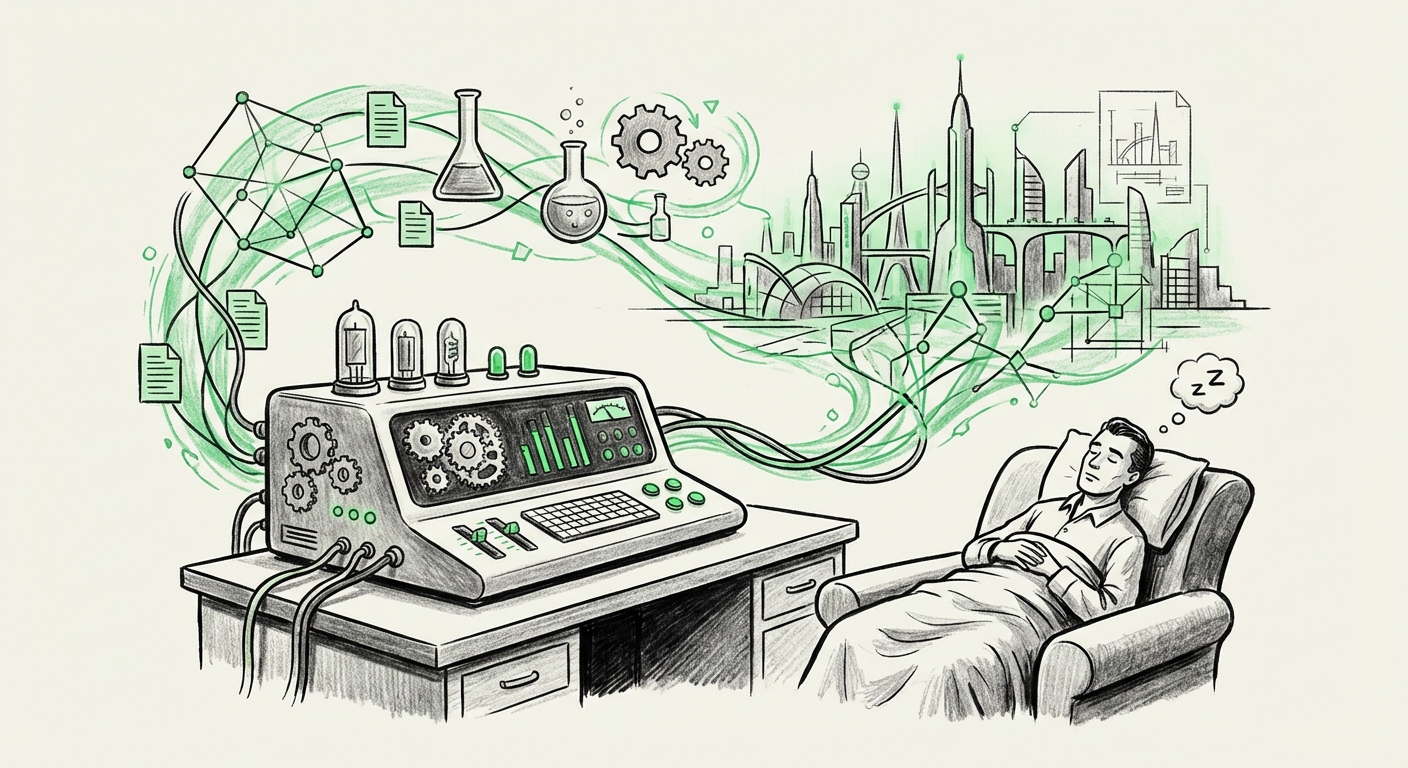
Staying Sane in an Insane World: How AI Is Reshaping Attention, Trust, and the Way We Work
There is a phrase that keeps coming up in conversations about technology right now: staying sane in an insane world. On the surface, it sounds like a wellness slogan. Look closer and it reads like a design brief, a set of requirements that the next generation of artificial intelligence tools either meets or fails.
The world AI is being built into is loud. Notifications stack up. Feeds refill faster than anyone can read them. Synthetic images, voices, and videos arrive with the same polish as real ones. And now, the very tools meant to help us cope with that noise, assistants, copilots, chatbots, recommendation engines, are themselves part of the volume problem. They answer instantly, generate infinitely, and never get tired.
That tension is the story worth following. Not whether AI gets more capable, but whether the people using it can stay clear-headed while it does. The answer will decide which AI products win, which companies keep their customers' trust, and how the technology actually gets used in daily life over the next several years.
The Overload Problem Just Got an Engine
For years, information overload was a side effect of the internet. More websites, more channels, more messages. It was annoying but fairly passive, someone else produced the content, and you chose how much of it to consume.
AI changes the physics of that. Generation is now cheap. A single person can produce a hundred variations of a message, a thousand images, or an endless stream of comments in the time it once took to write one paragraph. Software agents can browse, reply, summarize, and post on their own. The result is a world where the supply of content is no longer limited by human attention spans or working hours.
That has two immediate effects. First, the cost of being wrong about what is real goes up. A convincing fake used to require skill and time. Now it requires a prompt. Second, the cost of being ignored goes up, because everyone is competing against machines for the same slice of human focus.
Both effects push in the same direction: toward a world that feels louder and less trustworthy at the same time. That is the "insane" part of the phrase. It is not a metaphor. It is a description of the information environment AI is now accelerating.
The Three Pressure Points on Human Sanity
It helps to break the problem down. Most of the strain people feel around AI comes from three distinct pressure points.
1. Volume and velocity
AI systems produce faster than humans can review. Inboxes fill with AI-drafted replies. Dashboards refresh with AI-generated summaries. Teams get more output but not necessarily more clarity. When everything is fast, the slow human step, checking, deciding, agreeing, becomes the bottleneck, and people feel like they are drowning in a river that never stops rising.
2. Synthetic reality
When anyone can generate a believable image, voice clip, or video, the default assumption flips. Instead of trusting what you see, you start questioning it. That constant background doubt is mentally expensive. It also creates an opening for bad actors: if everything can be faked, then nothing can be definitively debunked, and people retreat into whichever version of reality feels most comfortable.
3. Machine intimacy
Conversational AI is genuinely good company for a lot of tasks, brainstorming, tutoring, venting, planning. But a system that is always available, always patient, and always agreeable is a very different social experience from dealing with another human being. Relationships with AI can be useful and even comforting, yet they do not come with the friction that teaches people to handle disagreement, disappointment, or nuance. Over time, that gap matters.
What This Means for the Future of AI
The most important shift ahead is that sanity becomes a product feature. Not a marketing slogan, but a measurable property of a system: does it reduce confusion or add to it? Does it help a person decide, or just keep them scrolling?
Expect the following directions to define the next wave of AI design.
Calm technology as a competitive advantage
The best AI products of the near future will likely be the quiet ones. Interfaces that summarize instead of flood. Assistants that speak up when asked and shut up when not. Systems that batch decisions instead of interrupting every few minutes. Companies that treat user attention as a resource to protect, rather than a surface to monetize, will earn loyalty that louder competitors cannot buy.
Provenance and verification built in
As synthetic content spreads, the value of proving where something came from rises sharply. Expect more emphasis on content credentials, watermarking, signing, and clear labeling of AI-generated material. The companies that make verification easy and invisible, a small badge, a quick check, a trusted source trail, will help rebuild the baseline trust that keeps people from exhausting themselves second-guessing everything.
Friction by design
Not all friction is bad. A confirmation step before sending a mass message, a pause before an AI agent takes a real-world action, a plain-language explanation of why a recommendation appeared, these small frictions prevent big mistakes. The design question of the next few years is not "how fast can this go" but "where should it slow down."
Measuring well-being, not just engagement
Engagement metrics reward whatever keeps people on the page. That is a poor proxy for whether a tool is helping. Expect more teams to start measuring outcomes like task completion, time saved, confidence in decisions, and reported stress. When well-being enters the dashboard, product decisions change.
Guardrails that hold under pressure
An AI system that behaves well in a demo and poorly in a crisis is a liability. As agents take on more autonomous work, researching, purchasing, replying, scheduling, reliability and clear boundaries become core features. The systems that survive public scrutiny will be the ones that fail gracefully and explain themselves clearly.
What It Means for Businesses
For leaders, the practical message is blunt: AI adoption is now a trust and clarity problem, not just a technology problem.
Employees are being handed new tools at a pace that often outstrips training. Customers are being served by chatbots that sometimes help and sometimes loop them in circles. Executives are being pitched dramatic productivity gains that rarely arrive in a straight line. All of that friction shows up as skepticism, burnout, and quiet non-adoption.
The organizations that get this right tend to do a few things consistently:
- They define the job clearly. Every AI rollout starts with the specific task it improves, drafting a response, triaging a queue, summarizing a document, not with a vague mandate to "use AI more."
- They keep a human in the loop where mistakes are costly. Automation handles volume; people handle judgment. The line between the two is written down, not guessed.
- They train for skepticism, not just usage. Staff learn to check outputs, spot fabricated details, and escalate uncertainty instead of hiding it.
- They set norms about communication. If AI is used in customer-facing messages, say so. Opaque automation erodes trust faster than honest automation.
- They protect focus. Not every tool needs to ping. Companies that limit AI-driven notifications to what truly requires a human decision get better attention from their teams.
Communications and marketing teams face the sharpest test
This is where volume pressure is most intense. When competitors can produce content at machine speed, the temptation is to match the output. But audiences are already fatigued, and a wall of generic, AI-generated messaging does not build a brand, it builds noise. The advantage goes to teams that use AI to free up time for sharper thinking, original reporting, and genuinely useful material, rather than simply multiplying posts.
What It Means for Society
Zoom out and the stakes get bigger. A society where nobody can agree on what is real cannot make decisions together. That is why verification tools, media literacy, and clear labeling of synthetic content are not side issues, they are infrastructure.
Education will need to shift too. The skills that keep people grounded in an AI-heavy world are old-fashioned and newly urgent: how to check a source, how to sit with uncertainty, how to disagree without collapsing, how to notice when a tool is manipulating your attention. These are teachable and, increasingly, essential.
There is also a case for treating digital well-being as a public health concern rather than a personal failing. If the environment is engineered to be overwhelming, telling individuals to simply cope better is not a strategy. Design standards, transparency requirements, and plain disclosure about how systems influence attention are the more honest response.
Actionable Takeaways
Whether you build AI, buy it, or simply live with it, a few practical moves make a measurable difference.
- Audit your AI inputs. List every AI tool that can reach you or your team. Cut the ones that only add noise.
- Name a verification habit. Before forwarding anything visual or surprising, run one check. Make it a team norm.
- Build a slowdown list. Decide which AI actions always require human approval, money, legal language, medical claims, public statements.
- Track outcomes, not activity. Measure time saved and errors avoided, not messages generated.
- Disclose when it matters. Tell people when they are talking to a machine or reading machine-written content. Trust compounds.
- Protect deep work. Give people blocks of time with AI tools muted. The best thinking rarely happens in a stream of interruptions.
- Invest in literacy. A short, regular training habit beats a one-time rollout session.
Conclusion: Sanity Is the Next Big Feature
AI is not going to get quieter on its own. Generation will keep getting cheaper, agents will keep getting more autonomous, and the boundary between real and synthetic will keep getting harder to see. That is the "insane world" part, and it is arriving regardless of anyone's preferences.
What is still up for grabs is the human side. The tools that win will not be the ones that shout the loudest or generate the most. They will be the ones that help people think clearly, verify quickly, and act with confidence, the ones that return attention instead of consuming it. Staying sane in an insane world is not a retreat from technology. It is the design goal that separates useful AI from exhausting AI. The companies and people who treat it that way will be the ones still standing, and still thinking, when the noise peaks.