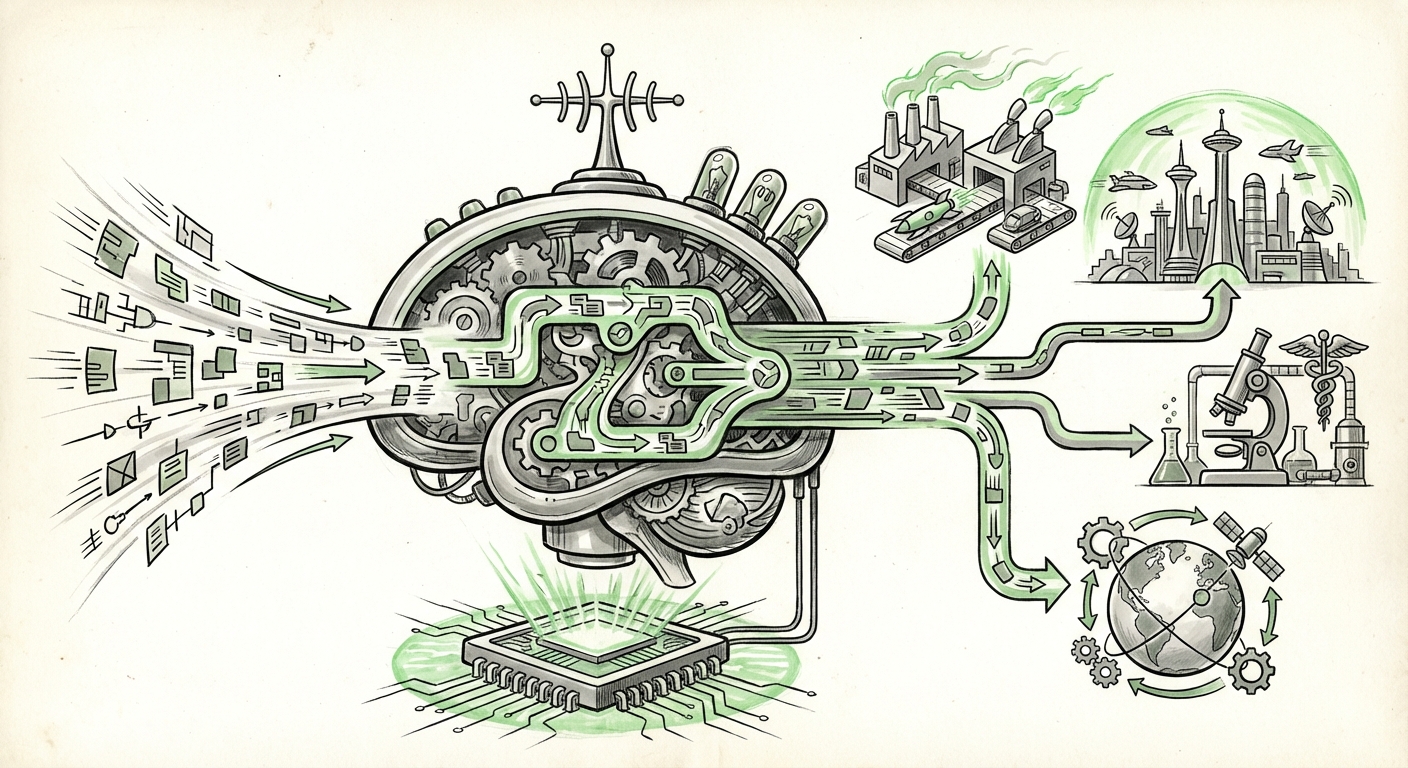
The Hammer of AI: Why Every Problem Looks Like a Nail, and What That Means for the Future of AI
Give a person a hammer and suddenly the world is full of nails. That old idea, the law of the instrument, has a new and much louder version in 2026. The hammer is now artificial intelligence, and it is the most persuasive hammer ever built. It writes, codes, summarizes, plans, draws, predicts, and answers. It never gets tired. It costs very little to swing. And here is the dangerous part: its output almost always looks finished.
That combination is reshaping how companies, governments, and ordinary workers decide what problems to solve. The critical question of this era is no longer "can AI do this?" Capability is everywhere. The real question is narrower and much harder: is this actually a nail?
The Law of the Instrument, Retooled for the AI Age
Every tool changes how we see the world, not just what we can do in it. A spreadsheet made managers think in rows and columns. A search engine made knowledge feel like a lookup. AI is different in three ways that matter.
First, it is general-purpose. A hammer is for nails. AI presents itself as useful for nearly anything, customer support, legal review, drug research, hiring, coding, marketing, logistics. When one tool claims to fit every job, people stop asking which tool fits.
Second, it is cheap to swing. Trying AI on a problem takes minutes, not a quarter of engineering time. Low cost of trial sounds like pure upside. In practice, it means we experiment far more often than we evaluate. Cheap attempts create the illusion of progress without the discipline of fit.
Third, and this is the part most leaders underestimate, fluent output feels like a result. A well-written paragraph or a clean-looking chart triggers the same instinct as a finished deliverable. Humans are wired to trust confidence. AI produces confidence by default, whether or not it has earned it. So the mismatch between "looks solved" and "is solved" widens quietly, and it widens fastest in exactly the places where mistakes are expensive.
Four Reasons Everything Starts Looking Like a Nail
1. Incentive gravity
Boards want an AI story. Budgets follow the story. Vendors sell the story. When the loudest pressure in the room is "show me your AI roadmap," the roadmap gets written first and the problem audit gets skipped. The hammer gets bought, and then the search for nails begins.
2. Demo fluency
A demo is a controlled environment where the problem has already been shaped to fit the tool. Real operations are messy, edge-case-heavy, and full of exceptions. Teams that evaluate AI on demos are not testing whether it fits their work; they are testing whether it fits the demo.
3. One tool is easier to learn than ten
Learning a general model feels like leverage. Learning a narrow, domain-specific system feels like a detour. So organizations standardize on the hammer and then quietly bend the work to match it, reshaping processes, forms, and job roles until the nail appears.
4. Painting over process debt
Many processes are broken before AI touches them: unclear ownership, contradictory rules, data nobody trusts. AI can produce polished output on top of that mess, which hides the mess rather than fixing it. The result is a shiny layer over a cracked foundation, and the cracks return, larger.
The Bill for Misapplied Hammers
Approximation where exactness is required. AI systems work in probabilities. That is their strength in language and their weakness in anything with a hard rule: billing, safety limits, eligibility checks, regulatory filings. A probabilistic answer to a deterministic question is not a shortcut. It is a new failure mode.
Trust erosion. A single confidently wrong answer can cost more trust than a dozen correct ones earn. Teams that deploy AI into high-stakes workflows without verification layers often find the human review burden rises, not falls, because reviewers can no longer assume the draft is roughly right.
Hidden cleanup labor. Much of the value of "AI did it" is actually "AI did the first 70 percent and a person fixed the rest." That labor is real, it is rarely in the business case, and it compounds over time. Call it automation debt. Like technical debt, it is invisible until it is expensive.
Opportunity cost. The most costly hammer problem is not a bad deployment. It is the good problem nobody worked on because the team was busy hammering.
The commodity trap. If everyone points the same general tool at the same obvious problems, everyone gets the same mediocre output. Competitive advantage never came from owning a hammer. It came from knowing which wall to hit.
Where the Hammer Is Genuinely the Right Tool
This is not an argument against AI. It is an argument for precision. AI is unmatched in a recognizable band of work: high volume, low stakes per item, reversible, language- or pattern-shaped, tolerant of small errors, and checkable by a human or a rule.
- The undo test: if a wrong answer is cheap to catch and reverse, swing freely.
- The stakes test: if a wrong answer is expensive, irreversible, or invisible, slow down.
- The shape test: if the work is mostly text, code, images, or pattern matching, AI fits. If it is mostly physical, relational, or rule-bound in ways that cannot be checked, it fits poorly.
- The verification test: if you can describe exactly how a reviewer would confirm the output, you can safely scale. If you cannot, you cannot.
Notice what these tests have in common: none of them are about the model. They are all about the problem. That is the whole point.
Nail-First Thinking: A Practical Playbook
The teams getting real value from AI in 2026 tend to follow the same discipline. It is unglamorous, and it works.
- Write the problem without the word AI in it. If the statement does not make sense without the tool, you have written a solution looking for a use case.
- Describe what a good outcome looks like today. How would you measure success if the work were done entirely by people? Establish that baseline first, or you will never know whether AI helped.
- Price the error. Estimate the cost of a wrong output, the cost of catching it, and the cost of missing it. This single number decides more deployments than any benchmark.
- Compare three options, including doing nothing. Sometimes the honest answer is a clearer process, a better form, or one more hire. AI should win on merit, not momentum.
- Start with the smallest slice of the work. Narrow scope, real data, real reviewers. Expand only after the verification loop proves it can keep up.
- Instrument everything and keep a kill switch. Track correction rates, review time, and escalation frequency. If the numbers do not improve, stop.
- Revisit the fit every quarter. The tool changes fast; the nail does not. A task that failed a year ago may now be a clean fit, and vice versa.
What This Means for the Future of AI
Expect the market to split in two. General-purpose models will keep getting better and cheaper, becoming a utility, the electricity of software. But the value will accumulate around fit: domain-specific tools, curated data, evaluation harnesses, and the governance layers that decide when a model's output can be trusted. The interesting companies will not be the ones with the biggest hammer. They will be the ones that know precisely which nails they serve.
The rise of agents raises the stakes sharply. An agent is a hammer with hands, it can act, not just suggest. That autonomy multiplies the cost of a bad fit, because a misapplied agent does not produce one wrong paragraph; it produces a chain of wrong actions before anyone notices. Expect the next wave of serious AI engineering to be less about capability and more about containment and verification: guardrails, permissioning, audit trails, and clear limits on what an autonomous system is allowed to touch.
Evaluation will become the real competitive moat. Anyone can call a model. Almost nobody can prove, with evidence, that it performs well on their specific work, under their specific failure conditions. Organizations that build that proof will move faster and safer than those that simply adopt loudly.
Procurement will change shape too. The right question to a vendor is no longer "what can it do?" It is "where does it fail, and how will I know?" A supplier who cannot answer that honestly is selling a hammer and calling it a solution.
The workforce impact follows the same logic. The useful framing is not "which jobs will AI replace" but "which tasks are nails." Most roles are a mix: some tasks are high-volume, reversible, and language-shaped, those will shift toward AI with human review. Others are relational, judgment-heavy, and accountable in ways no model can absorb. Companies that map tasks rather than job titles will redeploy people faster and with far less damage.
What Society Should Watch
The hammer problem has a public-sector version, and it is more consequential. Institutions with a high cost of error, benefits systems, courts, hospitals, schools, safety regulators, face enormous pressure to automate, and the same pressure to look modern. A confident, fluent, wrong answer delivered at scale is a different kind of harm than a slow, correct one.
There is also a policy version of the hammer. Some problems presented as AI problems are actually incentive problems, staffing problems, or data problems. Buying a hammer does not build the house. Leaders who can tell the difference will avoid expensive, high-profile failures; those who cannot will spend the next few years explaining them.
And there is a literacy dimension. As AI-generated text, images, and analysis spread, the most valuable skill in the room becomes a simple one: judging whether something that looks finished actually is. That skill is teachable, and it deserves a place in schools and in onboarding programs alongside the tools themselves.
The Takeaway
AI is not overhyped. It is misapplied, and misapplication is the ordinary fate of every powerful tool. The organizations that thrive will not be the ones that hammer hardest. They will be the ones that walk the wall first, mark the nails, and leave the rest alone. The hammer is extraordinary. The judgment about where to swing it is still, stubbornly, human. That is not a limitation of the technology. It is the whole reason the technology needs us.