Elon Musk Says AI and Robots Are the Only Fix for America's Debt, What It Means for the Future of AI
Elon Musk has a habit of turning a technology argument into an economic one. His latest claim does exactly that: he says AI and robots are the only way to solve America's debt burden. Not tax hikes. Not spending cuts. Not a clever bit of budgeting. Machines that make more stuff, faster and cheaper, until the economy is growing so quickly that the debt shrinks as a share of everything else.
It sounds like science fiction dressed up as fiscal policy. But strip away the drama, and there is a real idea underneath it, one that is already shaping how investors, executives, and policymakers think about artificial intelligence. The question is no longer just "what can AI do?" It is "what can AI grow, and who owns the growth?"
This article breaks down the argument, where it holds up, where it falls apart, and what it means for businesses that need to make decisions now rather than wait for a robot-powered utopia.
The Core Argument: Grow Your Way Out of Debt
Start with the simple version of the math. A country's debt is judged against the size of its economy. If the economy grows faster than the debt, the burden gets lighter even if the raw debt number never falls. That is the lever Musk is pointing at.
His framing is blunt: politicians have spent decades promising benefits and avoiding the painful choices needed to pay for them. Cutting spending angers voters. Raising taxes angers voters. Slowing the growth of entitlements angers the loudest voters of all. So the political system stalls, and the debt keeps building.
Musk's answer is to attack the problem from the other side of the equation. Instead of shrinking the numerator, explode the denominator. Make the economy so much more productive that a debt that looks crushing today looks manageable in a decade or two.
In that framing, AI and robots are not productivity tools. They are fiscal policy by another name. And that is a very different way of thinking about them than most companies currently use.
Why Software Alone Doesn't Close the Gap
Here is where the argument gets interesting, and where the "robots" half of Musk's phrase starts doing real work.
The last three decades of software have been a remarkable deflation machine, but only for digital things. Search, maps, messaging, photo storage, and now AI chat: costs per unit of capability have collapsed. Yet the stuff that actually dominates household and government budgets, housing, healthcare, construction, transport, elder care, and the physical moving of goods, got more expensive, not less.
That matters because government debt is ultimately a claim on real resources. You cannot service a debt with cheap software licenses. You service it with the output of an economy: goods, services, labor, and tax revenue generated by activity.
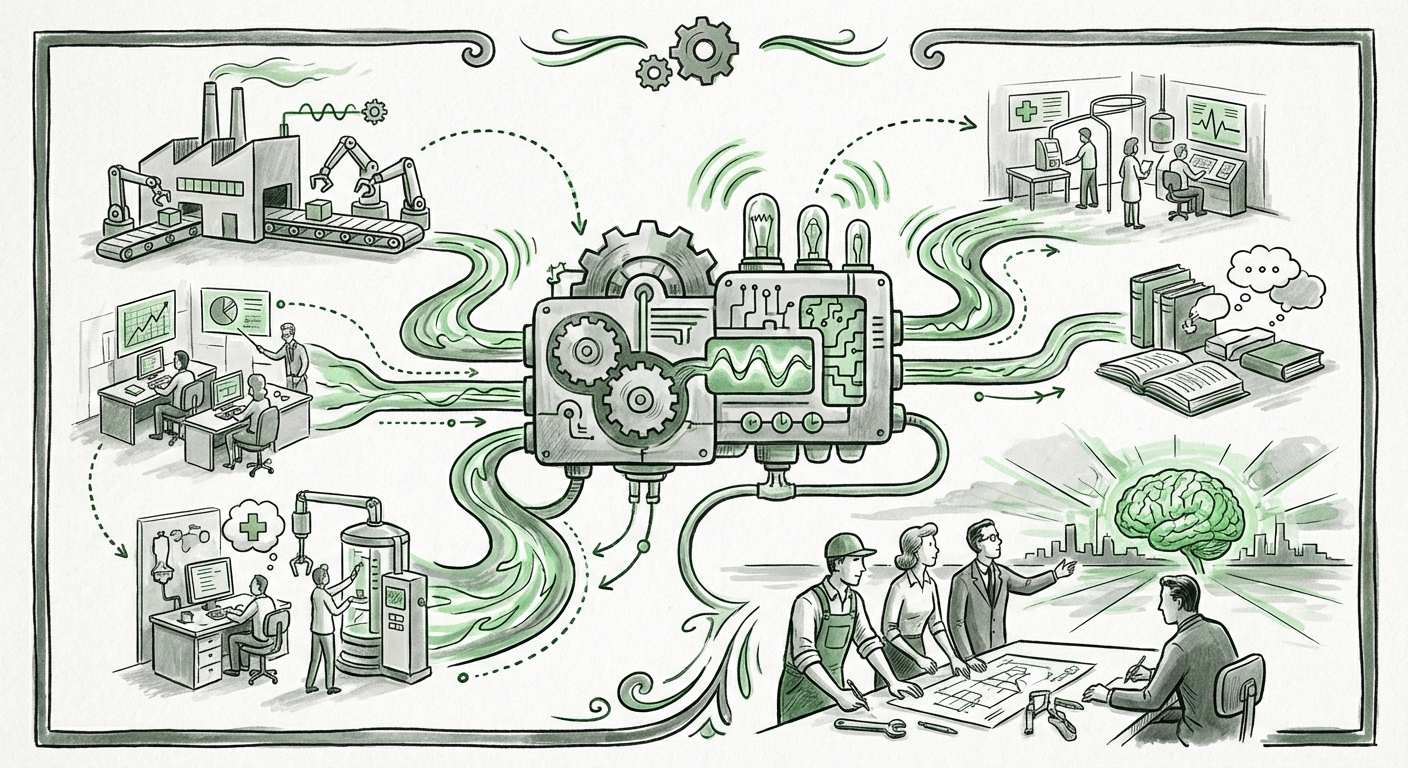
So Musk's claim only works if AI crosses over into the physical world. That means robots that weld, pick, inspect, drive, farm, clean, and care. It means AI that designs physical things better and runs factories with fewer errors and less waste. If AI stays purely digital, it raises the value of information and entertainment, and it makes some knowledge work dramatically cheaper, but it does not automatically fix a structural gap between what a country spends and what it produces.
That is the most useful takeaway from the statement: the future of AI is not just about better models. It is about AI escaping the browser.
The Deflation Problem Nobody Wants to Talk About
There is a sharp objection to Musk's argument, and it deserves airtime because it changes the business calculus.
If AI and robots are as powerful as advertised, they push prices down. Cheaper software. Cheaper logistics. Cheaper labor-intensive services. That is great for consumers. But debt is denominated in currency, and tax receipts are tied to nominal activity, the number of dollars changing hands, not just the real value delivered.
A world of rapid, broad price deflation can therefore make a fixed debt feel heavier, not lighter. Wages fall or flatten, nominal revenues shrink, and the tax base becomes trickier to project. Growth in real output does not automatically translate into growth in the government's ability to collect.
So the honest version of Musk's argument is not "AI makes debt disappear." It is closer to: AI creates a huge pool of real economic surplus, and the debt problem becomes a question of how that surplus is taxed and distributed. That is a political and ownership question, not a technical one.
Who Owns the Robots?
This is where the conversation usually gets uncomfortable. If productivity gains flow mainly to the owners of capital, the companies that build the models, the chips, the data centers, and the robot fleets, then the growth shows up in asset prices and corporate margins, not in broad-based wage growth. The debt burden may technically shrink as a share of the economy while the average household feels squeezed.
For businesses, that split matters enormously. It means the next decade will likely be defined by who can afford to operate at scale. Companies that own the compute, the data, and the physical automation will have cost structures their competitors simply cannot match. Those that do not will be forced to compete on things machines are bad at: trust, brand, regulation, relationships, speed of judgment, and accountability.
That is not a distant future. It is already visible in how margins move when a company successfully deploys AI into a core workflow versus when it simply buys a subscription and hopes.
What Could Go Wrong
Musk's timeline optimism is the weakest part of the claim. A few realities worth pricing in:
- Physical automation is hard. Software improves with a deployment. Hardware has to survive dust, weather, vibration, safety inspectors, and unpredictable humans. Progress in robotics has historically been slower than in software.
- Energy and infrastructure are bottlenecks. Training and running large systems requires serious power and cooling. That buildout takes years and capital, and it competes with everything else that needs electricity.
- Adoption lags invention. Businesses do not replace processes overnight. Regulation, liability, insurance, and worker retraining all slow the curve.
- Growth may arrive unevenly. A productivity boom concentrated in a few sectors can raise national output while leaving large parts of the labor market untouched.
None of these kill the thesis. They stretch the timeline. And a stretched timeline means the debt problem does not politely wait for the robots to arrive.
Practical Implications for Businesses
You do not need to agree with the politics to act on the economics. If capital is flowing toward the idea that AI-driven productivity is strategic, here is what that means at the operating level.
1. Treat AI as capacity, not a cost line
The most common mistake is treating AI spending as an IT expense to be minimized. The companies pulling ahead treat it as a way to add output without adding headcount. Track it that way: how much more work gets done per person, per dollar, per hour of compute.
2. Measure unit economics, not pilots
Pilot programs are easy to launch and easy to kill. The durable wins come from measuring cost per transaction, per ticket, per claim, or per shipment before and after deployment. If the number does not move, the use case was theater.
3. Prepare for price deflation in your category
If your product is largely information, reports, analysis, content, code, routine design, assume prices fall. Compete on distribution, trust, integration, and accountability rather than on the raw output. Customers will pay for someone who is responsible when the machine is wrong.
4. Watch the physical frontier closely
Robotics will land first in constrained, high-cost, repetitive environments: warehouses, inspection, agriculture, manufacturing lines, and hazardous work. Identify where your operation has repetitive physical tasks with clear safety and quality rules. That is where the ROI will appear first.
5. Redesign jobs, don't just automate tasks
The organizations that win will reshape roles around what AI does well, and push humans toward judgment, exception handling, and customer relationships. That requires training budgets and honest communication, not slogans.
6. Build the boring foundation
Clean data, documented processes, and reliable integration are still the difference between a working deployment and an expensive demo. This remains the least glamorous and highest-return investment in the entire field.
Signals to Watch
Rather than betting on a single prediction, watch these indicators to see whether Musk's framing is gaining real-world traction:
- Whether AI spending starts showing up as measurable output gains in national productivity data, not just in corporate earnings.
- Whether humanoid and industrial robot deployments move from demonstrations into repeatable, paid, multi-site contracts.
- Whether energy and grid investment keeps pace with compute demand.
- Whether policy debates shift from "how do we cut" toward "how do we tax and share the gains."
- Whether price declines in AI-heavy services start showing up in official inflation measures.
The Bigger Picture
Elon Musk's statement is best understood not as a forecast but as a frame. It says the debt problem is ultimately a growth problem, and the growth problem is ultimately a technology problem. Whether or not you buy the whole argument, it reframes AI from a novelty into a piece of national economic infrastructure, as consequential as roads, ports, or the power grid.
That reframing has consequences. It means AI investment will be judged on productivity, not press releases. It means the companies that win will be the ones that turn capability into output. And it means the central question of the next decade is not whether machines get smarter, but whether the gains they create are broad enough to matter to everyone who has to pay the bill.
The robots are coming. The harder question is who owns them, who taxes them, and who gets to keep what they make.