Gradient-Based Planning for World Models: Why Long-Horizon AI Planning Is the Next Big Breakthrough
Ask an AI to write one email and it does fine. Ask it to run a week-long project, and it starts to wobble. Ask a robot to pick up a cup and it works. Ask it to assemble a bookshelf in fifty steps, and it fails halfway through. That gap, the gap between short tasks and long ones, is one of the biggest barriers standing between today's AI and the reliable, autonomous systems businesses keep being promised.
New research into gradient-based planning for world models at longer horizons takes direct aim at that gap. The title sounds technical, but the idea underneath it is simple and important: if an AI can imagine the future well, and if it can also steer that imagination efficiently toward a goal, it can plan much further ahead than it can today. Getting both pieces to work together is the hard part, and it is where a lot of the next wave of AI value will be decided.
First, What Is a World Model?
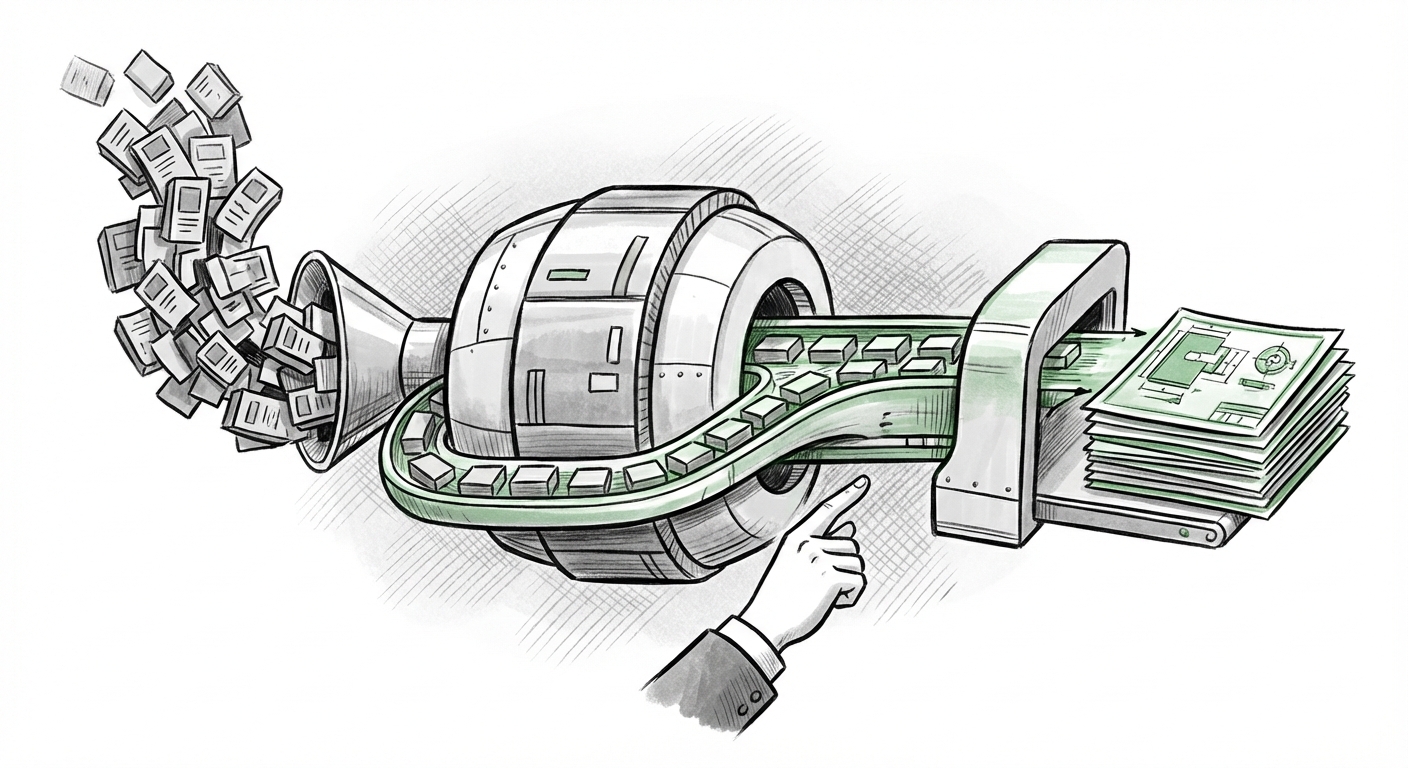
A world model is an AI system that learns to predict what happens next. You give it the current situation and a proposed action, and it produces a guess at the next situation. Run that guess forward again and again, and the model produces a simulated future, a little internal movie of how things might play out.
This matters because real-world trial and error is expensive. A delivery robot cannot afford to crash a thousand times to learn how to navigate a warehouse. A company cannot test a thousand pricing strategies on real customers just to see what happens. But a world model lets an AI rehearse. It can try actions inside its own imagination, score the outcomes, and only then act in reality.
World models are already behind a lot of what looks like magic in modern AI: agents that use software, robots that generalize to new objects, systems that generate video, and driving stacks that anticipate what a pedestrian might do next.
The Big Problem: Long Horizons Fall Apart
The trouble starts when you chain predictions together. One step is fine. Ten steps are usually okay. But a hundred steps? A thousand? That is where things break, and they break for a few predictable reasons.
1. Small errors pile up
Every prediction is a little bit wrong. Normally that is harmless. But when the model feeds its own prediction back into itself, those small errors become the input for the next step. The model starts reacting to its own mistakes instead of reality. By step fifty, the simulated future can look nothing like the real one. The AI plans brilliantly, for a world that does not exist.
2. Gradients get unstable over long chains
Gradient-based planning works by calculating how a small change in each action affects the final outcome, then nudging the actions in the direction that improves the score. Over a long chain of steps, that calculation involves multiplying many small numbers together. The result either shrinks to nothing (so the planner stops learning anything useful) or explodes (so the planner's suggestions become wildly unreliable). The longer the horizon, the worse the conditioning gets.
3. Credit assignment is genuinely hard
Suppose the goal is reached at step two hundred. Which of the two hundred actions deserves the credit? The action that actually mattered might have been step eight. Working backward through that much time is a hard learning problem, and it is the same puzzle that has frustrated planners for decades.
4. Planners find loopholes in the simulator
This one is subtle and important. When you optimize hard inside a learned model, the optimizer will find any action sequence that scores well in the model, including sequences that would never work in reality. The planner exploits the model's blind spots. It is a form of gaming the test. The stronger the optimizer, the more creative the cheating becomes.
Why Gradients Instead of Brute Force?
There are two main ways to plan with a world model. The first is to sample: try a whole batch of candidate action sequences, simulate each one, and keep the best. This is robust and simple, and it is what a lot of today's systems do. The catch is that it scales badly. If each action has many dimensions, a robot arm with seven joints, a whole fleet of vehicles, a long sequence of software operations, the space of possible action sequences explodes, and you need enormous numbers of samples to find a good one.
The second way is to use gradients. Because the world model is a neural network, it is differentiable. That means you can compute exactly how to adjust an entire action sequence to improve the predicted outcome, in one backward pass, rather than thousands of guesses. For high-dimensional problems, that is a huge efficiency win. It is the difference between searching a warehouse with a flashlight and having the lights turned on.
The research focus on longer horizons is essentially about making that efficiency survive over many steps. Approaches in this area generally combine a few ideas:
- Receding-horizon planning. Instead of committing to a full plan, optimize over a shorter window, execute the first action, then replan. This limits how far errors can drift while keeping the benefit of lookahead.
- Terminal value estimates. Add a learned estimate of "how good is this situation" at the end of the planning window. That way the planner still accounts for the far future without having to differentiate through all of it.
- Stabilizing the optimization. Careful scaling, regularization, and better-conditioned updates keep the gradient signal usable over longer chains.
- Hybrid search. Use gradients to get a strong starting guess, then use sampling to refine and verify it. This hedges against the model-exploitation problem.
- Uncertainty-aware models. Teach the model to know when it is guessing, and penalize plans that rely on shaky predictions.
What This Means for the Future of AI
The single most repeated complaint about AI agents today is that they are unreliable over long tasks. They drift, they forget the goal, they take a wrong turn at step twelve and never recover. That is a long-horizon planning problem, not a language problem. Better world models with better planners attack the root cause.
If long-horizon planning gets meaningfully better, several things change at once:
Agents become genuinely useful, not just demo-useful
A software agent that can complete a ten-step task is a novelty. One that can complete a two-hundred-step task, reconcile the accounts, file the reports, chase the exceptions, is a product. Almost every serious enterprise agent roadmap depends on this transition.
Robots move from single motions to whole jobs
Most deployed robots today execute tightly scripted motion primitives. Planning over longer horizons is what turns a robot that can pick into a robot that can stock a shelf. That is the difference between automation as a tool and automation as labor.
Compute economics shift
Gradient-based planning is more sample-efficient than brute-force search. That matters commercially: efficient planning can run on smaller, cheaper hardware, closer to the device. For robotics, drones, and vehicles, where you cannot ship a data center to the edge, that is the difference between a feature that ships and one that stays in the lab.
Simulation becomes a core business asset
If your AI plans inside a learned model, the quality of that model is your competitive moat. Companies with rich operational data, factories, logistics networks, hospitals, energy grids, are sitting on the raw material for world models that competitors cannot easily copy.
Practical Implications for Businesses
The temptation is to treat this as a research curiosity. It is not. Here is where it shows up in practice.
Manufacturing and logistics
Multi-step assembly, warehouse routing, and inventory planning are all long-horizon problems where small errors compound. Better planners mean fewer re-plans, less downtime, and the ability to handle messier real-world conditions without human rescue.
Autonomous vehicles and drones
Short lookahead handles lane-keeping. Long lookahead handles merging, route choice, and anticipating what happens three intersections ahead. That is where the safety and comfort gains live.
Healthcare operations
Bed allocation, staffing, and treatment scheduling are sequential decisions with delayed consequences. Planning tools that can reason over weeks instead of hours change what is optimizable.
Finance and risk
Any strategy that plays out over many steps, hedging, rebalancing, fraud investigation chains, benefits from planners that do not lose the thread. The caveat about model exploitation applies with extra force here, because a planner that games its own simulator in a market context is a very expensive bug.
Actionable Insights: What to Do Now
- Measure your horizon problem. Pick your most valuable AI workflow and measure performance at step 5 versus step 50 versus step 200. Most teams have never done this and are surprised by the cliff.
- Do not trust long chains without checkpoints. Today's agents should verify their state at intervals rather than running open-loop. Assume drift is happening and build recovery paths.
- Invest in evaluation for long tasks. Short-task benchmarks hide long-horizon failure. If you cannot measure drift, you cannot fix it.
- Prefer hybrids over purity. When evaluating planning systems, favor architectures that combine fast gradient-based proposals with sampling-based verification. Robustness usually beats elegance in production.
- Treat your simulation as a product. If planning quality hinges on model quality, then data pipelines, simulator fidelity, and uncertainty calibration are core engineering investments, not side projects.
- Add guardrails that target exploitation. Because aggressive optimizers find loopholes in their own models, keep a human or a rule-based checker on any high-stakes long-horizon decision loop.
The Honest Caveats
Long-horizon planning is not solved. Gradient-based methods are elegant but can be brittle, they can stall in bad local optima, and they depend on the world model being smooth and differentiable in useful ways. Sampling methods remain more robust in many settings and will not disappear. Expect the practical answer to be a blend, with the mix tuned per application.
There is also a governance dimension worth naming early. A planner that looks two hundred steps ahead is harder to audit than one that looks five steps ahead. The longer the horizon, the more important it becomes to explain why a plan was chosen, not just what it was. Organizations deploying these systems should be building that explainability capability now, before regulators ask for it.
The Bottom Line
The gap between a demo and a deployment is almost always a horizon problem. AI that works for one step looks impressive; AI that works for two hundred steps changes an industry. Work on world models and gradient-based planning at longer horizons is not a narrow technical footnote, it is the machinery that determines whether autonomous agents become dependable colleagues or stay expensive parlor tricks. The organizations that understand this now, and start measuring and investing around horizon length, will be the ones positioned to act when the technology crosses over.